2.5 Perception and learning

📣Honors Marketing Unit 2 Review
2.5 Perception and learning
📣 Honors Marketing
Definition of perception
Perception is the process by which consumers select, organize, and interpret sensory information to form a meaningful picture of the world around them. In marketing, perception matters more than objective reality: what consumers believe about your product drives their behavior, regardless of what's actually true.

Top images from around the web for Components of perception
Sensory Receptors | Anatomy and Physiology I View original
Is this image relevant?
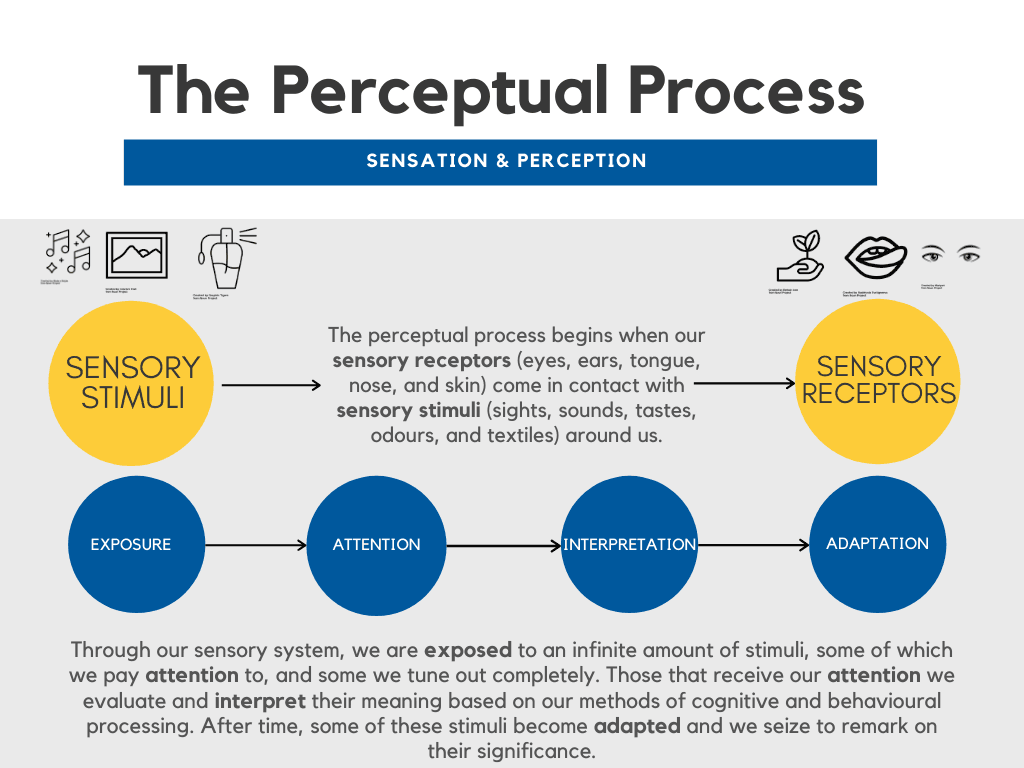
The Perceptual Process – Introduction to Consumer Behaviour View original
Is this image relevant?
Auditory Pathways to the Brain – Introduction to Sensation and Perception View original
Is this image relevant?
Sensory Receptors | Anatomy and Physiology I View original
Is this image relevant?
The Perceptual Process – Introduction to Consumer Behaviour View original
Is this image relevant?
Components of perception
- Sensory receptors receive external stimuli through sight, sound, smell, taste, and touch
- Neural signals transmit that sensory information to the brain for processing
- Cognitive interpretation assigns meaning to sensory inputs based on past experiences and existing knowledge
- Emotional response colors the overall perception, shaping consumer attitudes toward a brand or product
Perceptual process
The perceptual process unfolds in a predictable sequence:
- Exposure occurs when a consumer encounters a stimulus through a marketing channel (an ad, a product display, a social media post)
- Attention kicks in as the consumer selectively focuses on certain stimuli while filtering out the rest
- Organization arranges those sensory inputs into meaningful patterns or categories
- Interpretation assigns meaning to the organized information, producing a perceptual judgment
- Memory stores the result for future recall and decision-making
Not every stimulus makes it through all five stages. Most marketing messages drop off at the attention stage, which is why grabbing and holding attention is so critical.
Sensory inputs
Marketers use multiple sensory channels to shape how consumers experience products and brands. The more senses a brand engages, the stronger and more memorable the impression tends to be.
Visual perception
- Color psychology drives brand recognition and emotional associations. Red signals excitement and urgency (Coca-Cola, sale signs), while blue conveys trust and stability (banks, tech companies like IBM)
- Visual hierarchy guides the viewer's eye to key elements in ads and packaging, controlling what gets noticed first
- Gestalt principles explain how people organize visual elements into cohesive wholes. Marketers use these when designing logos and layouts so elements feel unified rather than scattered
- Motion and animation capture attention in digital marketing and convey a dynamic brand personality
Auditory perception
- Sonic branding creates distinctive audio identities. Intel's five-note chime is recognized worldwide and instantly triggers brand recall
- Background music in retail environments influences shopping pace and time perception. Slower tempos encourage shoppers to linger; faster tempos increase turnover
- Voice characteristics in ads affect perceived brand personality and credibility
- Auditory product cues shape quality perceptions. Think of the satisfying click of a luxury car door or the crisp snap of a fresh chip
Other sensory inputs
- Olfactory marketing uses scent to build positive associations. Hotels like Westin use signature fragrances so guests associate a specific smell with the brand experience
- Tactile elements in packaging and product design influence perceived quality. Heavier packaging often signals premium value, even when the product inside is identical
- Gustatory experiences in food and beverage marketing shape flavor expectations before a consumer even takes a bite
- Proprioception and kinesthesia affect how users experience physical products and interfaces (the weight of a phone, the resistance of a button)
Selective attention
Consumers encounter thousands of marketing messages daily. Selective attention is the filtering mechanism that determines which stimuli get noticed and processed, and which get ignored entirely.
Factors influencing attention
- Stimulus characteristics like size, contrast, color, and movement increase the odds of capturing attention
- Personal relevance determines engagement level. A new parent notices baby product ads that were invisible to them a year ago
- Emotional appeal influences both attention allocation and message retention
- Contextual factors such as time pressure and competing stimuli shrink or expand attention span
- Novelty and uniqueness help marketing elements stand out from familiar or repetitive surroundings
Attention in marketing
- Eye-tracking studies reveal exactly where consumers look on ads, websites, and product displays, helping marketers optimize visual placement
- Native advertising integrates branded content into the user's natural experience, reducing the impulse to skip or scroll past
- Personalization techniques tailor messages to individual preferences, increasing relevance and therefore attention
- Attention-grabbing headlines and visuals improve email open rates and click-through engagement
- Social media algorithms prioritize content based on user interaction patterns, making early engagement critical for visibility
Interpretation of stimuli
Two consumers can see the exact same ad and walk away with completely different impressions. Interpretation is where individual differences really come into play.
Cultural influences
- Cultural values shape how symbols and imagery are understood. White symbolizes purity in Western cultures but mourning in parts of East Asia
- Collectivist vs. individualist cultures respond differently to ad appeals. Group harmony resonates in Japan; personal achievement resonates in the U.S.
- Language and idioms create translation challenges across cultural boundaries
- Cultural taboos and sensitivities can make otherwise effective campaigns offensive in certain markets
Personal experiences
- Past interactions with a brand create expectations for future encounters. One bad experience can color perception for years
- Consumer expertise in a product category affects processing depth. A coffee enthusiast evaluates roast profiles; a casual drinker just checks the price
- Emotional associations from previous encounters carry forward into current perceptions
- Personal goals and motivations guide how consumers interpret product benefits (a health-conscious consumer reads nutrition labels differently than a taste-focused one)
Contextual factors
- Social setting influences interpretation. Peer presence can shift how someone evaluates a product
- Economic conditions shape perceptions of value and price sensitivity
- Technological context affects expectations for product functionality and user experience
- Temporal factors like seasonality and time of day impact the relevance and effectiveness of marketing stimuli

Consumer learning
Consumer learning is the process by which people acquire knowledge and experience that they apply to future purchasing behavior. Marketers use learning principles to educate consumers, build brand familiarity, and reinforce buying habits over time.
Types of learning
- Cognitive learning involves acquiring knowledge through active information processing and problem-solving (reading product reviews, comparing specs)
- Behavioral learning occurs through reinforcement and repetition of actions and responses
- Observational learning happens by watching others' behaviors and choices, then imitating them
- Incidental learning takes place unintentionally through casual exposure to marketing stimuli. You might absorb a brand name from a billboard you never consciously read
Learning theories
- Classical conditioning pairs a brand with a positive stimulus to create favorable emotional responses. A car commercial set against a beautiful sunset transfers those warm feelings to the brand
- Operant conditioning uses rewards and punishments to reinforce desired behaviors. Loyalty programs reward repeat purchases; a bad product experience punishes brand switching
- Social learning theory explains how consumers learn from observing others, including influencers and peers. This is the theoretical backbone of influencer marketing
- Elaboration Likelihood Model (ELM) describes two routes of persuasion. High-involvement consumers process arguments carefully (central route); low-involvement consumers rely on surface cues like celebrity endorsements (peripheral route)
Memory and recall
If consumers can't remember your brand at the point of purchase, everything else you've done is wasted. Memory is the bridge between marketing exposure and buying behavior.
Short-term vs. long-term memory
- Short-term memory holds limited information (roughly 7 items) for brief periods, affecting immediate purchase decisions
- Long-term memory stores vast amounts of brand and product knowledge for extended periods
- Working memory integrates new information with existing knowledge to form judgments in real time
- Episodic memory stores personal experiences with brands, contributing to emotional connections ("I remember the first time I tried that coffee")
- Semantic memory stores factual information about products and brand attributes (price ranges, features, ingredients)
Brand recall strategies
- Repetition of key messages enhances encoding and retrieval. This is why you see the same ad multiple times
- Distinctive brand elements like logos, jingles, and color schemes improve memorability. McDonald's golden arches are recognized in virtually every country
- Storytelling creates memorable associations and emotional connections that stick better than facts alone
- Mnemonic devices and acronyms aid recall of product features and brand names
- Cross-channel consistency reinforces brand memory by presenting the same identity across TV, social media, packaging, and in-store experiences
Perceptual biases
Consumers don't process information objectively. Cognitive biases systematically distort how people interpret and evaluate marketing information. Recognizing these biases helps marketers anticipate consumer reactions and design more effective campaigns.
Common cognitive biases
- Confirmation bias leads consumers to seek out and favor information that supports their existing beliefs about a brand
- Anchoring effect makes initial price points disproportionately influence later price perceptions. A $200 jacket marked down to $120 feels like a deal, even if the jacket is worth $100
- Availability heuristic causes people to judge likelihood or quality based on how easily examples come to mind. A widely publicized product recall can damage an entire category
- Framing effect shows that how information is presented changes decisions. "95% fat-free" sounds better than "contains 5% fat," even though they're identical
- Bandwagon effect drives consumers toward products perceived as popular. "Best-selling" labels and visible review counts leverage this bias
Impact on consumer behavior
- Overconfidence bias affects willingness to try new products or switch from familiar brands
- Loss aversion makes consumers roughly twice as sensitive to potential losses as to equivalent gains, which is why "Don't miss out" messaging works
- Endowment effect increases the perceived value of products consumers already own, making trade-ins and upgrades psychologically harder
- Choice overload can cause decision paralysis when too many options are available. Reducing a product line sometimes increases sales
- Sunk cost fallacy keeps consumers loyal to brands or services they've already invested in, even when better alternatives exist
Perception in marketing
How consumers perceive a brand often matters more than the product's objective qualities. Perception management is central to building competitive advantages and strong market positioning.
Brand perception
- Brand image consists of the associations and beliefs consumers hold about a brand's personality and values
- Brand equity is the added value a brand name brings beyond functional product benefits. People pay more for Nike shoes than identical unbranded shoes because of what Nike represents
- Perceived quality influences willingness to pay premium prices, sometimes independent of actual quality differences
- Brand trust develops through consistent positive experiences and fulfilled promises over time
- Brand loyalty results from favorable perceptions and emotional connections that make switching feel costly
Product positioning
- A unique selling proposition (USP) differentiates a product from competitors in the consumer's mind
- Perceptual mapping visualizes how consumers perceive various brands within a category along key dimensions (e.g., price vs. quality, traditional vs. innovative)
- Repositioning strategies aim to shift existing consumer perceptions. Old Spice successfully repositioned from an older demographic to a younger one through its humor-driven campaigns
- The price-quality relationship shapes how consumers perceive value. Extremely low prices can actually reduce perceived quality
- Category associations influence how new products are perceived based on the product categories they're placed in
Sensory marketing
Sensory marketing deliberately engages multiple senses to create immersive brand experiences. Research consistently shows that multisensory approaches strengthen emotional connections and improve recall.

Multisensory experiences
- Retail atmospherics combine visual design, music, lighting, and scent to influence shopping behavior. Abercrombie & Fitch became known for its dark lighting, loud music, and heavy cologne
- Product packaging engages multiple senses to communicate quality and brand personality before the product is even used
- Virtual and augmented reality technologies create immersive brand experiences that engage sight, sound, and sometimes touch
- Experiential marketing events provide hands-on, multisensory product interactions
- Synesthesia-inspired marketing creates cross-modal associations, like describing a flavor using color language
Sensory branding techniques
- Signature scents create olfactory brand identities in physical spaces (the Ritz-Carlton, Singapore Airlines)
- Tactile branding incorporates unique textures and materials into product design and packaging
- Audio logos and branded soundscapes reinforce recognition across touchpoints (Netflix's "ta-dum")
- Visual consistency in color palettes and design elements strengthens brand identity across all channels
- Flavor profiling develops distinctive taste experiences for food and beverage brands
Subliminal perception
Subliminal perception involves processing stimuli below the threshold of conscious awareness. Its role in marketing is controversial, and the gap between popular belief and scientific evidence is significant.
Effectiveness in marketing
- Priming effects can subtly influence behavior through exposure to related concepts. Showing images of money can make people behave more independently in subsequent tasks
- The mere exposure effect suggests that repeated encounters with a stimulus increase preference for it, even when the exposure is below conscious awareness
- Subliminal audio messages have shown very limited effectiveness in controlled studies
- Visual subliminal cues may have small effects on emotional responses and implicit brand attitudes, but the effects are weak and short-lived
- The practical impact of subliminal advertising is far smaller than popular culture suggests. The famous 1957 "Drink Coca-Cola" movie theater experiment was later revealed to be fabricated
Ethical considerations
- Regulatory bodies in many countries (including the FCC in the U.S.) prohibit subliminal advertising techniques
- Transparency and consumer consent are central ethical concerns in sensory marketing
- Potential manipulation of vulnerable populations raises serious concerns
- The line between legitimate persuasion and deception remains actively debated in the field
- Ethical guidelines emphasize the importance of preserving conscious consumer choice
Perceptual mapping
Perceptual mapping is a visual tool that plots how consumers perceive and differentiate brands or products within a category. It helps marketers understand competitive positioning and spot opportunities in the market.
Creating perceptual maps
- Identify the key attributes consumers use to evaluate products in the category (e.g., price, quality, innovation, convenience)
- Collect consumer perception data through surveys, focus groups, or social media sentiment analysis
- Select two primary dimensions for the map's axes (e.g., "affordable vs. premium" on one axis, "traditional vs. modern" on the other)
- Plot each brand's position on the two-dimensional graph based on consumer ratings
- For more complex analysis, use multidimensional scaling techniques that account for additional attributes
- Interpret the relative positions and distances between brands to draw strategic conclusions
Applications in marketing
- Identify gaps in the market where no brand currently occupies a desirable position
- Analyze the competitive landscape to understand how brands are differentiated in consumers' minds
- Guide product development by targeting specific attribute combinations that consumers value but can't currently find
- Inform repositioning strategies to shift brand perceptions toward desired market positions
- Track changes in brand perceptions over time to measure the impact of marketing campaigns
Consumer insights
Consumer insights go beyond surface-level data to reveal the deeper perceptions, motivations, and behaviors that drive purchasing decisions. These insights inform marketing strategy and product development.
Gathering perceptual data
- Surveys and questionnaires collect quantitative data on brand perceptions and preferences at scale
- In-depth interviews explore individual consumer perspectives and decision-making processes in detail
- Focus groups facilitate group discussions that uncover shared perceptions and attitudes
- Observational research captures natural consumer behaviors and interactions with products in real settings
- Social media listening tools analyze online conversations to gauge brand sentiment and emerging perceptions
Analyzing consumer perceptions
- Sentiment analysis categorizes consumer opinions as positive, negative, or neutral across large datasets
- Word association techniques reveal implicit, sometimes unconscious connections between brands and concepts
- Conjoint analysis measures the relative importance of different product attributes by asking consumers to make trade-offs between feature combinations
- Cluster analysis identifies groups of consumers with similar perceptual patterns and preferences
- Trend analysis tracks shifts in consumer perceptions and attitudes over time, helping brands stay ahead of changing expectations
Perception and decision making
Consumer perceptions directly shape purchase decisions. The connection between how someone perceives a product and whether they buy it is the practical payoff of everything covered in this unit.
Role in purchase decisions
- Perceived risk influences willingness to try new products or switch brands. Higher perceived risk leads to more information-seeking before purchase
- Price perception affects value judgments and willingness to pay. A $5 coffee feels reasonable at an airport but expensive at a gas station
- Brand associations impact product evaluations in competitive markets where functional differences are small
- Perceived quality drives premium pricing strategies and long-term brand loyalty
- Social perceptions and peer influences shape purchase decisions, especially for publicly visible products like clothing and cars
Influencing consumer choices
- Frame marketing messages to align with consumer values and goals
- Leverage social proof (reviews, testimonials, user counts) to influence perceptions of popularity and quality
- Use scarcity tactics to increase perceived value and create urgency ("Only 3 left in stock")
- Personalize communications to match individual consumer perceptions and preferences
- Provide sensory cues and experiences that positively shape product perceptions before and during purchase
See Fiveable more often in Google
Mark Fiveable as a preferred source and Google is more likely to show you our guides in Top Stories, with a "preferred" badge in AI Mode and AI Overviews.