6.5 Price elasticity of demand

📣Honors Marketing Unit 6 Review
6.5 Price elasticity of demand
📣 Honors Marketing
Price elasticity of demand measures how sensitive consumers are to price changes. It's one of the most practical tools in marketing because it directly answers the question: if we raise or lower our price, what happens to sales and revenue?
This guide covers how to calculate elasticity, what the values mean, and how marketers actually use it to make pricing decisions.
Definition of price elasticity
Price elasticity of demand (PED) quantifies how much the quantity demanded of a product changes when its price changes. A product with high elasticity sees big swings in demand from small price shifts. A product with low elasticity holds steady even when prices move.

Top images from around the web for Concept of elasticity
Reading: Elasticity, Costs, and Customers | Microeconomics View original
Is this image relevant?
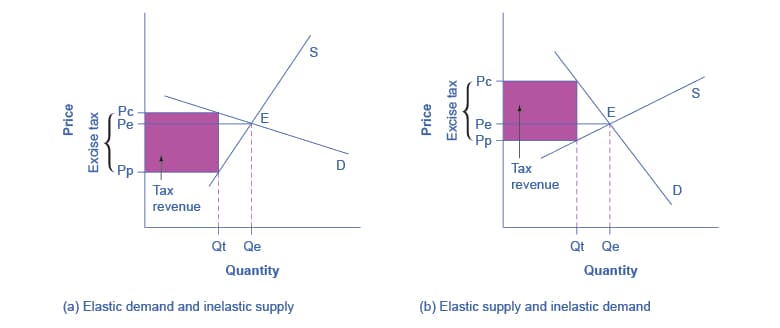
Elasticity and Pricing | OS Microeconomics 2e View original
Is this image relevant?
Elasticity – Introduction to Microeconomics View original
Is this image relevant?
Reading: Elasticity, Costs, and Customers | Microeconomics View original
Is this image relevant?
Elasticity and Pricing | OS Microeconomics 2e View original
Is this image relevant?
Concept of elasticity
Think of elasticity as a measure of consumer sensitivity. It reflects the percentage change in quantity demanded relative to the percentage change in price. This matters because it lets marketers predict what happens to sales volume before they actually change a price.
Formula for price elasticity
PED typically yields a negative value because price and demand move in opposite directions (price goes up, demand goes down). In practice, you'll often work with the absolute value to keep things simpler.
Quick example: If a 10% price increase causes a 20% drop in quantity demanded:
The absolute value is 2.0, which means demand is elastic (more on that below).
Interpreting elasticity values
Use the absolute value of PED to classify demand:
- Greater than 1 → Elastic demand. Consumers are highly responsive. A small price change causes a proportionally larger change in quantity demanded.
- Between 0 and 1 → Inelastic demand. Consumers are less responsive. Demand stays relatively stable even when prices shift.
- Exactly 1 → Unit elastic demand. The percentage change in quantity demanded exactly matches the percentage change in price.
Factors affecting price elasticity
Elasticity isn't fixed for a product. It depends on several factors that marketers need to evaluate for their specific market.
Availability of substitutes
This is the single biggest driver of elasticity. The more substitutes available, the more elastic demand becomes, because consumers can simply switch. A generic brand of cereal has many substitutes and high elasticity. A patented pharmaceutical with no alternatives has very few substitutes and low elasticity.
Products with strong brand loyalty also tend to have lower elasticity, since loyal customers treat the brand as less substitutable.
Necessity vs. luxury goods
- Necessities (food staples, utilities, basic medications) have inelastic demand. People buy them regardless of price changes.
- Luxuries (designer clothing, high-end electronics, vacations) have elastic demand. When prices rise, consumers cut back or delay purchases.
Time horizon
Elasticity tends to increase over time. In the short run, consumers are stuck with their habits and existing commitments. Over the long run, they find substitutes, change consumption patterns, or adjust their budgets. For example, a spike in gas prices might not change driving habits immediately, but over months, people may carpool, buy fuel-efficient cars, or switch to public transit.
Proportion of income
Products that take up a larger share of a consumer's budget tend to have higher elasticity. A 10% increase in the price of a car is a significant financial hit, so buyers are very sensitive. A 10% increase in the price of a pack of gum barely registers, so demand stays flat.
Types of price elasticity
These categories help marketers classify products and choose the right pricing approach.
Elastic demand (PED > 1)
A small price change produces a proportionally larger change in quantity demanded. Luxury goods and non-essential items typically fall here. If you sell an elastic product, cutting your price can actually increase total revenue because the jump in sales volume more than offsets the lower price.
Inelastic demand (PED < 1)
Quantity demanded doesn't move much when price changes. Necessities, addictive products (cigarettes, coffee), and products with few substitutes fall here. For inelastic products, raising prices tends to increase total revenue because you don't lose many customers.

Unit elastic demand (PED = 1)
The percentage change in quantity demanded exactly equals the percentage change in price. This is rare in the real world but serves as an important theoretical benchmark, especially for revenue maximization.
Perfectly elastic demand (PED = ∞)
Any price increase causes demand to drop to zero. This is a theoretical extreme, but it's approximated in markets with many sellers offering identical products (think commodities like wheat on an exchange). Consumers have zero reason to pay even a penny more.
Perfectly inelastic demand (PED = 0)
Quantity demanded doesn't change at all regardless of price. Also theoretical, but approximated by life-saving medications with no alternatives. If you need insulin to survive, you buy it at almost any price.
Calculating price elasticity
There are a few methods for computing PED. The right choice depends on your data and the size of the price change you're analyzing.
Arc elasticity method
Use this when you're measuring elasticity over a range of prices (large price changes or data points that are far apart). It uses the average of the two prices and quantities:
Point elasticity method
Use this when you know the demand function and want elasticity at a specific price-quantity combination. It's more precise for small price changes:
Here, is the derivative of the demand function (the slope of the demand curve at that point).
Midpoint method
This is actually the same formula as arc elasticity. The key advantage is that it gives you the same result regardless of direction. If you calculate elasticity going from point A to point B, you get the same answer as going from B to A. The standard percentage change formula doesn't do this, which is why the midpoint method is preferred in most textbook problems.
Worked example: A coffee shop raises its latte price from $4.00 to $5.00. Weekly sales drop from 200 to 150.
- Change in quantity:
- Average quantity:
- Change in price:
- Average price:
- PED:
The absolute value is 1.29, so demand is elastic. The price increase will reduce total revenue.
Price elasticity and total revenue
This is where elasticity becomes directly useful for business decisions. The relationship between elasticity and revenue tells you which direction to move your prices.
Relationship between elasticity and revenue
| Demand Type | Price Increase | Price Decrease |
|---|---|---|
| Elastic (PED > 1) | Revenue falls | Revenue rises |
| Inelastic (PED < 1) | Revenue rises | Revenue falls |
| Unit elastic (PED = 1) | Revenue unchanged | Revenue unchanged |
The logic: with elastic demand, the volume change outweighs the price change. With inelastic demand, the price change dominates because volume barely moves.
Revenue maximization strategies
- Total revenue is maximized at the unit elastic point (where PED = -1). This is the theoretical sweet spot.
- Price discrimination lets you charge different prices to segments with different elasticities. Students and seniors often have more elastic demand, so they get discounts. Business travelers have inelastic demand, so airlines charge them more.
- Seasonal pricing adjusts for shifting elasticities. Hotel rooms during peak vacation season face more inelastic demand (fewer alternatives for those dates), so prices go up.
- Bundling combines products with different elasticities to capture more consumer surplus. A cable package bundles channels you'd pay a lot for with channels you wouldn't buy separately.
Cross-price elasticity
Cross-price elasticity measures how demand for one product responds to a price change in a different product. It reveals competitive and complementary relationships between products.

Definition and formula
The sign of the result tells you the relationship:
- Positive value → Substitute goods. When Good B gets more expensive, consumers buy more of Good A instead.
- Negative value → Complementary goods. When Good B gets more expensive, consumers buy less of Good A too.
Complementary vs. substitute goods
Substitutes (positive cross-price elasticity): butter and margarine, Coke and Pepsi, Uber and Lyft. If one raises prices, the other sees increased demand. The larger the positive value, the closer the substitutes.
Complements (negative cross-price elasticity): printers and ink cartridges, cars and gasoline, smartphones and phone cases. If one gets more expensive, demand for both drops. This is why companies sometimes sell the base product cheaply (printers) and profit on the complement (ink).
Marketers use cross-price elasticity to anticipate how a competitor's price change will affect their own sales and to plan product line strategies.
Income elasticity of demand
Income elasticity measures how demand responds to changes in consumer income rather than price. It's especially useful for forecasting demand during economic expansions or recessions.
Definition and formula
Normal vs. inferior goods
The sign tells you the product category:
- Positive income elasticity → Normal good. Demand rises as income rises.
- Income elasticity between 0 and 1: Necessity. Demand grows, but slower than income. Examples: basic groceries, utilities.
- Income elasticity greater than 1: Luxury. Demand grows faster than income. Examples: designer handbags, yacht rentals, fine dining.
- Negative income elasticity → Inferior good. Demand falls as income rises. Examples: instant noodles, bus passes (people switch to cars), store-brand products. As consumers earn more, they trade up.
This classification helps marketers predict which products will thrive in a growing economy versus a downturn.
Applications in marketing
Pricing strategies
- Use elasticity data to set profit-maximizing prices rather than guessing.
- Implement dynamic pricing for products where elasticity shifts with demand (airline tickets get more inelastic as the departure date approaches, so prices rise).
- Create tiered pricing structures (basic, premium, enterprise) to serve segments with different price sensitivities.
- Adjust prices across the product lifecycle: new products with few competitors may have inelastic demand initially, but elasticity increases as competitors enter.
Market segmentation
Different consumer groups have different elasticities for the same product. College students are more price-sensitive for streaming services than working professionals. Identifying these differences lets you:
- Tailor promotions and discounts to high-elasticity segments
- Maintain higher prices for low-elasticity segments willing to pay more
- Allocate marketing budgets toward segments where price adjustments yield the biggest returns
Product positioning
- Emphasize unique features, quality, or brand identity to reduce elasticity. The more differentiated your product feels, the fewer substitutes consumers perceive.
- Brand loyalty programs (rewards points, memberships) decrease price sensitivity over time by increasing switching costs.
- Product bundling leverages different elasticities within a package, making it harder for consumers to compare individual prices with competitors.
Limitations and considerations
Data availability and accuracy
Reliable price and quantity data can be hard to obtain, especially for new products or niche markets. Historical data may not reflect current conditions, and elasticity estimates are sensitive to measurement errors. Regular market research and data validation help, but perfect data is rare.
Dynamic nature of elasticity
Elasticities shift over time as consumer preferences evolve, new competitors enter, and technology changes the landscape. Short-term and long-term elasticities can differ significantly for the same product. This means elasticity estimates need continuous updating rather than a one-time calculation.
Market-specific factors
Elasticities vary across geographic regions, cultural contexts, and regulatory environments. A product that's price-inelastic in one country might be elastic in another due to different income levels, substitute availability, or government policies (taxes and subsidies directly affect price sensitivity). Always consider local market conditions before applying elasticity estimates from a different context.
See Fiveable more often in Google
Mark Fiveable as a preferred source and Google is more likely to show you our guides in Top Stories, with a "preferred" badge in AI Mode and AI Overviews.