6.2 Cost-based pricing

📣Honors Marketing Unit 6 Review
6.2 Cost-based pricing
📣 Honors Marketing
Definition of Cost-Based Pricing
Cost-based pricing sets prices by starting with what it costs to make or deliver a product, then adding a margin on top. It's one of the most straightforward pricing strategies you'll encounter: figure out your costs, decide how much profit you want, and set the price accordingly.
This approach guarantees you won't sell at a loss, which is why so many companies use it as a baseline. But as you'll see, simplicity comes with trade-offs. Cost-based pricing can leave money on the table or price you out of a market if you're not also paying attention to customers and competitors.

Top images from around the web for Fixed vs variable costs
Break-even (economics) - Wikipedia View original
Is this image relevant?
General Pricing Strategies | Principles of Marketing View original
Is this image relevant?
Free Break-Even Analysis Template for PowerPoint - Free PowerPoint Templates - SlideHunter.com View original
Is this image relevant?
Break-even (economics) - Wikipedia View original
Is this image relevant?
General Pricing Strategies | Principles of Marketing View original
Is this image relevant?
Types of Costs
Fixed vs. Variable Costs
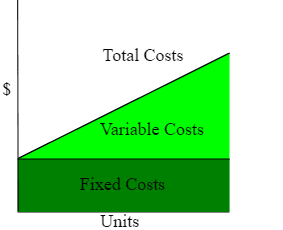
Fixed costs stay the same no matter how many units you produce. Think rent, salaried employees, and insurance. You pay these whether you sell 10 units or 10,000.
Variable costs change with production volume. Raw materials, direct labor (hourly workers on the production line), and packaging all go up as you make more product and down as you make less.
Why does this distinction matter for pricing? Because you need to understand both to figure out your break-even point and set a price that actually covers everything. If you only account for variable costs, you'll forget that rent is still due at the end of the month.
Direct vs. Indirect Costs
- Direct costs can be traced straight to a specific product. The leather in a pair of shoes, the labor to assemble a phone.
- Indirect costs (also called overhead) support the business broadly but can't be pinned to one product. Utilities, administrative salaries, and building maintenance fall here.
The tricky part is allocating indirect costs fairly across products. If a company makes three different products in the same factory, how do you split the electric bill? Activity-based costing (ABC) is one method that assigns indirect costs based on which activities actually drive those costs, rather than just splitting them evenly. This gives you more accurate per-unit cost figures, which leads to better pricing.
Cost-Plus Pricing Method
Markup Calculation
Cost-plus pricing is the most common cost-based method. You calculate total cost per unit, then add a markup percentage to reach your selling price.
For example, if a product costs to produce and you apply a 40% markup:
Markup percentages vary widely. Grocery stores might use 10–15%, while jewelry retailers often mark up 50% or more. The "right" percentage depends on your industry norms, competitive environment, and profit goals.
Advantages and Disadvantages
Advantages:
- Simple to calculate and easy to explain to stakeholders
- Guarantees you cover costs on every sale
- Produces consistent, predictable profit margins
Disadvantages:
- Ignores what customers are actually willing to pay
- Doesn't account for competitor pricing
- Can lead to overpricing in competitive markets (customers go elsewhere) or underpricing in high-demand markets (you leave profit on the table)
Target Return Pricing
Target return pricing works backward from a financial goal. Instead of just adding a markup, you ask: What price do we need to hit a specific return on our investment?
Break-Even Analysis
Before setting a target return, you need to know your break-even point, the sales volume where revenue exactly equals total costs (zero profit, zero loss).
Say your fixed costs are , your price is , and variable cost per unit is :
You need to sell 5,000 units just to cover costs. Every unit after that generates profit.
Return on Investment Goals
Once you know the break-even, you can set a price that achieves a specific ROI:
If your unit cost is , you've invested , you want a 20% return, and you expect to sell 25,000 units:
This method ties pricing directly to financial objectives, but notice the risk: if actual sales fall short of that 25,000-unit estimate, you won't hit your target return.
Cost-Based vs. Value-Based Pricing
These two approaches start from opposite directions:
- Cost-based looks inward: What does it cost us, and what margin do we want?
- Value-based looks outward: What is this worth to the customer?
A cost-based approach might price a specialty coffee at (covers costs plus margin), while a value-based approach might price it at because customers perceive it as a premium experience and will pay accordingly.
Cost-based pricing is safer but potentially less profitable. Value-based pricing captures more of the customer's willingness to pay but requires deeper market research. Many companies use a hybrid approach: cost-based pricing sets the floor (never sell below cost), and value-based thinking determines how far above that floor the price can go.

Pricing Strategies Using Costs
Penetration Pricing
Penetration pricing sets a low initial price to grab market share quickly. The logic depends on cost structure: as sales volume grows, economies of scale kick in and per-unit costs drop, eventually making the low price profitable.
This works well for new products entering competitive markets. But it requires careful cost management. If your costs don't actually decrease with volume, you're just selling cheap and losing money.
Skimming Pricing
Skimming does the opposite. You launch at a high price targeting early adopters who are less price-sensitive, then gradually lower the price to reach broader segments.
This strategy helps recover heavy upfront costs like R&D. Think about new tech products: the first buyers pay a premium, and as production scales up and costs drop, the company lowers the price to attract the next wave of customers.
Cost Considerations in Pricing
Production Efficiency
Lower production costs give you more pricing flexibility. You can either keep prices the same and pocket a higher margin, or lower prices to compete more aggressively.
Companies pursue efficiency through lean manufacturing (eliminating waste), automation, and continuous improvement programs. Automation requires upfront capital investment, but it can dramatically reduce variable labor costs over time.
Economies of Scale
As production volume increases, per-unit costs tend to fall for two reasons:
- Fixed costs get spread across more units (your rent divided by 100,000 units is each, not each at 10,000 units)
- Bulk purchasing of raw materials often earns volume discounts from suppliers
This is why large manufacturers can price so competitively. Their cost-per-unit advantage is structural.
Limitations of Cost-Based Pricing
Ignoring Market Demand
Cost-based pricing doesn't ask what customers value or how sensitive they are to price changes (price elasticity). A product might cost to make, and a 50% markup puts it at . But if customers would happily pay , you're leaving per unit on the table. Conversely, if the market only supports , your price means lost sales.
Overlooking the Competitive Landscape
If three competitors sell a similar product at and your cost-plus formula spits out , you have a problem. Cost-based pricing alone won't tell you that. It also doesn't account for substitute products that customers might switch to, or for competitors who can undercut you because of lower cost structures.
Cost-Based Pricing in Different Industries

Manufacturing Sector
Manufacturers deal with complex cost structures involving raw materials, labor, machinery, and overhead. Accurate cost allocation is critical, and many use activity-based costing to handle multi-product facilities. Raw material price fluctuations (steel, oil, cotton) add uncertainty, so manufacturers often combine cost-based pricing with regular market analysis.
Service Industry
Services are trickier because the primary cost is labor, and output is intangible. Pricing models often use hourly rates or project-based fees. A consulting firm, for example, calculates the loaded cost of an employee's time (salary plus benefits plus overhead), then adds a margin.
Utilization rate matters a lot here. If a consultant is only billable 60% of the time, the firm needs to price those billable hours high enough to cover the 40% of non-billable time too.
Impact on Profitability
Profit Margins
Cost-based pricing guarantees a minimum margin on each sale, which provides stability. But "guaranteed minimum" can also mean "consistently mediocre." If you never look beyond costs, you may never discover that certain products or customer segments could support significantly higher margins.
Regular review is essential. Costs change, markets shift, and a markup percentage that worked last year might not work today.
Volume Considerations
Price and volume have an inverse relationship in most markets. Lower prices tend to drive higher volume; higher prices reduce volume but increase per-unit profit. The optimal combination depends on your cost structure and the elasticity of demand for your product.
Break-even analysis helps you model these trade-offs: If we lower the price by 10%, how many more units do we need to sell to maintain the same total profit?
Cost-Based Pricing and Market Position
Relying solely on cost-based pricing can push a brand toward commoditization, where customers see no difference between you and competitors and just buy the cheapest option. That's a tough position to be in.
For premium brands, cost-based pricing should be the floor, not the ceiling. A luxury handbag's materials might cost , but the brand, craftsmanship, and exclusivity justify a far higher price. Companies also use cost awareness to structure product line pricing, offering good/better/best tiers where each tier reflects different cost structures and target margins.
Ethical Considerations in Cost-Based Pricing
Cost-based pricing has an inherent fairness argument: the price reflects what it actually costs to produce, plus a reasonable profit. Transparency about costs and markups can build customer trust, especially in B2B relationships.
Ethical concerns arise when companies artificially inflate reported costs to justify higher prices, or when cost-cutting measures compromise worker welfare. For essential goods like food and medicine, there's also a social responsibility dimension: pricing purely on cost-plus may be defensible, but the size of that "plus" matters.
Future Trends in Cost-Based Pricing
Technology Impact
Advanced analytics and AI are making cost allocation far more precise. Companies can now track costs in real time across complex supply chains, leading to more dynamic and accurate cost-based pricing. Digital tools also reduce operational costs themselves, which changes the pricing math.
Sustainability Considerations
Environmental costs are increasingly being factored into pricing models. Carbon emissions, waste disposal, and sustainable sourcing all add to production costs. As regulations tighten and consumers show more willingness to pay for sustainable products, companies are rethinking what "total cost" really means. The challenge is balancing these higher costs with what the market will bear.
See Fiveable more often in Google
Mark Fiveable as a preferred source and Google is more likely to show you our guides in Top Stories, with a "preferred" badge in AI Mode and AI Overviews.