2.4 Consumer motivation theories

📣Honors Marketing Unit 2 Review
2.4 Consumer motivation theories
📣 Honors Marketing
Consumer motivation theories explain the psychological forces behind purchasing decisions. These frameworks give marketers a way to understand why consumers buy, which shapes everything from product design to advertising strategy.
Fundamentals of Consumer Motivation
Consumer motivation is the internal drive that compels people to satisfy needs and wants through purchasing decisions. It includes both physiological factors (you're hungry, so you buy food) and psychological ones (you want to feel successful, so you buy a premium brand). These drives can be conscious or subconscious, and they shift over time as personal circumstances and external influences change.
Understanding motivation matters for marketing strategy because it touches every element of the marketing mix:
- Product development can target specific consumer needs
- Advertising messages resonate more when they speak to real motivations
- Pricing strategies work better when aligned with perceived value
- Distribution channels can be chosen based on how and where motivated consumers shop
- Brand positioning gains strength when it connects to core motivations

Top images from around the web for Definition of consumer motivation
Reading: Influences on Consumer Decisions | Introduction to Business View original
Is this image relevant?
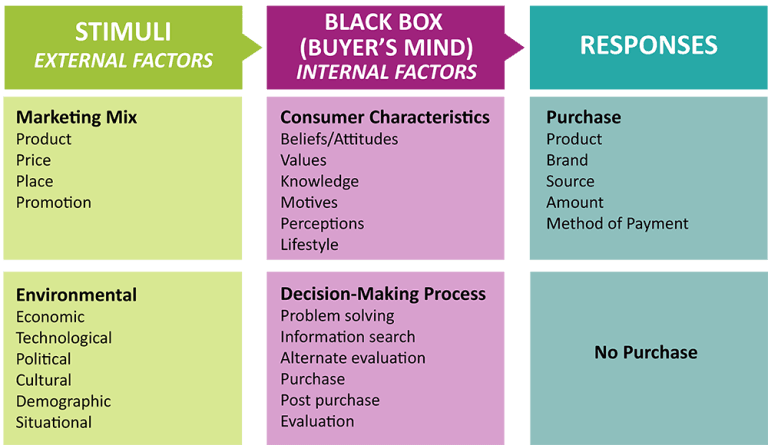
Reading: The “Black Box” of Consumer Behavior | Principles of Marketing View original
Is this image relevant?
Reading: Psychological Factors | Principles of Marketing View original
Is this image relevant?
Reading: Influences on Consumer Decisions | Introduction to Business View original
Is this image relevant?
Reading: The “Black Box” of Consumer Behavior | Principles of Marketing View original
Is this image relevant?
Key Consumer Motivation Theories
Three major theories form the backbone of how marketers think about consumer motivation. Each offers a different lens for understanding what drives people to buy.
Maslow's Hierarchy of Needs
Maslow's hierarchy arranges human needs into five levels, typically shown as a pyramid. The core idea: people tend to satisfy lower-level needs before pursuing higher-level ones.
- Physiological needs (base): food, water, shelter, sleep
- Safety needs: security, stability, health, financial safety
- Belongingness and love needs: relationships, social connections, community
- Esteem needs: self-respect, recognition, status, accomplishment
- Self-actualization (top): personal growth, creativity, fulfillment of potential
For marketers, this hierarchy helps identify which need level a product addresses. A home security system targets safety needs. A social media platform targets belongingness. A luxury watch targets esteem. Campaigns that clearly connect to the right need level tend to resonate more strongly with their audience.
Herzberg's Two-Factor Theory
Herzberg originally developed this theory for workplace motivation, but it translates well to consumer behavior. The key distinction is between two types of factors:
- Hygiene factors prevent dissatisfaction but don't actively create satisfaction. Think basic product quality, reliable customer service, or a functional website. If these are missing, consumers are unhappy. If they're present, consumers simply aren't dissatisfied.
- Motivators actively create satisfaction and positive feelings. These include innovative features, exceptional design, or a sense of achievement from using the product.
The practical takeaway: a product needs solid hygiene factors as a baseline, but motivators are what actually drive purchase enthusiasm and loyalty. A car with working brakes (hygiene) won't excite anyone, but a car with an innovative infotainment system (motivator) might.
McClelland's Acquired Needs Theory
McClelland proposed that people develop three core motivators through life experiences:
- Need for achievement: desire for success, excellence, and mastery
- Need for affiliation: desire to build and maintain relationships and belong to groups
- Need for power: desire to influence others and gain status
These needs aren't mutually exclusive, but most people lean toward one dominant motivator. Marketers use this to shape positioning: luxury brands often target the need for power, fitness brands target achievement, and social platforms target affiliation.
Psychological Factors in Motivation
Psychological processes shape how consumers perceive, process, and respond to marketing. These factors often operate below conscious awareness.
Perception and Cognition
Perception is how consumers select, organize, and interpret sensory information. Not every marketing message gets noticed. Selective attention means consumers filter out most stimuli and focus on what's personally relevant.
Once a message gets through, cognitive processes determine how it's understood. Framing effects are particularly powerful: pricing something at $0.99 instead of $1.00 changes perception of value even though the difference is trivial. Cognitive biases like anchoring (relying too heavily on the first piece of information encountered) and confirmation bias (favoring information that supports existing beliefs) also shape how consumers evaluate products.
Learning and Memory
Consumer learning directly shapes future buying behavior. Two conditioning models are especially relevant:
- Classical conditioning pairs a product with a positive stimulus. A catchy jingle or beloved mascot creates positive associations with the brand over time.
- Operant conditioning reinforces behavior through rewards. Loyalty programs that offer points or discounts encourage repeat purchases.
Memory also plays a critical role. Episodic memory (personal past experiences with a product) and semantic memory (general product knowledge) both influence how consumers evaluate options. Marketers use repetition and distinctive messaging to strengthen brand recall.
Attitudes and Beliefs
Attitudes are overall evaluations of a product or brand, while beliefs are specific thoughts about its attributes ("this brand is eco-friendly"). Attitudes have three components:
- Cognitive: what you think and know about the product
- Affective: how you feel about it emotionally
- Behavioral: what you intend to do (buy it, recommend it, avoid it)
Attitudes can shift through persuasive communication or direct experience with a product. Brands that achieve consistency across all three components tend to see stronger loyalty.
Sociocultural Influences on Motivation
Social and cultural context shapes what consumers want and how they go about getting it. These factors interact with psychological motivators to drive decisions.
Cultural Norms and Values
Cultural values define what a society considers important and desirable. Several cultural dimensions affect marketing:
- Individualism vs. collectivism determines whether appeals to personal achievement or family benefit will resonate more
- Long-term vs. short-term orientation influences how consumers plan purchases
- Power distance affects how authority and status are perceived in marketing messages
- Uncertainty avoidance shapes willingness to try new or innovative products
Marketers operating across cultures need to adapt strategies accordingly. An ad emphasizing individual success might work in the U.S. but fall flat in a more collectivist culture like Japan.
Social Class and Status
Social class groups consumers by income, education, and occupation, and it strongly influences consumption patterns. Different classes tend to prefer different brands, products, and shopping experiences.
Aspirational marketing targets consumers who want to move up in perceived social class. Luxury brands leverage this by associating their products with status and prestige. Marketing messages can be tailored to reflect the values and goals of specific social classes.
Reference Groups and Family
Reference groups are the people consumers compare themselves to when forming attitudes and making decisions:
- Primary groups (family, close friends) exert the strongest influence on everyday purchases
- Secondary groups (professional associations, clubs) shape consumption in specific areas
- Aspirational groups motivate consumers to emulate desired lifestyles
Within families, different members play different roles in purchase decisions: initiator, influencer, decider, buyer, and user. A child might initiate a cereal purchase, a parent decides which brand, and the whole family uses it. Word-of-mouth and social proof from reference groups are among the most powerful motivational forces in consumer behavior.
Emotional Drivers of Consumer Behavior
Emotions often drive purchasing decisions more powerfully than rational analysis. Emotional connections to brands tend to be stickier than purely logical ones.
Pleasure vs. Pain Principle
At a basic level, consumers are motivated to seek pleasure and avoid pain. This creates two distinct marketing approaches:
- Pleasure-seeking drives purchases of indulgent or luxury items (a spa day, premium chocolate)
- Pain-avoidance motivates purchases of problem-solving or protective products (insurance, pain relievers)
Marketers can frame the same product either way. A mattress company might emphasize the pleasure of great sleep or the pain of waking up with a sore back. Positive emotional appeals (joy, excitement) tend to build brand affinity, while negative appeals (fear, guilt) can motivate action but risk unintended backlash if overdone.

Approach vs. Avoidance Motivation
Closely related to the pleasure/pain principle:
- Approach motivation pulls consumers toward desired outcomes ("Achieve your dream body")
- Avoidance motivation pushes consumers away from negative outcomes ("Don't let identity theft ruin your credit")
Consumers tend to lean toward one orientation. Approach-oriented consumers respond better to aspirational messaging, while avoidance-oriented consumers respond to risk-reduction and problem-solving messages. Knowing your target audience's orientation helps you craft more effective campaigns.
Self-Esteem and Self-Actualization
Products that enhance self-esteem often appeal to status or social approval. Products tied to self-actualization focus on personal development, creativity, and reaching one's potential.
Marketers can target different aspects of self-concept. The gap between a consumer's actual self (how they see themselves now) and ideal self (how they want to be seen) creates motivation to buy products that close that gap. Brands that align with consumers' self-image generate stronger loyalty and engagement.
Rational vs. Emotional Motivation
Most purchase decisions involve a mix of rational and emotional factors. The balance shifts depending on the product category and the individual consumer.
Cognitive Decision-Making Processes
Rational decision-making involves logically evaluating product attributes, weighing costs against benefits, and choosing the option that maximizes utility. Rational appeals focus on features, performance, and value propositions.
Consumers also rely on decision heuristics (mental shortcuts) to simplify complex choices. For example, "buy the brand I recognize" or "choose the mid-priced option." Comparative advertising leverages cognitive processes by directly highlighting competitive advantages. Marketers can support rational decision-making by providing clear product information, comparison tools, and decision aids.
Impulse Buying Behavior
Impulse purchases happen without prior planning, driven more by emotion than logic. Several factors increase impulse buying:
- Environmental cues: store layout, product placement, point-of-sale displays
- Time pressure and scarcity: "Only 3 left in stock" or "Sale ends tonight"
- Positive emotions: excitement and pleasure in the moment
Post-purchase regret often follows when emotional motivations override rational considerations. Marketers design strategies to encourage impulse purchases (limited-time offers, checkout aisle displays), but this can create tension with long-term customer satisfaction.
Risk Perception and Avoidance
Perceived risk is a major factor in consumer motivation. Types of risk include:
- Financial: "Will I waste my money?"
- Performance: "Will it actually work?"
- Physical: "Is it safe?"
- Social: "Will people judge me for buying this?"
- Psychological: "Will I regret this?"
Risk-averse consumers need more information and reassurance before purchasing. Effective risk-reduction strategies include warranties, money-back guarantees, free trials, and social proof (reviews and testimonials).
Motivation in the Consumer Decision-Making Process
Consumer motivation operates differently at each stage of the decision-making process. Effective marketing addresses the right motivational factors at the right time.
Problem Recognition Stage
The decision process begins when a consumer identifies a gap between their current state and a desired state. This can be triggered by:
- Internal stimuli: hunger, discomfort, boredom
- External stimuli: advertising, social influence, life events
Marketers can create problem awareness by highlighting discrepancies between where consumers are and where they could be. Understanding consumer pain points helps craft relevant messages that trigger this recognition.
Information Search Process
Once a problem is recognized, consumers gather information to evaluate potential solutions:
- Internal search: recalling past experiences and stored knowledge
- External search: consulting online reviews, asking friends, reading ads, comparing products
Search intensity depends on product importance, perceived risk, and the consumer's existing knowledge. Marketers can facilitate this stage through content marketing, SEO, educational materials, and comparison tools that position the brand as a helpful resource.
Evaluation of Alternatives
Consumers compare options using personal criteria. This evaluation can be:
- Extensive for high-involvement decisions (buying a car)
- Limited for low-involvement purchases (choosing a snack)
Two evaluation models are worth knowing. Compensatory models involve trading off strengths and weaknesses across options (a higher price might be acceptable if quality is superior). Non-compensatory models use elimination rules (reject any option over $50, regardless of other features).
Marketers influence this stage by highlighting key differentiators and unique selling propositions, and by using framing effects to shape how consumers weigh different attributes.
Motivational Conflicts and Resolution
Consumers frequently face conflicting motivations. Understanding these conflicts helps marketers remove barriers to purchase.
Approach-Approach Conflict
This occurs when a consumer must choose between two equally attractive options. Both have strong positives, making the decision difficult. This can lead to decision paralysis or post-purchase regret.
Marketers can help by clearly differentiating their product through unique features or emotional benefits. Bundling options, providing expert recommendations, or offering decision support tools can also help consumers navigate this conflict.
Avoidance-Avoidance Conflict
Here, a consumer must choose between two unattractive alternatives. This often happens when a purchase is necessary but no option feels great. Consumers may postpone the decision entirely.
Marketers can address this by reframing negatives as necessary trade-offs, offering additional services or warranties to soften drawbacks, and being transparent about limitations (which builds trust). The decoy effect can also apply: introducing a third, clearly inferior option can make one of the original choices look more appealing by comparison.
Approach-Avoidance Conflict
This arises when a single option has both significant positives and negatives. A consumer might want a luxury vacation (approach) but dread the cost (avoidance). This is common in high-stakes purchases.
Resolution strategies include emphasizing positive attributes while directly addressing concerns, offering risk-reduction tools (free trials, money-back guarantees), and using testimonials from others who faced the same conflict and were satisfied with their decision.

Measuring Consumer Motivation
Marketers use multiple research methods to assess consumer motivation. Combining approaches gives the most complete picture.
Qualitative Research Methods
Qualitative methods explore the depth of consumer motivations:
- In-depth interviews uncover individual decision-making processes
- Focus groups reveal shared motivations and perceptions through discussion
- Observational research examines behavior in natural settings
- Ethnographic studies immerse researchers in consumers' daily lives
- Diary studies track consumer thoughts and behaviors over time
- Content analysis of reviews and social media reveals motivational themes
Quantitative Research Techniques
Quantitative methods measure motivations at scale:
- Surveys with Likert scales assess agreement levels with motivational statements
- Conjoint analysis determines the relative importance of different product attributes
- Factor analysis identifies underlying motivational dimensions from multiple variables
- Regression analysis examines relationships between motivational factors and behavior
- A/B testing compares consumer responses to different motivational appeals
Projective Techniques
Projective techniques are indirect methods designed to uncover subconscious motivations that consumers may not articulate directly:
- Sentence completion tasks reveal hidden thoughts about products or brands
- Word association tests identify emotional connections to marketing stimuli
- Thematic Apperception Test (TAT) uses ambiguous images to elicit motivational narratives
- Collage creation lets consumers visually express motivations and brand perceptions
- Metaphor elicitation uncovers deep-seated motivations and brand associations
These techniques are especially useful when consumers can't or won't directly state their true motivations.
Applying Motivation Theories in Marketing
The real value of motivation theories is in their application across marketing strategy.
Product Development and Positioning
- Identify unmet needs to guide new product creation
- Align product features with specific levels of Maslow's hierarchy
- Use McClelland's theory to develop products appealing to achievement, affiliation, or power motives
- Apply Herzberg's framework: ensure hygiene factors are solid, then add motivators that create genuine excitement
- Develop unique selling propositions (USPs) rooted in key consumer motivations
- Create product lines that serve different motivational segments within your target market
Advertising and Promotion Strategies
- Craft messages that speak to the target audience's primary motivations
- Use emotional appeals aligned with pleasure-seeking or pain-avoidance drives
- Develop campaigns addressing different levels of Maslow's hierarchy for broader reach
- Leverage social proof and reference group influence in promotional materials
- Create aspirational advertising that taps into self-esteem and self-actualization needs
- Use scarcity and urgency messaging to motivate action (limited-time offers, exclusive deals)
- Adapt promotional strategies to match the cultural values of target markets
Customer Loyalty Programs
- Design rewards that align with customer motivations (status, savings, experiences)
- Use operant conditioning principles to reinforce desired behaviors
- Create tiered programs that appeal to achievement and status motivations
- Offer personalized rewards based on individual preferences and purchase history
- Implement gamification elements (challenges, progress tracking) to tap into intrinsic motivation
- Foster a sense of community and belonging to satisfy affiliation needs
Ethical Considerations in Motivation
Marketers must balance effective motivation techniques with ethical responsibility. The line between persuasion and manipulation matters.
Manipulation vs. Persuasion
Persuasion presents information to help consumers make informed decisions. Manipulation uses deception or exploits vulnerabilities to control behavior. The distinction matters both ethically and practically, since manipulative tactics erode trust over time.
Ethical marketing focuses on informing and empowering consumers. This means being transparent about product capabilities and limitations, avoiding fear-based tactics that exaggerate risks, and respecting consumer autonomy rather than relying on high-pressure tactics.
Transparency in Marketing Practices
- Clearly disclose all relevant product information, including potential drawbacks
- Avoid hidden fees or misleading pricing that exploits consumer motivations
- Provide accessible information about data collection and usage
- Clearly label sponsored content and influencer partnerships
- Ensure marketing messages are consistent with actual product delivery
- Be honest about environmental and social impact claims to avoid greenwashing (making misleading sustainability claims)
Consumer Rights and Protection
- Respect privacy and data protection regulations (GDPR, CCPA)
- Adhere to truth-in-advertising laws and regulatory guidelines
- Provide clear opt-out methods for marketing communications
- Offer fair return policies and warranty information
- Implement age restrictions for products not suitable for all consumers
- Avoid targeting vulnerable populations with potentially harmful products
- Establish clear complaint resolution processes
Future Trends in Consumer Motivation
Consumer motivations evolve alongside technology and social change. Staying aware of these shifts helps marketers remain relevant.
Technology and Changing Motivations
- Growing demand for seamless, omnichannel shopping experiences
- Increasing motivation for personalized products enabled by AI and big data
- Shift toward digital-first interactions and virtual experiences (AR, VR)
- Rising importance of cybersecurity and data privacy as purchase factors
- Emerging tension between desire for tech-enabled convenience and digital well-being
Sustainability and Ethical Consumption
- Growing consumer motivation to support environmentally responsible brands
- Increased demand for supply chain transparency and ethical sourcing
- Rising importance of social responsibility in brand choice
- Interest in circular economy initiatives, minimalism, and reduced consumption in some segments
- Growing preference for plant-based, cruelty-free, and locally sourced products
Personalization and Individual Differences
- Increasing demand for hyper-personalized products and experiences
- Growing importance of self-expression and identity in consumer choices
- Rise of niche markets organized around specific motivational profiles rather than demographics alone
- Expanding use of AI and machine learning to predict individual motivations
- Emerging conflict between desire for personalization and concern over privacy
See Fiveable more often in Google
Mark Fiveable as a preferred source and Google is more likely to show you our guides in Top Stories, with a "preferred" badge in AI Mode and AI Overviews.