1.3 Marketing environment

📣Honors Marketing Unit 1 Review
1.3 Marketing environment
📣 Honors Marketing
The Marketing Environment
The marketing environment includes every force that shapes how a company markets its products. Some of these forces sit outside the company (like economic shifts or new technology), while others come from within (like budget, talent, or company culture). Grasping these forces helps marketers adapt strategies, spot opportunities, and avoid threats.
This topic covers the external and internal environments, tools like PESTEL and SWOT, market dynamics, stakeholder analysis, environmental scanning, and how companies adapt to change. It also touches on ethics and the global marketing landscape.

Top images from around the web for Macro environmental factors
External Forces That Shape Business Activities | Introduction to Business View original
Is this image relevant?
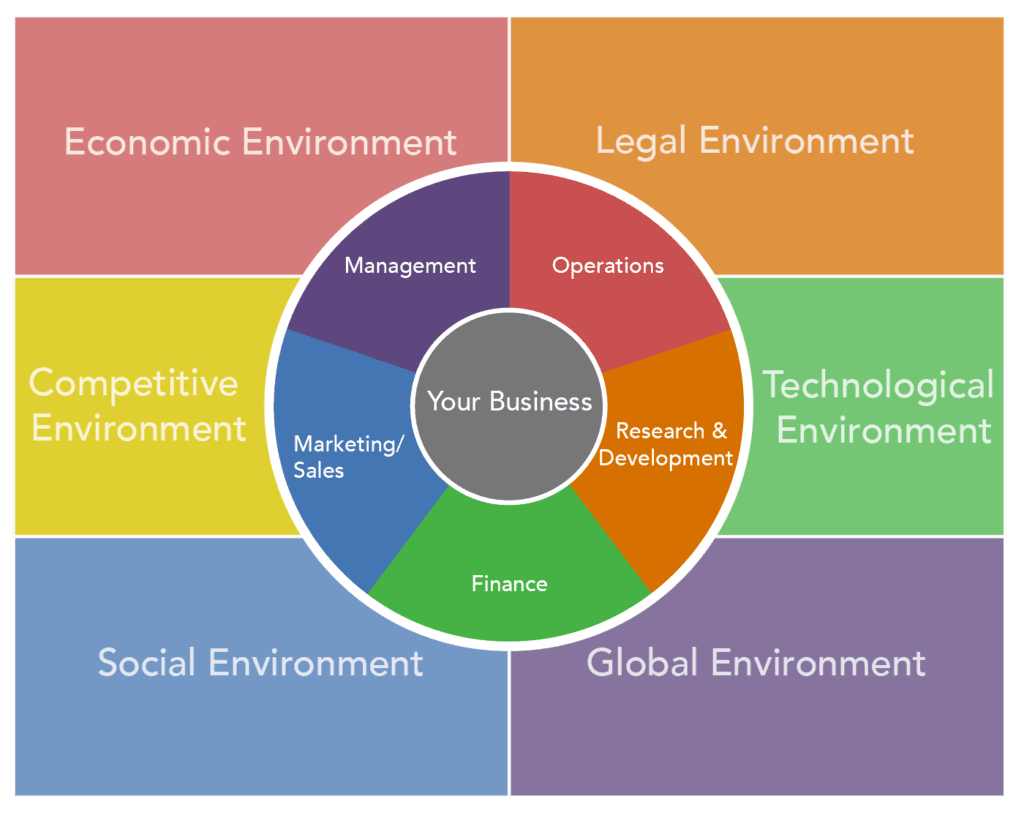
External Forces | Introduction to Business View original
Is this image relevant?
Understanding the Business Environment | OpenStax Intro to Business View original
Is this image relevant?
External Forces That Shape Business Activities | Introduction to Business View original
Is this image relevant?
External Forces | Introduction to Business View original
Is this image relevant?
External Marketing Environment
The external marketing environment covers all the factors outside a company's control that still affect its marketing decisions and performance. Because these factors are uncontrollable, companies have to monitor them constantly and adjust strategies in response.
Macro Environmental Factors
Macro factors operate at the broadest level and affect entire industries, not just one company.
- Demographic trends shape who your target market is. Aging populations, urbanization, and birth rates all shift consumer preferences.
- Economic conditions determine how much consumers can spend. Recessions shrink purchasing power; periods of growth expand it.
- Sociocultural factors reflect changing values, lifestyles, and attitudes. For example, growing health consciousness has reshaped the food and beverage industry.
- Technological advancements open new marketing channels and enable entirely new product categories.
- Environmental concerns push companies toward sustainability initiatives and green marketing.
- Legal and regulatory changes set the rules marketers must follow, from advertising standards to data privacy laws.
These six categories form the basis of the PESTEL framework (covered below).
Micro Environmental Factors
Micro factors are closer to the company and more specific to its industry. They're still external, but they interact with the company more directly than macro forces do.
- Customers are the core of the micro environment. Their demand and preferences drive every marketing decision.
- Competitors influence your pricing, positioning, and market share.
- Suppliers affect production costs and product quality. A supplier shortage can derail an entire product launch.
- Distributors determine how easily your product reaches the market.
- Media outlets shape public perception and brand image through coverage and commentary.
- Other stakeholders (investors, community groups, industry associations) influence company decisions and reputation.
PESTEL Analysis Framework
PESTEL is a structured tool for scanning the macro environment. Each letter represents a category of external forces:
- Political: Government policies, political stability, trade regulations, tax policy
- Economic: GDP growth, inflation rates, unemployment levels, consumer confidence
- Social: Cultural norms, demographic shifts, lifestyle changes, attitudes toward health or sustainability
- Technological: Innovation rates, digital transformation, R&D activity, automation
- Environmental: Climate change impact, sustainability expectations, ecological regulations
- Legal: Consumer protection laws, employment regulations, industry-specific compliance standards
To use PESTEL effectively, identify the most relevant factors in each category for your specific industry, then assess whether each factor represents an opportunity or a threat.
Competitive Landscape Assessment
Understanding your competitive environment is just as important as understanding the broader macro forces.
- Market structure analysis identifies whether you're operating in an oligopoly (few dominant firms), monopoly, monopolistic competition, or near-perfect competition. This shapes pricing power significantly.
- Competitor profiling evaluates rivals' strengths, weaknesses, and positioning.
- Benchmarking compares your company's performance metrics against industry leaders.
- Porter's Five Forces assesses competitive intensity by examining: (1) threat of new entrants, (2) bargaining power of suppliers, (3) bargaining power of buyers, (4) threat of substitutes, and (5) rivalry among existing competitors.
- Strategic group mapping plots competitors based on key dimensions (like price vs. quality) to identify who your direct and indirect competitors really are.
- Competitive intelligence gathering involves systematically collecting data on competitors to inform your own strategy.
Internal Marketing Environment
The internal environment covers everything within the organization that affects marketing effectiveness. Unlike external factors, these are largely within the company's control.
Organizational Culture
Culture is the "personality" of a company, and it directly shapes how marketing gets done.
- Company values guide decision-making and set expectations for employee behavior.
- Leadership style influences how freely teams communicate and innovate. A top-down culture produces very different marketing than a collaborative one.
- Mission and vision provide direction for long-term marketing objectives.
- Organizational structure affects how information flows between departments. Siloed structures can slow down marketing responsiveness.
- Employee engagement matters because engaged employees deliver better customer service and represent the brand more authentically.
- Learning and development programs build marketing capabilities and help teams adapt to new tools and trends.
Company Resources and Capabilities
Your internal resources set the boundaries for what your marketing can actually accomplish.
- Financial resources determine budget size and investment capacity. A startup with $50,000 for marketing faces very different constraints than a corporation with $50 million.
- Human capital includes the expertise, creativity, and specialized skills on your marketing team.
- Technological infrastructure supports data analysis, CRM systems, and digital marketing execution.
- Brand equity is the value your brand name carries. Strong brand equity (think Apple or Nike) provides a built-in competitive advantage.
- Intellectual property protects unique marketing assets like trademarks, patents, and proprietary methods.
- Distribution networks determine how efficiently you can get products to customers.
SWOT Analysis
SWOT is one of the most commonly used strategic tools. It bridges the internal and external environments by organizing factors into four categories:
- Strengths (internal, positive): What does the company do well? Examples include strong brand recognition, proprietary technology, or a loyal customer base.
- Weaknesses (internal, negative): Where does the company fall short? Limited budget, outdated technology, or high employee turnover are common weaknesses.
- Opportunities (external, positive): What favorable external conditions could the company capitalize on? Emerging markets, new technologies, or shifting consumer preferences.
- Threats (external, negative): What external challenges could hurt the company? Intense competition, regulatory changes, or economic downturns.
The real value of SWOT comes from cross-analysis: matching strengths to opportunities (how can we leverage what we're good at?) and identifying where weaknesses intersect with threats (where are we most vulnerable?). SWOT should be updated regularly since market conditions shift.
Core Competencies
Core competencies are the unique capabilities that give a company its competitive edge. A true core competency meets three criteria:
- It provides access to a wide variety of markets (applicable across products).
- It contributes significantly to the benefits customers perceive in the end product.
- It's difficult for competitors to imitate.
For example, Amazon's core competency in logistics and distribution supports everything from retail to cloud services. Companies should continuously develop and refine these competencies to maintain their market position.
Market Dynamics
Market dynamics are the forces and interactions that shape how markets behave and evolve. Understanding them helps marketers predict trends, set prices, and plan product development.
Supply and Demand Forces
- Price elasticity of demand measures how sensitive consumers are to price changes. A product with high elasticity (like a luxury item) sees big demand swings when prices shift; inelastic products (like gasoline) don't.
- Supply chain disruptions can suddenly change product availability and prices, as many industries experienced during the COVID-19 pandemic.
- Equilibrium price is where supply and demand balance in a competitive market.
- Seasonal fluctuations create predictable demand patterns (holiday shopping, back-to-school, etc.).
- Market saturation occurs when most potential customers already own the product, leading to fiercer competition and price pressure.
- Scarcity drives prices up and can create opportunities for premium positioning.
Market Trends and Patterns
- Product life cycle stages (introduction, growth, maturity, decline) each require different marketing strategies and resource levels.
- Adoption curves predict how quickly different consumer segments will embrace a new product, from innovators to laggards.
- Industry consolidation (mergers and acquisitions) reshapes competitive landscapes.
- Premiumization is the trend of consumers trading up to higher-quality, higher-priced products.
- Customization and personalization become key differentiators as markets mature.
- Subscription-based models continue gaining popularity across industries, from software to meal kits.

Consumer Behavior Shifts
- Generational differences significantly impact purchasing habits. Gen Z shops differently than Baby Boomers, both in channel preference and brand expectations.
- Digital transformation has changed how consumers research and buy. Most purchase journeys now start online, even for in-store purchases.
- Health and wellness focus influences product choices across food, fitness, beauty, and beyond.
- Sustainability concerns drive growing demand for eco-friendly and ethically produced products.
- Social media influence shapes opinions and brand perceptions through reviews, influencer content, and peer recommendations.
- Experience-driven consumption reflects a shift where many consumers prioritize memorable experiences over material goods.
Technological Disruptions
- Artificial intelligence enhances personalization, predictive analytics, and customer service automation.
- Augmented and virtual reality transform how customers visualize and experience products before buying.
- Internet of Things (IoT) enables smart products and continuous data collection from connected devices.
- Blockchain technology improves supply chain transparency and transaction security.
- 5G networks accelerate mobile commerce and enable richer video marketing.
- Voice search optimization is increasingly important as smart speakers and voice assistants become household staples.
Stakeholder Analysis
Stakeholder analysis identifies the groups and individuals who are affected by or can influence an organization. It's essential for prioritizing communication efforts and managing relationships strategically.
Primary vs. Secondary Stakeholders
Primary stakeholders are directly affected by the organization's activities. Employees, customers, investors, and suppliers fall into this group. They typically require more immediate attention and resources.
Secondary stakeholders are indirectly impacted or influential. Media outlets, government agencies, community groups, and industry associations are common examples. Though less directly involved, they can significantly shape public opinion and the regulatory environment.
Balancing the needs of both groups is essential for long-term success. Categorizing stakeholders this way helps you prioritize where to focus engagement efforts.
Stakeholder Mapping Techniques
Several tools help visualize and categorize stakeholder relationships:
- Stakeholder wheel: Visually maps relationships and connections around the organization
- Influence-interest matrix: Categorizes stakeholders by their power and level of concern (see Power-Interest Grid below)
- Salience model: Assesses stakeholders on three dimensions: power, legitimacy, and urgency
- Stakeholder onion diagram: Shows layers of stakeholder involvement, from core to peripheral
- Social network analysis: Reveals informal relationships and information flow patterns
- Venn diagrams: Highlight where stakeholder interests overlap
Power-Interest Grid
This is one of the most practical stakeholder tools. It places stakeholders on a 2x2 matrix based on their power (ability to influence) and interest (level of concern):
| High Interest | Low Interest | |
|---|---|---|
| High Power | Manage closely | Keep satisfied |
| Low Power | Keep informed | Monitor with minimal effort |
Stakeholder positions on this grid can shift over time, so revisit it regularly. The grid directly informs how you allocate communication resources.
Stakeholder Engagement Strategies
Engagement exists on a spectrum of increasing involvement:
- Informing: One-way communication to keep stakeholders updated
- Consulting: Seeking input and feedback on specific issues
- Involving: Actively engaging stakeholders in decision-making
- Collaborating: Forming partnerships to develop joint solutions
- Empowering: Delegating actual decision-making authority to stakeholders
The right approach depends on where each stakeholder falls on the power-interest grid. High-power, high-interest stakeholders typically warrant collaboration or empowerment, while low-power, low-interest groups may only need periodic updates.
Environmental Scanning
Environmental scanning is the systematic process of collecting and analyzing information about external factors. It helps organizations spot emerging opportunities and potential threats before they fully materialize.
Information Gathering Methods
- PEST/PESTEL analysis provides a structured framework for examining macro factors
- Industry reports (from firms like IBISWorld, Statista, or McKinsey) offer market trend data and competitive insights
- Social media monitoring captures real-time consumer sentiment and emerging preferences
- Expert interviews provide in-depth qualitative perspectives on specific topics
- Customer feedback surveys gather direct input on satisfaction and unmet needs
- Competitive intelligence tools track competitors' activities, pricing, and positioning
Scenario Planning
Scenario planning prepares organizations for uncertainty by developing multiple plausible futures rather than betting on a single forecast.
Steps in scenario planning:
- Identify the key uncertainties that could shape your market
- Develop 3-4 distinct, plausible scenarios based on different combinations of those uncertainties
- Assess how each scenario would impact your business and current strategies
- Identify early warning indicators that signal which scenario is unfolding
- Develop flexible strategies and contingency plans for each scenario
- Stress-test current plans against all scenarios to find vulnerabilities
Trend Analysis Techniques
- Time series analysis examines patterns and cycles in historical data to identify recurring trends
- Delphi method gathers and synthesizes expert opinions through multiple rounds of anonymous forecasting
- Trend extrapolation projects current trends forward, assuming they'll continue (useful but risky if conditions change)
- Cross-impact analysis explores how multiple trends interact and influence each other
- S-curve analysis predicts technology adoption and market growth patterns, showing slow start, rapid growth, then plateau
- Horizon scanning looks for weak signals of emerging trends that haven't yet become mainstream
Forecasting Models
- Quantitative models use statistical techniques and numerical data to predict outcomes
- Qualitative models rely on expert judgment and intuition when hard data is limited
- Causal models examine cause-and-effect relationships between variables
- Time series models analyze historical data patterns to project future values
- Econometric models incorporate economic theory into statistical analysis
- Machine learning algorithms process large datasets to identify patterns and improve forecast accuracy over time
Adapting to Environmental Changes
The ability to adapt is what separates companies that thrive from those that get left behind. Adaptation requires flexibility, responsiveness, and a willingness to change course when the environment shifts.

Agile Marketing Strategies
Agile marketing borrows principles from agile software development and applies them to marketing execution:
- Cross-functional teams collaborate on rapid iterations of campaigns rather than working in silos
- Sprints are short, focused work periods (typically 1-4 weeks) with specific deliverables
- Continuous feedback loops allow quick adjustments based on real-time market response
- A/B testing optimizes messages, visuals, and channel selection by comparing performance
- Kanban boards visualize workflow and help teams prioritize tasks
- Retrospectives are regular team reviews that encourage learning and process improvement
Risk Management Approaches
- Risk identification: Systematically uncover potential threats to marketing objectives
- Qualitative risk analysis: Assess each risk's likelihood and potential impact
- Quantitative risk analysis: Use numerical data to evaluate risk probabilities where possible
- Risk mitigation: Develop action plans for high-priority risks
- Contingency reserves: Allocate budget and resources for unforeseen circumstances
- Regular risk reviews: Monitor and reassess risks on an ongoing basis
Opportunity Identification
- Market gap analysis reveals unmet customer needs or underserved segments
- Trend spotting identifies emerging consumer preferences or technological shifts early
- Blue ocean strategy seeks to create entirely new, uncontested market space rather than competing in crowded existing markets
- Open innovation leverages external ideas, partnerships, and technologies
- Customer journey mapping uncovers pain points and areas for improvement across the entire customer experience
- Competitive analysis identifies weaknesses in rival offerings that you could exploit
Contingency Planning
Contingency planning prepares the organization for "what if" scenarios:
- Develop alternative courses of action for potential disruptions
- Identify trigger events that signal when to activate a contingency plan
- Establish clear decision-making processes so the team knows who does what during a crisis
- Allocate resources and assign responsibilities in advance
- Review and update plans regularly to keep them relevant
- Run simulation exercises to test whether plans actually work before you need them
Ethical Considerations
Ethical marketing builds long-term brand reputation and customer trust. It goes beyond legal compliance to address broader societal expectations for responsible business practices.
Corporate Social Responsibility
Corporate social responsibility (CSR) is the idea that businesses have obligations beyond profit.
- The triple bottom line framework balances three goals: economic performance (profit), social impact (people), and environmental stewardship (planet).
- Stakeholder engagement ensures company initiatives align with community expectations.
- Cause-related marketing ties product sales to social or environmental causes (e.g., TOMS donating a pair of shoes for every pair sold).
- Employee volunteer programs build community connections and boost engagement.
- Transparency in reporting demonstrates accountability to stakeholders.
- Strategic philanthropy aligns charitable giving with business objectives so both the cause and the company benefit.
Sustainable Marketing Practices
- Eco-friendly packaging reduces environmental impact and appeals to environmentally conscious consumers
- Circular economy principles promote product recycling, reuse, and waste reduction rather than a linear "make, use, dispose" model
- Green advertising communicates environmental benefits honestly. Greenwashing (making misleading environmental claims) damages credibility when exposed.
- Life cycle assessment evaluates a product's environmental impact from raw materials through disposal
- Sustainable sourcing ensures ethical and environmentally responsible supply chains
- Energy-efficient operations reduce both carbon footprint and operational costs
Environmental Impact Assessment
- Carbon footprint calculation measures total greenhouse gas emissions
- Water usage analysis identifies conservation and efficiency opportunities
- Waste reduction initiatives minimize landfill contributions
- Biodiversity impact studies assess effects on local ecosystems
- Energy audits evaluate consumption patterns and identify savings
- Life cycle analysis examines environmental impact from production through disposal
Ethical Decision-Making Frameworks
When facing an ethical dilemma, marketers can apply several frameworks:
- Utilitarian approach: Choose the action that produces the greatest good for the greatest number
- Deontological ethics: Follow moral rules and duties regardless of outcomes (e.g., "never deceive customers" even if deception would boost short-term sales)
- Virtue ethics: Ask what a person of strong moral character would do
- Stakeholder theory: Consider the impact on all affected parties, not just shareholders
- Corporate governance guidelines: Follow established organizational ethical standards
- Code of ethics: Reference the company's formal guidelines for employee behavior and decision-making
Global Marketing Environment
The global marketing environment encompasses all international factors that affect marketing strategies across borders. It demands understanding of diverse cultures, economies, and regulatory systems.
Cross-Cultural Considerations
- Hofstede's cultural dimensions (individualism vs. collectivism, power distance, uncertainty avoidance, etc.) guide how marketing messages should be adapted for different cultures
- Language localization goes beyond translation to ensure messages resonate naturally in the target language
- Cultural sensitivity in advertising prevents unintentional offense. What works in one market can backfire in another.
- Product adaptation adjusts features, flavors, sizes, or functions to match local preferences
- Local customs and traditions influence promotional timing and messaging (e.g., marketing around Lunar New Year in East Asia vs. Christmas in Western markets)
- Color symbolism varies significantly across cultures. White symbolizes purity in Western cultures but mourning in some East Asian cultures. This affects packaging and branding choices.
International Trade Regulations
- Tariffs and quotas directly impact pricing strategies and market entry feasibility
- Free trade agreements (like USMCA or EU single market rules) reduce barriers and facilitate cross-border commerce
- Intellectual property protection varies by country, affecting how brands protect trademarks and patents abroad
- Export controls restrict trade of certain products for security or political reasons
- Customs procedures influence supply chain timelines and delivery costs
- Foreign investment regulations affect which market entry modes are available (some countries restrict foreign ownership)
Geopolitical Factors
- Political stability influences whether long-term investment in a foreign market is wise
- Economic sanctions can completely block access to certain countries or industries
- Currency exchange rate fluctuations affect pricing, costs, and profit margins for international operations
- Regional economic blocs (EU, ASEAN, Mercosur) create larger unified markets with shared trade rules
- Trade wars and diplomatic tensions can disrupt supply chains and restrict market access unpredictably
- Government changes may shift economic policies, tax structures, and regulatory environments
Global Market Entry Strategies
Companies can enter foreign markets through several approaches, each with different levels of risk, investment, and control:
- Exporting: Lowest risk. Allows testing a foreign market with minimal investment.
- Licensing: A local partner produces and sells your product using your brand and IP. Leverages their market knowledge.
- Joint ventures: Two companies share ownership, risks, and resources. Useful when local knowledge or connections are critical.
- Wholly owned subsidiaries: Full control but requires significant capital investment and carries the most risk.
- Franchising: Expands brand presence through local entrepreneurs who operate under your business model.
- Strategic alliances: Partnerships that provide access to new markets or technologies without formal ownership structures.
See Fiveable more often in Google
Mark Fiveable as a preferred source and Google is more likely to show you our guides in Top Stories, with a "preferred" badge in AI Mode and AI Overviews.