1.2 Marketing mix (4Ps)

📣Honors Marketing Unit 1 Review
1.2 Marketing mix (4Ps)
📣 Honors Marketing
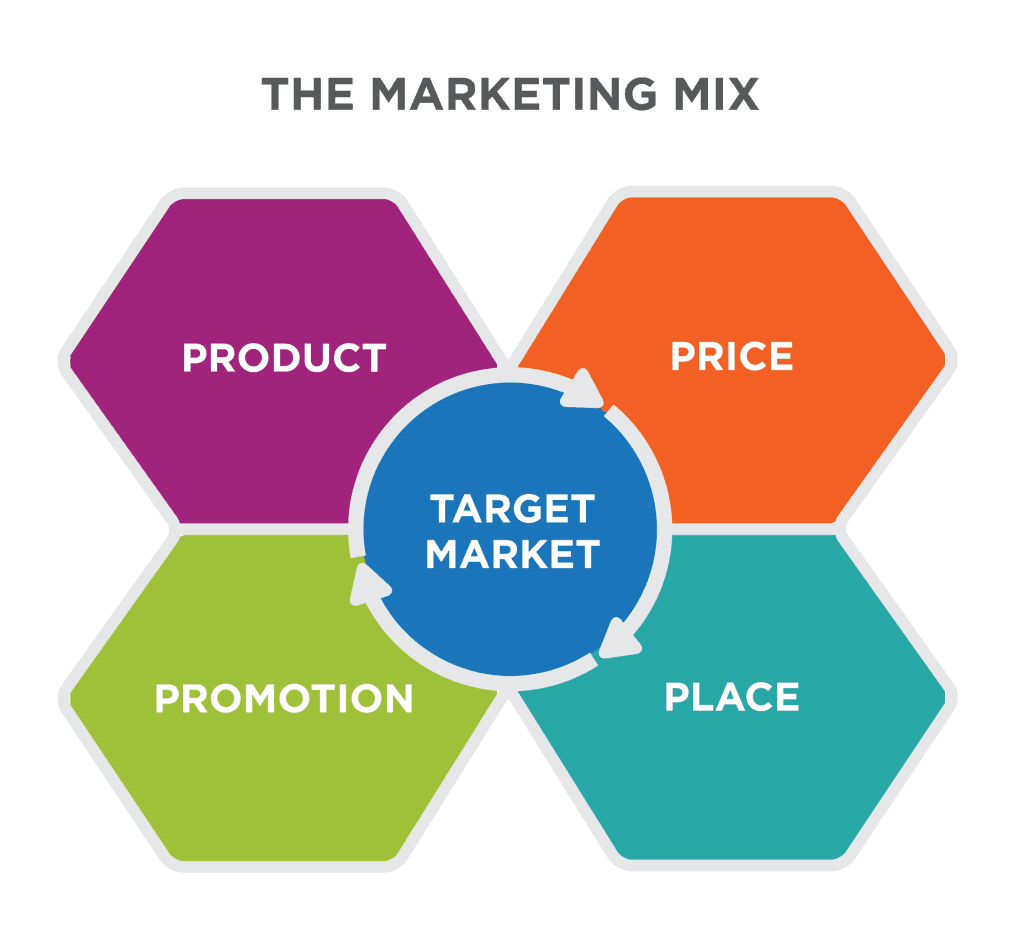
The marketing mix, or 4Ps, is a framework that helps companies decide what to sell, how much to charge, where to sell it, and how to tell people about it. Every marketing decision you'll analyze in this course connects back to these four levers, so understanding how they work individually and together is essential.
Definition of Marketing Mix
The marketing mix is a set of controllable variables a company uses to influence how consumers respond to its offering. The classic model has four components: Product, Price, Place, and Promotion. Think of them as four dials that marketers adjust in coordination. Turning one dial (say, raising the price) usually means you need to adjust the others (stronger promotion to justify the cost, more selective distribution to signal exclusivity, etc.).
The key idea is that these elements don't operate in isolation. A well-designed product at the wrong price, sold in the wrong channel, with weak promotion will still fail. The "mix" part is what matters.

Top images from around the web for Product
Products and Marketing Mix | Principles of Marketing View original
Is this image relevant?
The Marketing Mix | Introduction to Business MC View original
Is this image relevant?
Products and Marketing Mix | Principles of Marketing View original
Is this image relevant?
Products and Marketing Mix | Principles of Marketing View original
Is this image relevant?
The Marketing Mix | Introduction to Business MC View original
Is this image relevant?
Elements of 4Ps
Product
A product is any tangible good or intangible service offered to satisfy a customer need. It's more than just the physical item; "product" includes features, quality, design, packaging, warranties, and even the brand name attached to it.
- A smartphone's "product" includes the hardware, the operating system, the warranty, and the Apple or Samsung brand identity
- Services count too: a Spotify subscription, a haircut, or a consulting engagement are all products in marketing terms
Product decisions start with one question: what problem does this solve for the customer? Everything else (design, features, branding) flows from that answer.
Price
Price is what the customer gives up to obtain the product. It's the only P that directly generates revenue; the other three all represent costs.
- Price signals value. A $5 t-shirt and a $50 t-shirt create very different expectations before the customer even touches the fabric.
- Pricing decisions factor in production costs, competitor prices, and what customers are willing to pay.
- Price also includes terms like discounts, financing options, and subscription models (Netflix charging $15.49/month rather than selling individual movies).
Place
Place covers how and where customers can access the product. The goal is getting the right product to the right location at the right time.
- Direct distribution: selling straight to the consumer (Tesla's company-owned showrooms, a brand's own website)
- Indirect distribution: using intermediaries like wholesalers or retailers (a cereal brand selling through grocery chains)
- Place decisions also include logistics, inventory levels, and whether to sell online, in-store, or both
A great product at a great price means nothing if customers can't find it or get it conveniently.
Promotion
Promotion is how a company communicates with its target audience to inform, persuade, and remind them about the product. It includes:
- Advertising: paid messages through TV, social media, search engines, billboards, etc.
- Public relations: earned media coverage, press releases, sponsorships
- Sales promotion: short-term incentives like coupons, flash sales, or buy-one-get-one deals
- Personal selling: direct one-on-one interaction, common in B2B or high-value sales (car dealerships, enterprise software)
The promotion strategy should match the product, price, and place decisions. A luxury watch brand wouldn't run a buy-one-get-one coupon in a Sunday newspaper.
Product Strategies
Product Lifecycle
Products tend to move through four predictable stages, and the marketing mix shifts at each one:
- Introduction: The product launches. Sales are low, costs are high (R&D, initial marketing push), and most consumers don't know the product exists yet. Heavy promotion is typical.
- Growth: Sales climb as the market adopts the product. Competitors start entering. The company may expand distribution and adjust pricing.
- Maturity: Sales peak and level off. Competition is intense. Companies often differentiate through branding, minor product updates, or promotional deals.
- Decline: Sales drop as consumer preferences shift or better alternatives emerge. The company decides whether to discontinue, reposition, or harvest remaining profits.
Not every product follows this pattern neatly, but it's a useful mental model for anticipating what strategic decisions come next.
Branding
Branding is the process of building a distinct identity that separates your product from competitors. It goes beyond a logo: branding includes the name, visual design, tone of voice, and the associations customers form in their minds.
- Brand positioning defines where the brand sits relative to competitors. Volvo owns "safety." Red Bull owns "energy and extreme sports."
- Brand equity is the added value a brand name gives a product. People will pay more for Tylenol than a generic acetaminophen tablet with the same active ingredient.
- Strong branding builds customer loyalty, which reduces the need to compete purely on price.
Packaging
Packaging serves two roles: functional (protecting the product during shipping and storage) and marketing (catching the customer's eye and communicating brand identity).
- Packaging influences purchase decisions at the shelf. Studies show consumers form impressions within seconds.
- Regulatory requirements matter too: food products must include nutritional labels, pharmaceuticals need dosage information.
- Sustainability is increasingly important. Brands like Apple have redesigned packaging to reduce plastic and cardboard waste, which also reinforces their brand image.
Product Line Decisions
A product line is a group of related products offered by the same company. Managing it involves three dimensions:
- Breadth: how many different product lines the company offers (Samsung sells phones, TVs, appliances, semiconductors)
- Depth: how many variations exist within a single line (iPhone 15, iPhone 15 Plus, iPhone 15 Pro, iPhone 15 Pro Max)
- Consistency: how closely related the product lines are to each other
Companies use line extensions (new flavors, sizes, or models within an existing line) and brand extensions (using an established brand name to enter a new category) to grow revenue and cover more market segments.
Pricing Strategies
Cost-Based Pricing
This approach starts with what it costs to make and deliver the product, then adds a margin on top.
- Markup pricing: Add a fixed percentage to the unit cost. If a product costs $10 to produce and you apply a 50% markup, the selling price is $15.
- Break-even analysis: Calculate the point where total revenue equals total costs. If fixed costs are $100,000, variable cost per unit is $5, and selling price is $15, you break even at 10,000 units:
Cost-based pricing is straightforward but has a weakness: it ignores what customers are actually willing to pay.
Value-Based Pricing
Here, the price is set according to how much value the customer perceives, not what it costs to produce. This is common for premium and luxury products.
- A Starbucks latte costs far more than the ingredients justify. Customers pay for the experience, convenience, and brand.
- Value-based pricing requires deep understanding of your target customer's needs and willingness to pay.
- When done well, it yields higher profit margins than cost-based approaches.

Competition-Based Pricing
Prices are set relative to what competitors charge. This works well in markets where products are similar and customers can easily compare.
- A gas station might price fuel one cent below the station across the street.
- Companies can position above competitors (premium), at parity (matching), or below (budget/value).
- This strategy requires constant monitoring of competitor pricing.
Pricing Objectives
Different business goals lead to different pricing approaches:
- Profit maximization: finding the price point that yields the highest total profit
- Market share growth: pricing low to attract a large customer base quickly (penetration pricing)
- Price skimming: launching at a high price to capture early adopters willing to pay more, then gradually lowering it (common with new tech products)
- Price stability: keeping prices consistent to build trust and predictability with customers
Place (Distribution) Strategies
Distribution Channels
A distribution channel is the path a product takes from producer to end consumer.
- Direct channels: The company sells straight to the buyer. Examples include a manufacturer's own website, factory outlet stores, or a farmer selling at a market.
- Indirect channels: Intermediaries handle distribution. A clothing brand might sell to a wholesaler, who sells to a retailer, who sells to the consumer.
- Multi-channel distribution: Using several channel types simultaneously to reach different segments (selling through Amazon, your own website, and physical retail partners).
Each additional intermediary adds cost but can also expand reach. The trade-off between control and coverage is central to place decisions.
Supply Chain Management
The supply chain encompasses everything from sourcing raw materials to delivering the finished product to the customer's door.
- Effective supply chain management reduces costs, shortens delivery times, and improves reliability.
- Companies use technology like RFID tracking, demand forecasting software, and real-time inventory systems to keep things running smoothly.
- Supply chain disruptions (like those during COVID-19) can cripple even the strongest brands, which is why resilience and backup sourcing matter.
Retail vs. Wholesale
- Retailers sell directly to end consumers. Their strategies focus on store layout, customer experience, merchandising, and location.
- Wholesalers sell in bulk to businesses or retailers. Their strategies emphasize volume pricing, efficient logistics, and strong B2B relationships.
A single product often passes through both: a wholesaler buys 10,000 units from the manufacturer, then distributes them to hundreds of retail locations.
E-Commerce Considerations
Online selling introduces its own set of strategic decisions:
- Website design and user experience directly affect conversion rates. A confusing checkout process loses customers.
- Digital payment security and data privacy are non-negotiable for building consumer trust.
- Omnichannel strategies blend online and offline experiences. A customer might research a product on a brand's app, try it in-store, and then order it online for home delivery.
Promotion Strategies
Advertising
Advertising is paid, non-personal communication designed to reach a broad audience.
- Traditional media: TV, radio, print (newspapers, magazines), outdoor (billboards)
- Digital advertising: social media ads, search engine marketing (Google Ads), display ads, influencer partnerships
- Effective advertising requires choosing the right media for your target audience, crafting a compelling message, and measuring results (click-through rates, conversion rates, return on ad spend).
Public Relations
PR focuses on managing a company's reputation and earning positive media coverage rather than paying for it.
- Tools include press releases, media events, sponsorships, and corporate social responsibility initiatives.
- Crisis management is a critical PR function. How a company responds to a product recall or scandal can define its brand for years.
- PR tends to be more credible than advertising in consumers' eyes because the message comes through a third party (a journalist, a community organization).
Sales Promotion
Sales promotions are short-term tactics designed to create urgency and boost immediate sales.
- Examples: limited-time discounts, coupons, free samples, contests, loyalty reward programs
- They're effective for clearing inventory, attracting new customers, or countering a competitor's move.
- The risk: overusing promotions can train customers to only buy on sale, which erodes brand value and profit margins over time.
Personal Selling
Personal selling involves direct, usually face-to-face interaction between a salesperson and a prospective buyer.
- Most effective for complex, high-value, or customizable products (enterprise software, real estate, industrial equipment)
- The process typically follows these steps: prospecting, needs assessment, presentation, handling objections, closing, and follow-up
- It's expensive per contact compared to advertising, but the conversion rate is much higher because the pitch is tailored to the individual buyer.
Integration of 4Ps
The 4Ps only work when they're aligned. A mismatch between any two elements creates confusion for the customer and inefficiency for the company.
Consider a luxury skincare brand: the product uses high-quality ingredients (Product), it's priced at $85 per jar (Price), it's sold exclusively at Sephora and the brand's own website (Place), and it's promoted through dermatologist endorsements and glossy magazine ads (Promotion). Every element reinforces the same positioning. If that same brand suddenly showed up at a dollar store, the entire strategy would unravel.
Cross-functional collaboration is essential. The product team, pricing analysts, sales/distribution team, and marketing communications team all need to be working from the same strategic playbook.

Marketing Mix in the Service Industry
Services have four characteristics that make them different from physical goods:
- Intangibility: You can't touch or hold a service before buying it. A hotel stay can't be inspected in advance the way a shirt can.
- Inseparability: Production and consumption happen simultaneously. A doctor's consultation is created and consumed at the same time.
- Variability: Service quality can differ depending on who provides it, when, and where. Your experience at a restaurant depends on which server you get.
- Perishability: Services can't be stored. An empty airline seat on today's flight is lost revenue forever.
Because of these differences, the traditional 4Ps often aren't enough for services, which is why the extended 7Ps model was developed.
Digital Marketing Mix
Applying the 4Ps in digital environments requires some adaptation:
- Product: Digital products (apps, streaming content, SaaS tools) can be updated continuously after launch, unlike physical goods.
- Price: Dynamic pricing is easier online. Airlines and ride-share apps adjust prices in real time based on demand.
- Place: Distribution happens through websites, app stores, and digital marketplaces. The "shelf space" competition shifts to search engine rankings and platform algorithms.
- Promotion: Digital promotion relies on SEO, social media marketing, email campaigns, and content marketing. Data analytics allow precise targeting and real-time performance measurement.
Extended Marketing Mix (7Ps)
The 7Ps add three elements to the original framework, primarily to address service marketing.
People
"People" refers to everyone involved in delivering the service: employees, managers, and even customers themselves.
- Employee training and motivation directly affect service quality. A knowledgeable, friendly barista creates a different Starbucks experience than a disengaged one.
- Customers also play a role. In a fitness class, the energy of other participants shapes the experience for everyone.
- Hiring, training, and retention strategies are marketing decisions in service industries, not just HR decisions.
Process
Process covers the procedures and flow of activities through which a service is delivered.
- A streamlined checkout process at a grocery store (self-checkout, mobile pay) improves customer satisfaction.
- Service blueprinting maps out every step of the customer journey to identify pain points and improvement opportunities.
- Consistency matters: customers expect the same quality every time. McDonald's obsessive process standardization is a classic example.
Physical Evidence
Since services are intangible, physical evidence gives customers something concrete to evaluate.
- A law firm's office design, a hotel's lobby, a restaurant's table settings all signal quality before the service even begins.
- Digital physical evidence includes website design, app interface, and even email formatting.
- Uniforms, signage, receipts, and branded materials all contribute to the customer's perception of the service.
Marketing Mix vs. Marketing Strategy
These two terms are related but distinct:
- Marketing strategy is the big picture: which customers to target, how to position the brand, and what long-term competitive advantage to pursue.
- Marketing mix is the tactical execution of that strategy through specific Product, Price, Place, and Promotion decisions.
Think of strategy as the destination and the marketing mix as the route you take to get there. The strategy might say "target health-conscious millennials with a premium positioning." The marketing mix then determines the organic ingredients (Product), the $6.99 price point (Price), distribution through Whole Foods and the brand's DTC website (Place), and Instagram-focused promotion featuring nutritionists (Promotion).
Adapting the Marketing Mix
Cultural Considerations
When companies enter new markets, the marketing mix often needs to be adjusted for local culture.
- Product: McDonald's serves McSpicy Paneer in India and teriyaki burgers in Japan. The core brand stays consistent, but the menu adapts.
- Price: Purchasing power varies by country. Apple prices iPhones differently across markets.
- Promotion: Colors, humor, and imagery that work in one culture can be offensive or confusing in another. Marketing messages need local insight.
Market Segmentation Impact
Different customer segments within the same market may need different marketing mixes.
- An automaker might offer a budget compact (Nissan Versa), a mid-range sedan (Nissan Altima), and a luxury SUV (Infiniti QX80), each with its own pricing, distribution, and promotional approach.
- Segmentation variables (demographic, psychographic, behavioral, geographic) determine how finely the mix should be tailored.
Measuring Marketing Mix Effectiveness
You can't improve what you don't measure. Common approaches include:
- Sales metrics: revenue, units sold, market share changes
- Customer metrics: satisfaction scores, Net Promoter Score (NPS), retention rates
- Brand metrics: awareness levels, brand equity surveys
- Marketing mix modeling: statistical analysis that isolates the contribution of each P to overall results. This helps answer questions like "Did the price drop or the new ad campaign drive last quarter's sales increase?"
Ongoing measurement allows companies to reallocate resources toward whatever's working and away from what isn't.
Challenges in Marketing Mix Implementation
- Internal conflicts: The sales team wants lower prices to close deals; the finance team wants higher margins. Aligning departments around a unified mix takes negotiation.
- Rapid market changes: Consumer preferences, competitor moves, and technology shifts can make a well-designed mix obsolete quickly.
- Budget constraints: Every element of the mix costs money. Companies must prioritize where limited resources will have the greatest impact.
- Attribution difficulty: When sales increase, was it the new packaging, the price cut, or the social media campaign? Isolating the effect of individual elements is genuinely hard.
Future Trends in Marketing Mix
- Hyper-personalization: AI and data analytics enable companies to tailor product recommendations, pricing, and promotions to individual consumers rather than broad segments.
- Sustainability as a core P: Environmental and social responsibility are increasingly influencing product design, packaging, sourcing, and messaging. Consumers (especially younger demographics) reward brands that align with their values.
- Experiential marketing: Brands are investing in immersive experiences (pop-up shops, AR/VR product demos) that blur the line between promotion and product.
- Omnichannel evolution: The distinction between online and offline continues to dissolve. The marketing mix must work seamlessly across every touchpoint a customer might use.
See Fiveable more often in Google
Mark Fiveable as a preferred source and Google is more likely to show you our guides in Top Stories, with a "preferred" badge in AI Mode and AI Overviews.