3.14 Required Supreme Court Cases

👩🏾⚖️AP US Government Unit 3 Review
3.14 Required Supreme Court Cases
👩🏾⚖️ AP US Government
1.1
Ideals of Democracy
1.2
Types of Democracy
1.3
Federalist No. 10 & Brutus 1 Summary
1.4
Challenges of the Articles of Confederation
1.5
Ratification of the U.S. Constitution
1.6
Principles of American Government
1.7
Relationship Between States and the Federal Government
1.8
Constitutional Interpretations of Federalism
1.9
Federalism in Action
1.10
Required Founding Documents
TLDR
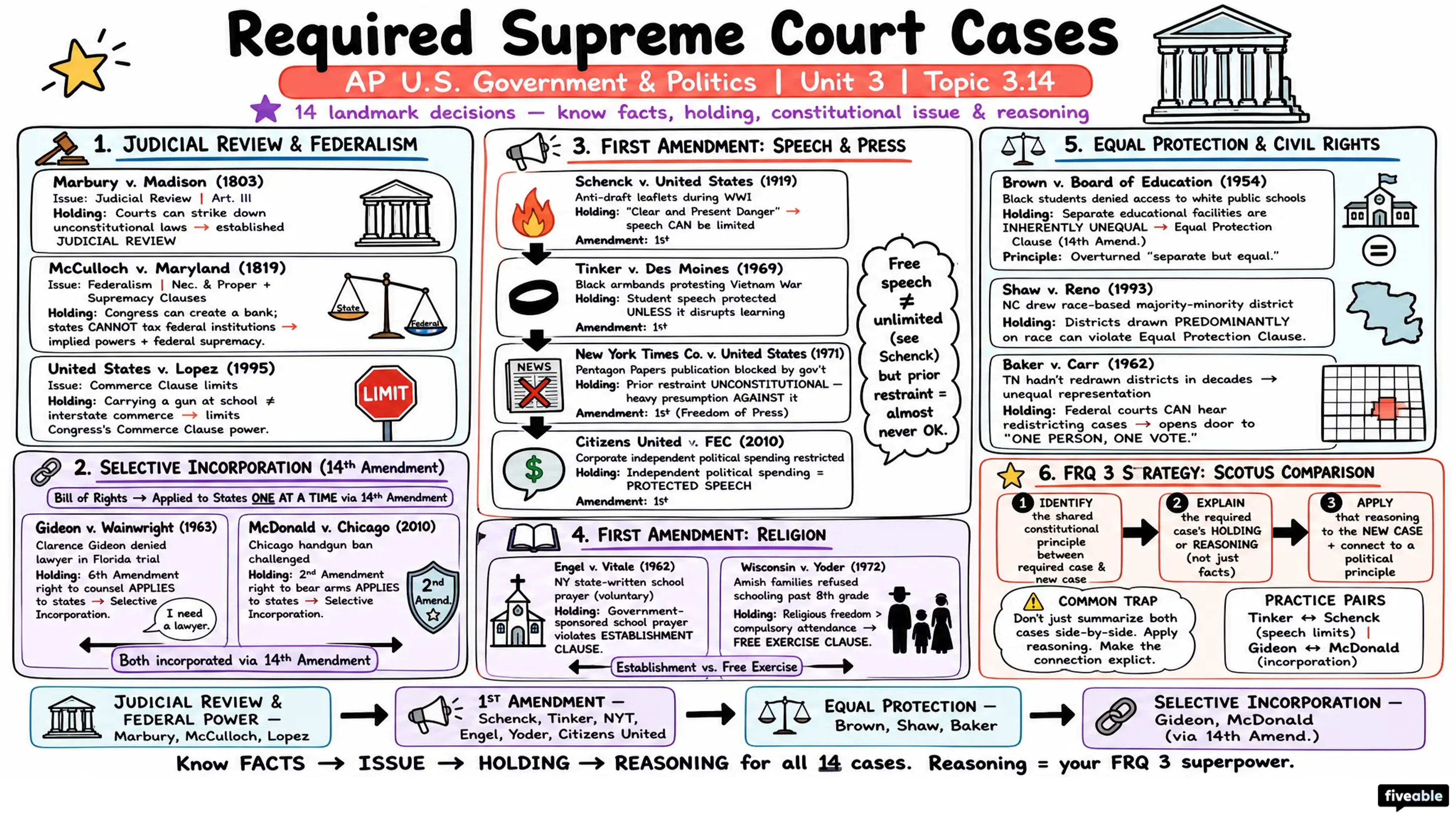
The AP Gov required Supreme Court cases are 14 landmark SCOTUS decisions you need to know by name, fact pattern, constitutional issue, holding, reasoning, and broader principle. This guide is a course-wide reference, not just a Unit 3 topic, and it is built for quick review before MCQs and FRQ 3: SCOTUS Comparison.
What Are the AP Gov Required Supreme Court Cases?
The 14 AP Gov required Supreme Court cases are Marbury v. Madison, McCulloch v. Maryland, Schenck v. United States, Brown v. Board of Education, Baker v. Carr, Engel v. Vitale, Gideon v. Wainwright, Tinker v. Des Moines, New York Times Co. v. United States, Wisconsin v. Yoder, Shaw v. Reno, United States v. Lopez, McDonald v. Chicago, and Citizens United v. FEC.
These required cases cover judicial review, federalism, civil liberties, civil rights, redistricting, and campaign finance. The exam expects you to know more than a case name. For each one, focus on what happened, what constitutional question the Court answered, what the Court held, and what principle you can apply to a new scenario.
Why This Matters for the AP Gov Exam
These cases show up across the whole exam, not just one unit. They appear in multiple-choice questions, in scenarios, and even in political cartoons, so knowing each case's constitutional issue and holding pays off everywhere.
The biggest payoff is FRQ 3: SCOTUS Comparison. On that question, you get one required case and one non-required case. You have to explain how a principle, holding, or reasoning from the required case applies to the new one, then connect it to a political principle. You cannot do that well if you only memorized case names. You need to understand the reasoning behind each decision so you can transfer it to an unfamiliar case.
Key Takeaways
- There are 14 required Supreme Court cases, and you should know each one's facts, constitutional issue, holding, and reasoning.
- For every case, lock in the specific clause or amendment involved, since that is what lets you compare cases that share an issue.
- FRQ 3 asks you to apply a required case to a non-required one, so practice transferring reasoning, not just listing facts.
- Group cases by theme such as federalism, First Amendment, selective incorporation, and equal protection to make comparisons faster.
- The same case can appear in MCQs, scenarios, and cartoons, so understanding why the Court ruled is more useful than memorizing a one-line summary.
How to Study Each Case
For every required case, build a quick mental card with four parts:
- Facts and context: what actually happened
- Constitutional issue: the specific clause or amendment in question
- Holding and reasoning: what the Court decided and why
- Impact or principle: what changed or what idea it stands for
That last part matters most for FRQ 3, because the comparison question rewards you for connecting reasoning to a broader political principle.
Quick Reference Table of the 14 Required Cases
| Case | What happened | Holding | Exam principle |
|---|---|---|---|
| Marbury v. Madison (1803) | Marbury sued to force delivery of a judicial commission. | The Court could not use an unconstitutional part of the Judiciary Act to issue the order. | Judicial review lets courts declare laws unconstitutional. |
| McCulloch v. Maryland (1819) | Maryland taxed the national bank, and McCulloch refused to pay. | Congress could create the bank, and Maryland could not tax it. | Implied powers and federal supremacy strengthen national authority. |
| Schenck v. United States (1919) | Anti-draft leaflets were distributed during World War I. | Speech creating a clear and present danger was not protected. | Free speech can be limited in some national-security contexts. |
| Brown v. Board of Education (1954) | Black students challenged segregated public schools. | Separate educational facilities are inherently unequal. | The Equal Protection Clause bars school segregation by race. |
| Baker v. Carr (1962) | Tennessee voters challenged unequal legislative districts. | Federal courts could hear redistricting cases. | Redistricting can raise justiciable equal-protection questions. |
| Engel v. Vitale (1962) | Public schools used a state-written voluntary prayer. | Government-sponsored school prayer violated the Establishment Clause. | Government cannot sponsor religious activity in public schools. |
| Gideon v. Wainwright (1963) | Gideon was denied a lawyer in a state felony trial. | States must provide counsel to defendants who cannot afford one. | The Sixth Amendment right to counsel applies to states through the Fourteenth Amendment. |
| Tinker v. Des Moines (1969) | Students wore armbands to protest the Vietnam War. | The armbands were protected symbolic speech unless they caused substantial disruption. | Students retain First Amendment rights in public schools. |
| New York Times Co. v. United States (1971) | The government tried to stop publication of the Pentagon Papers. | Prior restraint was unconstitutional without an extremely strong justification. | Freedom of the press receives strong protection against prior restraint. |
| Wisconsin v. Yoder (1972) | Amish parents objected to compulsory schooling after eighth grade. | The law violated their free exercise rights. | Religious exercise can outweigh some generally applicable state interests. |
| Shaw v. Reno (1993) | North Carolina drew an oddly shaped majority-minority district. | Racial gerrymandering claims could be challenged under equal protection. | Race cannot be the predominant basis for district lines without strong justification. |
| United States v. Lopez (1995) | Congress banned guns in school zones under the Commerce Clause. | The law exceeded Congress's commerce power. | Congress's Commerce Clause power has limits when activity is local and non-economic. |
| McDonald v. Chicago (2010) | Chicago's handgun ban was challenged under the Second Amendment. | The Second Amendment applies to states through the Fourteenth Amendment. | Selective incorporation can apply individual rights against state governments. |
| Citizens United v. FEC (2010) | Federal law restricted independent political spending by corporations and unions. | Independent political spending is protected speech. | Political spending can receive First Amendment protection when it is independent of campaigns. |
Required Court Cases by Constitutional Principle
Use this table when you are trying to remember which cases go together. The AP exam often rewards grouping cases by shared constitutional principle instead of memorizing them as a random list.
| Principle | Required cases to group together | What to remember |
|---|---|---|
| Judicial review and federal supremacy | Marbury, McCulloch | The Court can check the other branches, and federal law is supreme over conflicting state action. |
| Federalism and limits on national power | McCulloch, Lopez | McCulloch expands federal power through implied powers, while Lopez marks a limit on commerce power. |
| First Amendment speech and press | Schenck, Tinker, New York Times, Citizens United | Speech and press get strong protection, but context matters. Look for disruption, national security, prior restraint, and political spending. |
| First Amendment religion | Engel, Wisconsin v. Yoder | Engel is about the Establishment Clause; Yoder is about the Free Exercise Clause. |
| Selective incorporation | Gideon, McDonald | The Fourteenth Amendment applies specific Bill of Rights protections to state governments. |
| Equal protection and representation | Brown, Baker, Shaw | These cases involve racial equality, representation, and how district lines affect political power. |
Judicial Review and Federalism
Marbury v. Madison (1803)
- Facts: William Marbury sued to receive a judicial commission that was never delivered.
- Issue: Could the Court order the commission to be delivered under the Judiciary Act of 1789?
- Holding: No. Part of the Judiciary Act conflicted with the Constitution, so the Court struck it down.
- Principle: Established judicial review, the power of courts to declare laws unconstitutional.
McCulloch v. Maryland (1819)
- Facts: Maryland tried to tax the national bank, and bank employee James McCulloch refused to pay.
- Issue: Could Congress create a bank, and could a state tax a federal institution?
- Holding: Yes to the bank, under the Necessary and Proper Clause, and no to the tax, under the Supremacy Clause.
- Principle: Confirmed implied powers and federal supremacy over the states.
United States v. Lopez (1995)
- Facts: A student brought a gun to school and was charged under the Gun-Free School Zones Act, which Congress based on the Commerce Clause.
- Issue: Did Congress exceed its Commerce Clause power?
- Holding: Yes. Carrying a gun in a school zone did not substantially affect interstate commerce.
- Principle: Set a limit on the Commerce Clause and protected state authority.
First Amendment: Religion, Speech, and Press
Engel v. Vitale (1962)
- Facts: New York schools used a state-written voluntary prayer.
- Issue: Did it violate the Establishment Clause?
- Holding: Yes. Government-sponsored school prayer violates the First Amendment, even if it is voluntary.
Wisconsin v. Yoder (1972)
- Facts: Amish families refused to send their children to school past eighth grade for religious reasons.
- Issue: Did the compulsory attendance law violate the Free Exercise Clause?
- Holding: Yes. Religious freedom outweighed the state's interest in requiring more schooling.
Tinker v. Des Moines (1969)
- Facts: Students were suspended for wearing black armbands to protest the Vietnam War.
- Issue: Was the armband protest protected symbolic speech?
- Holding: Yes. Students keep their First Amendment rights at school unless the speech disrupts learning.
New York Times Co. v. United States (1971)
- Facts: The government tried to block publication of the classified Pentagon Papers.
- Issue: Was this prior restraint constitutional?
- Holding: No. There is a heavy presumption against prior restraint, even in national security cases.
Schenck v. United States (1919)
- Facts: Activists handed out leaflets urging resistance to the WWI draft.
- Issue: Was this speech protected, or did it violate the Espionage Act?
- Holding: The speech created a "clear and present danger," so it was not protected.
Selective Incorporation
Gideon v. Wainwright (1963)
- Facts: Clarence Gideon was denied a lawyer at his Florida trial because he could not afford one.
- Issue: Does the right to counsel apply to state trials?
- Holding: Yes. The Sixth Amendment right to an attorney applies to the states through the Fourteenth Amendment.
McDonald v. Chicago (2010)
- Facts: Chicago's handgun ban was challenged after the Court recognized an individual right to bear arms.
- Issue: Does the Second Amendment apply to the states?
- Holding: Yes. The right to bear arms is incorporated against the states through the Fourteenth Amendment.
Equal Protection and Civil Rights
Brown v. Board of Education (1954)
- Facts: Black students were denied access to white public schools under "separate but equal."
- Issue: Did school segregation violate the Equal Protection Clause?
- Holding: Yes. Separate educational facilities are inherently unequal.
- Principle: Declared race-based school segregation a violation of the Fourteenth Amendment.
Shaw v. Reno (1993)
- Facts: North Carolina drew a district shaped largely by race to create a majority-minority district.
- Issue: Could a district drawn primarily on race be challenged?
- Holding: Yes. Districts based predominantly on race can violate the Equal Protection Clause.
Representation and Redistricting
Baker v. Carr (1962)
- Facts: Tennessee had not redrawn its legislative districts in decades, creating unequal representation.
- Issue: Could federal courts hear redistricting cases?
- Holding: Yes. Redistricting questions can be heard in federal court, opening the door to "one person, one vote."
Campaign Finance and Elections
Citizens United v. FEC (2010)
- Facts: Citizens United wanted to air a film critical of a presidential candidate, but federal law restricted that spending.
- Issue: Could the government limit independent political spending by corporations?
- Holding: No. Independent political spending is protected speech under the First Amendment.
- Principle: Treated corporate independent spending as protected political speech.
How to Use This on the AP Gov Exam
These are the most common ways required cases show up, not every possible question.
MCQ
Expect questions that give a scenario, a quote from an opinion, or a cartoon and ask which case or principle fits. Knowing the constitutional issue behind each case helps you match fast, even when the case name is not stated directly.
FRQ 3: SCOTUS Comparison
You will get one required case and one non-required case. To earn the points, identify the shared constitutional principle, explain the relevant holding or reasoning from the required case, and then apply it to the new case. Practice by pairing cases with the same issue, like Tinker and Schenck on speech, or Gideon and McDonald on incorporation.
For more judicial branch context, review 2.8 The Judicial Branch, 2.9 Legitimacy of the Judicial Branch, and 2.10 The Court in Action. For rights cases, connect this guide to 3.3 First Amendment: Freedom of Speech and 3.7 Selective Incorporation & the 14th Amendment.
FRQ 3 Comparison Pairings to Practice
These pairings are not predictions. They are practice prompts for learning how to compare constitutional reasoning.
| Required case | Compare it with a case or scenario about... | What to practice explaining |
|---|---|---|
| Tinker v. Des Moines | Student speech, school discipline, or symbolic speech | Whether the speech creates a substantial disruption in a public school setting. |
| Schenck v. United States | Speech during war, national security, or public danger | Why some speech can be restricted when the government shows a serious danger. |
| New York Times Co. v. United States | Government efforts to block publication | Why prior restraint faces a very high constitutional burden. |
| Engel v. Vitale | Prayer, religion, or official school activities | How the Establishment Clause limits government-sponsored religious practice. |
| Wisconsin v. Yoder | Religious practice conflicting with a state rule | How Free Exercise claims are balanced against state interests. |
| Gideon v. Wainwright | Criminal procedure in state courts | How selective incorporation applies the right to counsel to state defendants. |
| McDonald v. Chicago | State or local gun regulations | How the Fourteenth Amendment can incorporate a Bill of Rights protection. |
| McCulloch v. Maryland | Federal power, implied powers, or state resistance | How the Necessary and Proper Clause and Supremacy Clause support national power. |
| United States v. Lopez | Federal regulation of local activity | How the Commerce Clause can be limited when activity is not economic or interstate. |
| Citizens United v. FEC | Campaign spending, independent expenditures, or political speech | Why independent political spending can be treated as protected speech. |
Fast Study Checklist
Before test day, make sure you can do these five things for each case:
- Name the constitutional clause or amendment.
- State the holding in one sentence.
- Explain the reasoning in your own words.
- Connect the case to a broader AP Gov principle.
- Compare it to a new scenario without just retelling the facts.
Common Trap
Do not just describe both cases side by side. The comparison question wants you to apply reasoning from the required case to the new one and tie it to a political principle. Summarizing facts without making that connection loses points.
Common Misconceptions
- Misconception: These cases are a Unit 3 only topic.Actually: These cases are not a Unit 3 only topic. They come from across the course and can appear on any part of the exam.
- Misconception: Knowing the holding is enough.Actually: Knowing the holding is not enough. FRQ 3 rewards understanding the reasoning so you can transfer it to a new case.
- Misconception: Selective incorporation applies the whole Bill of Rights to the states at once.Actually: Selective incorporation does not apply the whole Bill of Rights to the states at once. It applies specific protections one at a time through the Fourteenth Amendment, as in Gideon and McDonald.
- Misconception: Free speech is unlimited.Actually: Free speech is not unlimited. Schenck shows the Court has allowed limits when speech creates a clear and present danger.
- Misconception: Citizens United removed all campaign finance rules.Actually: Citizens United protected independent political spending as speech. It is not a ruling that removed all campaign finance rules.
- Misconception: Lopez erased the Commerce Clause.Actually: Lopez did not erase the Commerce Clause. It set a limit by saying some activities are too local to count as interstate commerce.
- Misconception: There are 15 AP Gov court cases.Actually: but this required-case reference uses the 14-case AP Gov list covered in the Fiveable course materials and CED-aligned review.
Related AP Gov Guides
Frequently Asked Questions
How many required Supreme Court cases are on the AP Gov exam?
There are 14 required Supreme Court cases in this AP Gov review set. You should know each case's facts, issue, holding, reasoning, decision, and constitutional principle.
What are the 14 required Supreme Court cases for AP Gov?
The 14 required cases are Marbury v. Madison, McCulloch v. Maryland, Schenck v. United States, Brown v. Board of Education, Baker v. Carr, Engel v. Vitale, Gideon v. Wainwright, Tinker v. Des Moines, New York Times Co. v. United States, Wisconsin v. Yoder, Shaw v. Reno, United States v. Lopez, McDonald v. Chicago, and Citizens United v. FEC.
Which AP Gov FRQ uses required Supreme Court cases?
FRQ 3: SCOTUS Comparison uses required Supreme Court cases. The prompt gives you a required case and a non-required case, then asks you to compare the constitutional principle, holding, or reasoning.
What should I memorize for each required Supreme Court case?
Memorize the basic facts, constitutional issue, holding, reasoning, decision, and broader principle. For FRQ 3, the reasoning and principle matter most because you have to apply them to a new case.
Which AP Gov required cases are about the First Amendment?
The First Amendment required cases are Schenck v. United States, Engel v. Vitale, Tinker v. Des Moines, New York Times Co. v. United States, Wisconsin v. Yoder, and Citizens United v. FEC. They cover speech, press, establishment, free exercise, symbolic speech, and political spending.
Are the required Supreme Court cases only tested in Unit 3?
No. This guide appears in Unit 3 because many cases involve civil liberties and civil rights, but the required cases draw from the whole course. They can appear in MCQs, scenarios, cartoons, and FRQ 3.
See Fiveable more often in Google
Mark Fiveable as a preferred source and Google is more likely to show you our guides in Top Stories, with a "preferred" badge in AI Mode and AI Overviews.