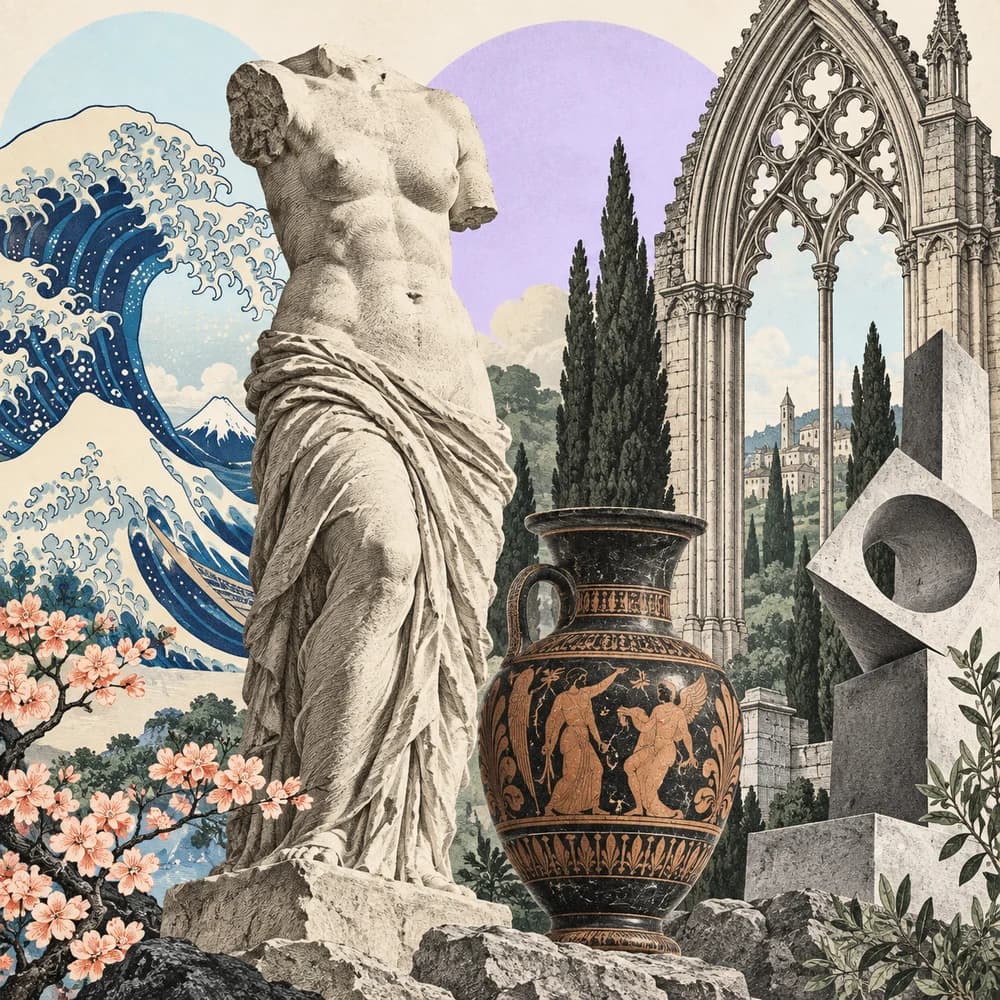
The AP Art History exam is a two-section test, combining multiple-choice and free-response questions, scored on a 1 to 5 scale, and an apah score calculator can help you estimate where you stand before test day. APAH covers global art across time, from prehistoric works to contemporary pieces, with content spanning architecture, painting, sculpture, and more. This page pulls together the key concepts, image analysis skills, and contextual frameworks you'll need to feel ready for the apah exam.
The AP Art History exam is three hours and twenty minutes long, split evenly between two sections. Section I has 80 multiple-choice questions in 60 minutes, worth 50% of your score. Section II has 6 free-response questions across 120 minutes, also worth 50%. The exam has been fully digital since May 2025, meaning images appear on screen rather than in a printed booklet. Scoring runs on a 1 to 5 scale, and the content spans global art history from prehistoric works through contemporary pieces across all ten units.
The two sections carry equal weight, so neither one can be an afterthought.
Section I: Multiple Choice (50%) 80 questions, 60 minutes. Questions appear individually and in sets of 3 to 6 tied to one or more images. Some images come from the 250 required works; others are unfamiliar works chosen because they connect to traditions and visual conventions you already know. That distinction matters: you need to recognize the required works on sight and apply your analytical skills to works you've never seen before.
Section II: Free Response (50%) 6 questions, 120 minutes, 34 raw points total.
| Question | Type | Points | Suggested Time | |, -|, -|, -|, -| | Q1 | Long Comparison Essay | 8 pts | ~35 min | | Q2 | Long Visual/Contextual Analysis | 6 pts | ~25 min | | Q3 | Short: Visual Analysis | 5 pts | ~15 min | | Q4 | Short: Contextual Analysis | 5 pts | ~15 min | | Q5 | Short: Attribution | 5 pts | ~15 min | | Q6 | Short: Continuity and Change | 5 pts | ~15 min |
The two long essays open Section II and carry the most individual weight. The four short essays together account for 20 of the 34 raw free-response points, so consistent performance across all six questions matters more than perfecting any single one.
AP Art History is built around a global curriculum. The 10 units move from Global Prehistoric Art through Ancient Mediterranean, Early European and Colonial American, Later European and American, Indigenous American, African, West and Central Asian, South and Southeast Asian, Pacific, and Global Contemporary Art. Every question, whether multiple choice or free response, asks you to work with visual evidence and connect it to cultural, historical, or social context.
The core skills the exam assesses are:
These skills appear in both sections. The MCQ tests them through image-based questions. The FRQs ask you to demonstrate them in writing with specific evidence.
The required image set is the backbone of this exam. Knowing a work means more than memorizing its title and date. You need to recognize it visually, describe its formal qualities, explain its function and context, and connect it to broader traditions. Unfamiliar works on the exam are selected precisely because they resemble or relate to works you already know, so a strong mental library of the 250 images is your most transferable tool.
Organizing the required works by unit and then by visual or thematic patterns tends to be more effective than memorizing them in isolation. Grouping works by material, patron type, religious function, or formal style builds the kind of flexible knowledge the exam rewards.
The child pages here break down each exam component in detail:
For content review by period and region, the unit pages cover everything from Global Prehistoric Art through Global Contemporary Art.
How long is the AP Art History exam? Three hours and twenty minutes total: 60 minutes for the MCQ section and 120 minutes for the free-response section.
Is the AP Art History exam digital? Yes. The exam moved to a fully digital format in May 2025. Images appear on screen, and you type your free-response answers. The question types, scoring, and content have not changed.
How is the AP Art History exam scored? Section I (MCQ) and Section II (FRQ) each count for 50% of your total score. The FRQ section has 34 raw points across 6 questions. Raw scores from both sections are combined and converted to the 1 to 5 AP scale.
Do I need to know all 250 required works? Yes, and knowing them well is the most direct path to a strong score. The MCQ section includes images from the required set, and the FRQ prompts often specify required works or ask you to select from them. Familiarity with the full set also helps when encountering unfamiliar works, since those are chosen to connect to traditions you already know.
What if I don't recognize a work on the exam? For unfamiliar works, apply the same analytical approach you use for required works. Describe what you see, identify formal elements, consider what the visual evidence suggests about function or cultural context, and connect it to traditions from the relevant unit. The exam is testing your skills, not just your memory.
The APAH AP Classroom Progress Check includes both MCQ and FRQ parts drawn from the full range of AP Art History content, covering works from the global art history curriculum across all time periods and cultures. The MCQ section tests visual analysis and contextual knowledge, while the FRQ part asks you to compare works, analyze formal qualities, or explain cultural context. For matched practice questions and study guides tied to these exact topics, visit /ap-art-history/ap-art-history-exam.
To practice APAH free-response questions, focus on the four FRQ types College Board uses: visual analysis, contextual analysis, comparison, and long essay. Each asks you to identify formal qualities like line, color, and composition, then connect them to cultural or historical context. Strong FRQ practice means writing timed responses on works from the 250 required images and getting feedback on your thesis and evidence. You can find FRQ practice resources at /ap-art-history/ap-art-history-exam.
You can find APAH multiple-choice and practice test questions at /ap-art-history/ap-art-history-exam. That page has MCQ practice covering visual analysis of the 250 required works, contextual identification, and comparison questions that mirror the real exam format. For the best results, mix timed MCQ sets with written FRQ responses so you're ready for both sections on exam day.
Start by getting comfortable with the 250 required works of art, grouping them by culture and time period so patterns in style and context stick. Then practice writing short visual analysis paragraphs using formal elements like line, space, and material. Review comparison strategies since the exam asks you to connect works across cultures. Use flashcards for artist, date, and patron details, then shift to timed FRQ writing in the final weeks. Find structured study resources at /ap-art-history/ap-art-history-exam.