6.4 The Effects of Government Intervention in Different Market Structures

🤑AP Microeconomics Unit 6 Review
6.4 The Effects of Government Intervention in Different Market Structures
🤑 AP Microeconomics
Government intervention changes market outcomes through taxes, subsidies, price controls, and regulation. Per unit taxes shift marginal cost and change quantity, lump sum taxes only hit fixed costs, and price regulation can push a monopoly toward the socially optimal or break even output.
Why This Matters for the AP Microeconomics Exam
Government intervention shows up in some of the most frequently missed questions on the AP Microeconomics exam, so it is worth slowing down here. You need to predict and explain how a policy changes price, quantity, surplus, deadweight loss, and government revenue or cost, and you need to do it correctly across different market structures.
This topic asks you to do three things: define the policy tools, explain their effects with graphs, and calculate changes in market outcomes from a graph or table. That mix of explanation and calculation is exactly the kind of thinking the exam rewards, especially when a per-unit tax versus a lump-sum tax leads to different graph shifts.
Key Takeaways
- A per-unit tax acts like an added cost on each unit, so it shifts marginal cost up and changes the profit-maximizing quantity. A per-unit subsidy does the opposite.
- A lump-sum tax or subsidy only changes fixed costs, so it shifts ATC but leaves MC and the quantity unchanged.
- For per-unit taxes and subsidies, the split between buyers and sellers and the size of deadweight loss depend on the price elasticities of supply and demand.
- Binding price ceilings and floors affect price and quantity differently depending on the market structure (perfect competition, monopoly, monopolistic competition, monopsony) and the elasticities involved.
- Price regulation can push a monopoly toward marginal-cost (socially optimal) output or average-cost (break-even) output, and a natural monopoly needs a lump-sum subsidy to produce at the allocatively efficient quantity.
- Antitrust policy is another tool governments use to try to make markets more competitive.
Per-Unit vs. Lump-Sum Taxes and Subsidies
The two basic moves a government can make toward a firm are to tax it (take money) or subsidize it (give money). How that policy is structured decides which cost curves move.
Per-Unit vs. Lump-Sum
A per-unit tax is a tax on every unit produced. For example, if a $2 tax applied to every laptop a firm makes, that is a per-unit tax. A lump-sum tax is a one-time fixed amount, like a flat $500 tax no matter how much the firm produces.
This distinction matters because a lump-sum tax behaves like a fixed cost, while a per-unit tax behaves like a cost on each additional unit, which means it affects marginal cost.
Graphing Taxes in the Firm
The logic for a subsidy is the same as a tax, just in the opposite direction. The effect on MC and ATC works the same way in perfect competition and in imperfect competition since the cost curves are built the same way.
Per-Unit Taxes
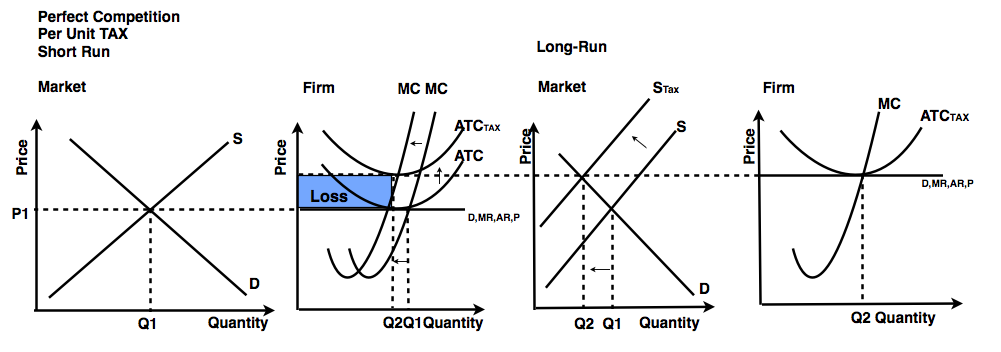
A per-unit tax adds to marginal cost because it is an extra cost on each additional unit. If producing one more unit cost $3 and you add a $1 per-unit tax, the new marginal cost is $4. So a per-unit tax shifts the MC curve up. It also shifts ATC up, since it raises variable cost per unit. The higher marginal cost lowers the profit-maximizing quantity.
Lump-Sum Taxes
A lump-sum tax does not change marginal cost because it is a fixed amount that does not depend on output. It raises average fixed cost and therefore ATC, but MC stays put. Because MC is unchanged, the profit-maximizing quantity does not change from a lump-sum tax.
This is the single most important contrast to remember: per-unit changes MC and quantity, lump-sum changes only fixed costs and ATC.
Per-Unit Taxes, Subsidies, and Surplus in a Market
In a market diagram, a per-unit tax drives a wedge between the price buyers pay and the net price sellers receive. That wedge lowers equilibrium quantity, shrinks consumer and producer surplus, creates deadweight loss, and raises government revenue.
How the tax burden splits between buyers and sellers, and how big the deadweight loss is, depends on the price elasticities of supply and demand. The more inelastic side tends to carry more of the tax. A per-unit subsidy works in reverse: it can raise quantity and create a government cost rather than revenue.
Price Ceilings and Floors Across Market Structures
A binding price ceiling sits below equilibrium and a binding price floor sits above it. In a competitive market a binding ceiling causes a shortage and a binding floor causes a surplus.
The effect is not identical in every market structure. Binding price ceilings and floors change prices and quantities differently in perfect competition, monopoly, monopolistic competition, and monopsony, and the elasticities of supply and demand shape the size of those changes. A minimum wage, for example, can behave very differently in a competitive labor market than in a monopsony.
Regulating a Monopoly
An unregulated monopoly produces where marginal revenue equals marginal cost, which gives a higher price and lower quantity than the socially optimal point where P = MC. That gap creates deadweight loss, a form of market failure.
Government can use price regulation to reduce this inefficiency. Two common target points are:
- Socially optimal (marginal-cost pricing): Set the regulated price where P = MC. This reaches the allocatively efficient quantity, but the firm may earn a loss at that price.
- Fair-return (average-cost pricing): Set the regulated price where price equals ATC. The firm breaks even, the government does not need to fund it, and there is still a small amount of deadweight loss, but much less than the unregulated outcome.
Natural Monopoly
A natural monopoly has costs that keep falling over the relevant range, so one firm can serve the whole market at lower cost than several firms could. If you force it to produce at the allocatively efficient (P = MC) quantity, it earns a loss. To keep it operating there, the government provides a lump-sum subsidy. That subsidy shifts ATC down enough for the firm to break even at the efficient quantity, without changing marginal cost (so it does not distort the efficient output choice).
Antitrust Policy
Beyond price regulation, governments use antitrust policy to try to make markets more competitive, for instance by challenging mergers or anticompetitive behavior. (A graph of inefficiency and policy due to collusion is outside the scope of this course.)
How to Use This on the AP Microeconomics Exam
Free Response
- When a prompt gives a per-unit tax, shift MC up and ATC up, then find the new profit-maximizing quantity. For a lump-sum tax, shift only ATC and keep quantity the same. Mixing these up is a common point loss.
- For a monopoly regulation question, be ready to label the unregulated quantity (MR = MC), the socially optimal quantity (P = MC), and the fair-return quantity (P = ATC), and explain the trade-off between efficiency and firm losses.
- For a natural monopoly, state that marginal-cost pricing causes a loss and that a lump-sum subsidy is needed to keep the firm at the efficient quantity.
Problem Solving
- For a market with a per-unit tax, use a graph or table to calculate the new price buyers pay, the net price sellers receive, the new quantity, the change in consumer and producer surplus, deadweight loss, and government revenue.
- Tie the burden split to elasticity: the more inelastic side pays more of the tax, and more inelastic curves usually mean smaller deadweight loss.
Common Trap
- "A tax always lowers quantity." A per-unit tax does, but a lump-sum tax leaves the profit-maximizing quantity unchanged because MC does not move.
Common Misconceptions
- Misconception: Lump-sum taxes change quantity.Actually: They do not. They only raise fixed costs and ATC. Marginal cost and the profit-maximizing quantity stay the same.
- Misconception: The party that sends the tax to the government bears the whole tax.Actually: Tax incidence depends on elasticity, not on who legally pays. The more inelastic side carries more of the burden.
- Misconception: Marginal-cost pricing always makes a regulated monopoly profitable.Actually: Setting P = MC reaches efficiency but can leave the firm with a loss, which is why a natural monopoly may need a lump-sum subsidy.
- Misconception: Fair-return pricing removes all deadweight loss.Actually: Average-cost (break-even) pricing reduces deadweight loss compared to the unregulated monopoly, but a small amount usually remains.
- Misconception: Price controls affect every market the same way.Actually: Binding ceilings and floors play out differently in perfect competition, monopoly, monopolistic competition, and monopsony, and elasticities shape the size of the effect.
- Misconception: Antitrust policy sets prices.Actually: Antitrust is about making markets more competitive (such as challenging mergers), which is different from directly regulating a monopoly's price.
Related AP Microeconomics Guides
Practice Questions for 6.4
1 of 10
The graph shows the perfectly competitive market for Good X.
The government grants a per-unit subsidy of to producers of Good X. What is the new price paid by consumers, and how will this policy affect the market for Good Y, a complement to Good X?
A.
Consumers pay $12; demand for Good Y increases, raising its price.
B.
Consumers pay ; supply of Good Y increases, lowering its price.
C.
Consumers pay ; demand for Good Y increases, raising its price.
D.
Consumers pay ; demand for Good Y increases, raising its price.
E.
Consumers pay ; demand for Good Y decreases, lowering its price.
Vocabulary
The following words are mentioned explicitly in the AP® course framework for this topic.Term | Definition |
|---|---|
allocatively efficient | An outcome where resources are distributed such that marginal benefit equals marginal cost and total surplus is maximized. |
antitrust policy | Government policies designed to prevent monopolistic practices and promote competition in markets. |
binding price ceilings | A government-imposed maximum price that is set below the equilibrium price, preventing prices from rising above that level. |
binding price floors | A government-imposed minimum price that is set above the equilibrium price, preventing prices from falling below that level. |
consumer surplus | The difference between the maximum price consumers are willing to pay for a good and the actual price they pay, representing the benefit consumers receive from purchasing at market price. |
deadweight loss | The loss of economic efficiency that occurs when equilibrium is not at the socially optimal quantity, resulting in reduced total surplus. |
equilibrium quantity | The quantity of a good or service that is both supplied and demanded at the equilibrium price. |
government policies | Actions and regulations implemented by government to influence economic activity and market outcomes. |
government policy interventions | Actions taken by the government to regulate markets and influence economic outcomes, such as taxes, subsidies, and price controls. |
imperfect markets | Markets where firms have some degree of market power and prices do not equal marginal cost, including monopoly, monopolistic competition, and monopsony. |
imperfectly competitive markets | Markets where individual firms have some degree of market power and can influence prices, including monopolistic competition, oligopoly, and monopoly. |
lump-sum subsidies | A fixed payment by the government that does not vary with the quantity of output produced, affecting only fixed costs and not marginal benefit. |
lump-sum taxes | A fixed tax amount that does not vary with the quantity of output produced, affecting only fixed costs and not marginal cost. |
marginal benefits | The additional benefit or satisfaction gained from consuming or producing one more unit of a good. |
marginal costs | The additional cost incurred from producing one more unit of output. |
market failure | A situation where the free market fails to allocate resources efficiently, resulting in a loss of economic welfare. |
market outcomes | The results of market activity, including equilibrium price and quantity, consumer surplus, producer surplus, and deadweight loss. |
monopolistic competition | A market structure with many firms producing differentiated products, free entry and exit, and some degree of market power. |
monopoly | A market structure with one firm that produces a unique product with no close substitutes and has significant market power. |
monopsony | A market structure with one buyer facing many sellers, giving the buyer significant power to influence price. |
natural monopoly | A market where one firm can produce the entire market output at a lower cost than multiple firms due to economies of scale. |
per-unit subsidies | A fixed payment by the government for each unit of a good produced or sold, reducing the price consumers pay and increasing the net price firms receive. |
per-unit taxes | A fixed tax amount imposed on each unit of a good sold, affecting both the price consumers pay and the net price firms receive. |
perfect competition | A market structure with many firms, homogeneous products, free entry and exit, and firms that are price takers. |
perfectly competitive markets | Markets characterized by many buyers and sellers, homogeneous products, free entry and exit, and perfect information where individual firms are price takers. |
price elasticity of demand | A measure of the responsiveness of quantity demanded to changes in price, calculated as the percentage change in quantity demanded divided by the percentage change in price. |
price elasticity of supply | A measure of the responsiveness of quantity supplied to changes in price, calculated as the percentage change in quantity supplied divided by the percentage change in price. |
price regulation | Government policies that control the prices firms can charge for goods and services. |
producer surplus | The difference between the actual price received by a producer and the minimum price at which they are willing to supply a good, representing the benefit producers receive from selling at market price. |
Frequently Asked Questions
What government interventions are tested in AP Micro 6.4?
AP Micro 6.4 covers per-unit taxes and subsidies, lump-sum taxes and subsidies, binding price ceilings and floors, monopoly price regulation, natural monopoly subsidies, and antitrust policy.
What is the difference between a per-unit tax and a lump-sum tax?
A per-unit tax adds cost to each unit and shifts marginal cost, changing output. A lump-sum tax is a fixed cost, so it shifts average total cost but does not change marginal cost or profit-maximizing quantity.
How do per-unit taxes affect surplus?
A per-unit tax creates a wedge between the price buyers pay and the net price sellers receive. It lowers quantity, reduces consumer and producer surplus, creates deadweight loss, and raises government revenue.
Why does elasticity matter for taxes and subsidies?
Elasticity affects who bears more of a tax or receives more benefit from a subsidy. The more inelastic side of the market usually bears more tax burden.
How can government regulate a monopoly?
Government can use marginal-cost pricing to reach the socially optimal quantity or average-cost pricing to let the firm break even. Marginal-cost pricing may require a subsidy for a natural monopoly.
What is the AP Micro exam trap for lump-sum taxes?
Do not shift marginal cost for a lump-sum tax. Lump-sum taxes affect fixed cost and average total cost, but the profit-maximizing quantity stays the same because MC does not move.
See Fiveable more often in Google
Mark Fiveable as a preferred source and Google is more likely to show you our guides in Top Stories, with a "preferred" badge in AI Mode and AI Overviews.