1.6 Marginal Analysis and Consumer Choice

🤑AP Microeconomics Unit 1 Review
1.6 Marginal Analysis and Consumer Choice
🤑 AP Microeconomics
TLDR
Marginal analysis is how rational consumers decide what to buy: they compare the extra benefit (marginal benefit or marginal utility) of one more unit against its extra cost. A consumer maximizes utility by spending all their income so that the marginal utility per dollar (MU/P) is equal across all goods. This is one of the most common calculation problems in AP Microeconomics, so you need to be comfortable building MU and MU/P tables.
Marginal Analysis and Consumer Choice Summary
Marginal analysis and consumer choice explain how rational consumers make optimal decisions with limited income. The AP model assumes consumers maximize total utility, face budget constraints, and experience diminishing marginal utility as they consume more of a good.
For AP Microeconomics, the key rule is to compare marginal utility per dollar, not raw marginal utility. A utility-maximizing bundle spends the full budget and makes the MU/P of the last unit of each good equal, or as close as possible given the available choices.
Why This Matters for the AP Microeconomics Exam
This topic builds the core logic you will use for the rest of AP Microeconomics: rational agents make decisions "on the margin" by weighing marginal benefit against marginal cost. Free-response questions often hand you a table of total utility or marginal utility and ask you to find the utility-maximizing combination of two goods, so you have to show the calculation steps clearly. Multiple-choice questions test whether you can read MU and MU/P values and decide whether a consumer should buy more, buy less, or stay put. The same MB = MC thinking returns later when firms choose how much to produce, so locking it in now pays off all year.
Key Takeaways
- A rational consumer is assumed to maximize total utility while staying within a budget constraint set by income and prices.
- Utility shows diminishing marginal utility: each additional unit of a good usually adds less satisfaction than the one before.
- Compare goods using marginal utility per dollar (MU/P), not raw MU, because goods have different prices.
- The utility-maximizing rule is MUx/Px = MUy/Py with all income spent.
- For any single activity, the optimal quantity is where marginal benefit equals marginal cost (MB = MC), or where total benefit is highest.
- Sunk costs (fixed costs already paid) do not affect the optimal quantity; only future marginal benefits and costs matter.
Core Concepts
The rational consumer and the budget constraint
The model of consumer choice starts with a few assumptions. Consumers are rational, meaning they try to maximize their total utility, where utility just means satisfaction. They also face constraints: a limited income and the prices of goods. That income-and-prices limit is the budget constraint, and it forces trade-offs. You cannot buy everything, so you choose the bundle that gives you the most satisfaction for your money.
Note: indifference curves are outside the scope of this course, but comparing the ratios of marginal utility to price is in scope.
Diminishing marginal utility
The law of diminishing marginal utility says that as you consume more of a good, the additional satisfaction from each extra unit usually falls.
Think about eating cake. The first slice gives you a lot of satisfaction. The second is still good. By the fourth or fifth slice you enjoy each one less, and the sixth might even make you feel sick, meaning marginal utility could turn negative and your total utility falls. The benefit per extra unit shrinks as quantity rises.
Why you compare MU/P, not just MU

Each good has a different price, so you need to measure satisfaction in the same terms: satisfaction per dollar spent. That is marginal utility per dollar, MU/P, sometimes called "bang for your buck."
Suppose good 1 and good 2 each give 10 utils of marginal utility, but good 1 costs 100 dollars and good 2 costs 10 dollars. Good 2 gives far more utility per dollar, so it is the better buy at those prices.
The utility-maximizing rule
Using the same logic as MB = MC, total utility is maximized when
MUx/Px = MUy/Py
and the consumer has spent all of their income.
If MUx/Px is greater than MUy/Py, the consumer gets more satisfaction per dollar from good x, so they should buy more of good x. As they buy more of x, diminishing marginal utility lowers MUx, which pulls MUx/Px down. The process continues until the ratios are equal. If MUy/Py is the larger ratio, the same logic runs in reverse.
Marginal analysis and MB = MC
Marginal analysis means comparing the additional benefit of doing a bit more of an activity with the additional cost. Comparing marginal benefit (MB) with marginal cost (MC) tells a consumer or firm whether to do more, do less, or stay where they are.
- If MB > MC, do more of the activity.
- If MB < MC, do less.
- The optimal quantity is where MB = MC, which is also where total net benefit (total benefit minus total cost) is highest.
One key rule: the optimal quantity does not depend on sunk costs or fixed benefits already locked in by past choices. Money you already spent is gone and should not change your next decision. Only forward-looking marginal benefits and costs matter.
How to Use This on the AP Microeconomics Exam
Problem Solving
A common setup gives you total utility (TU) or marginal utility (MU) for two goods, their prices, and a budget. Work it in order:
- If you are given total utility, find marginal utility first. MU is the change in TU when you add one more unit (subtract the previous TU from the current TU). If the table already gives MU, skip to step 2.
- Calculate marginal utility per dollar (MU/P) for each unit by dividing MU by the good's price.
- Buy the next unit from whichever good has the higher MU/P, then subtract its price from your budget.
- Repeat until your entire budget is spent. The combination you end up with should leave the MU/P of the last unit of each good equal (or as close as the numbers allow) while staying in budget.
Show your work. Graders reward visible steps, and a small arithmetic slip is easier to catch when your calculations are written out.
Worked Example: maximizing utility on a budget
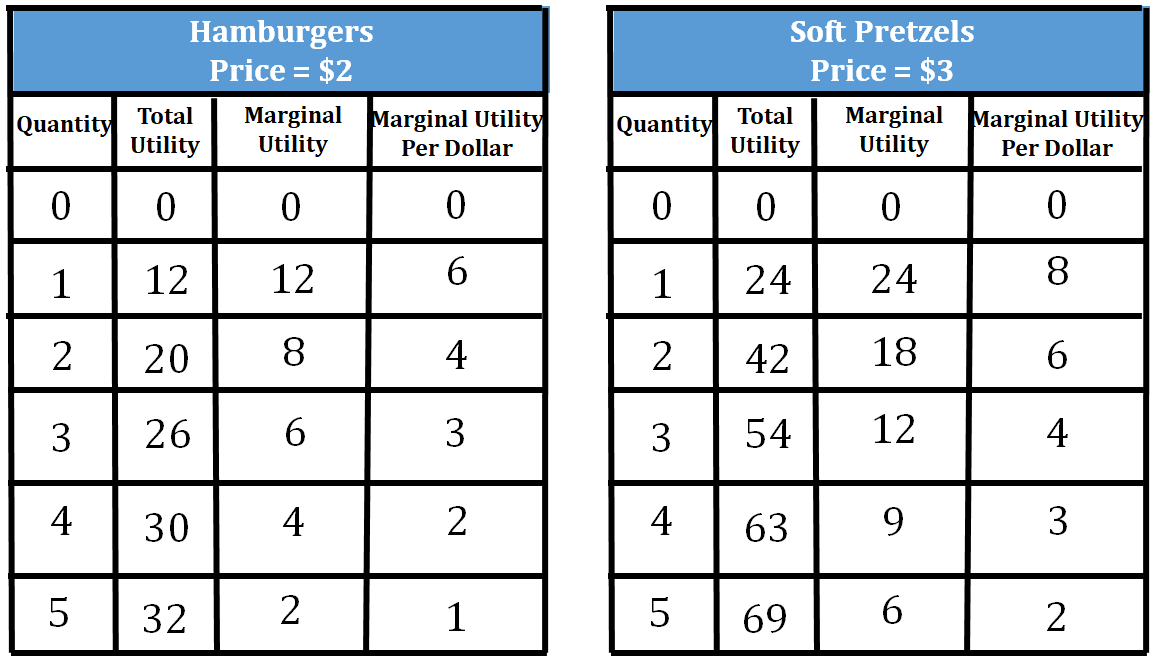
Sam has 18 dollars to spend at a county fair on hamburgers and soft pretzels, and you are given the MU/P values for each.
- He first buys one soft pretzel because its MU/P is 8 versus 6 for a hamburger. Budget left: 15 dollars.
- Next he buys a second soft pretzel (MU/P = 6) and a first hamburger (MU/P = 6). Budget left: 10 dollars.
- Then he buys a second hamburger (MU/P = 4) and a third soft pretzel (MU/P = 4). Budget left: 5 dollars.
- Finally he buys a third hamburger (MU/P = 3) and a fourth soft pretzel (MU/P = 3), spending the rest.
The answer is 3 hamburgers and 4 soft pretzels. At that point the MU/P of the last hamburger equals the MU/P of the last soft pretzel (3 = 3), and the full 18 dollars is spent.
Worked Example: pencils and composition books

Heather has 21 dollars for packs of pencils and composition books.
- She buys one composition book first (MU/P = 7 versus 6 for pencils). Budget left: 17 dollars.
- She buys a first pack of pencils (MU/P = 6) instead of a second composition book (MU/P = 5), since 6 > 5. Budget left: 14 dollars.
- She buys a second pack of pencils (MU/P = 5) and a second composition book (MU/P = 5). Budget left: 7 dollars.
- She buys a third pack of pencils (MU/P = 4) and a third composition book (MU/P = 4), spending the rest.
The answer is 3 packs of pencils and 3 composition books, where the last-unit MU/P values are equal (4 = 4) and the budget is fully used.
MCQ
Sometimes a question gives you only the MU and price of the last unit each consumer bought and asks whether the combination was optimal.
Example: Donna spent her whole budget on popcorn buckets and large sodas. The last large soda had MU = 18 at a price of 3 dollars (MU/P = 6), and the last popcorn bucket had MU = 25 at a price of 5 dollars (MU/P = 5). To maximize utility, Donna should have bought more large sodas and fewer popcorn buckets, because 6 > 5.
The shortcut: if the MU/P values are not equal, buy more of the higher-ratio good and less of the lower-ratio good until they match.
Common Misconceptions
- Misconception: Raw MU should be compared instead of MU/P.Actually: A good with high marginal utility can still be a poor choice if it is expensive. Always divide by price first.
- Misconception: Utility is maximized when MU is equal.Actually: The rule equates MU per dollar (MUx/Px = MUy/Py), not MU by itself.
- Misconception: The budget does not need to be considered.Actually: The optimal bundle must satisfy both the MU/P equality and spend all available income, not just one of those conditions.
- Misconception: Sunk costs should drive decisions.Actually: Money already spent should not influence what you buy next; only future marginal benefit and marginal cost matter.
- Misconception: MB = MC means costs are bad or low.Actually: MB = MC just identifies the quantity where total net benefit is highest, not where cost is minimized.
- Misconception: Marginal utility can never be negative.Actually: Past a point, an extra unit can lower total utility, which means marginal utility has turned negative.
Related AP Microeconomics Guides
Practice Questions for 1.6
1 of 10
The graph above shows the various combinations of Good X and Good Y a consumer can purchase with a fixed income.
Which economic concept does the solid line represent?
A.
Budget constraint
B.
Supply curve
C.
Demand curve
D.
Indifference curve
E.
Production possibilities curve
Vocabulary
The following words are mentioned explicitly in the AP® course framework for this topic.Term | Definition |
|---|---|
constraints | Limitations that restrict economic agents' choices, such as income, time, legal frameworks, or regulatory requirements. |
consumer choice theory | A model that explains how consumers make decisions to maximize satisfaction given their constraints and preferences. |
diminishing marginal utility | The principle that as a consumer consumes more of a good, the additional satisfaction gained from each additional unit decreases. |
fixed costs | Costs that do not change regardless of the level of output produced, such as rent or equipment purchases. |
limited income | The finite amount of money a consumer has available to spend on goods and services. |
marginal analysis | A method of comparing the additional benefits of increasing an activity with the additional costs to determine optimal decision-making. |
marginal benefits | The additional benefit or satisfaction gained from consuming or producing one more unit of a good. |
marginal costs | The additional cost incurred from producing one more unit of output. |
marginal utility | The additional satisfaction gained from consuming one more unit of a good or service. |
marginal utility per dollar | The additional satisfaction gained from spending one more dollar on a good, calculated as marginal utility divided by price. |
optimal decisions | Choices that best satisfy a consumer's goals given their constraints and available options. |
optimal quantity | The level of consumption or production that maximizes total benefit or occurs when marginal benefit equals marginal cost. |
rational consumer choice | A model assuming consumers make decisions systematically to maximize their satisfaction or utility. |
sunk costs | Costs that have already been incurred in the past and cannot be recovered, which should not influence current optimal decisions. |
total benefit | The overall satisfaction or gain received from consuming or producing a given quantity of a good or service. |
total utility | The total satisfaction or well-being a consumer receives from consuming a combination of goods and services. |
Frequently Asked Questions
What is marginal analysis in AP Microeconomics?
Marginal analysis compares the additional benefit of one more unit of an activity with the additional cost. Rational consumers and firms use MB and MC to decide whether to do more, do less, or stay at the current level.
What is consumer choice theory?
Consumer choice theory models consumers as rational decision makers who maximize total utility while facing limited income and prices. Consumers choose the combination of goods that gives the most satisfaction within the budget constraint.
Why do AP Micro students compare marginal utility per dollar?
You compare marginal utility per dollar because goods have different prices. MU/P shows how much extra satisfaction each dollar buys, making it possible to compare different goods fairly.
What is the utility-maximizing rule?
For two goods, the utility-maximizing rule is MUx/Px = MUy/Py with all income spent, or as close as the available choices allow. If one good has a higher MU/P, the consumer should shift spending toward that good.
Are indifference curves tested in AP Micro Topic 1.6?
No. Indifference curves are outside the AP Microeconomics course and exam scope. Equating the ratios of marginal utility to price is within scope.
What is a common mistake on marginal analysis questions?
A common mistake is comparing raw marginal utility instead of marginal utility per dollar. Another is letting sunk costs affect the decision, even though only future marginal benefits and marginal costs matter.
See Fiveable more often in Google
Mark Fiveable as a preferred source and Google is more likely to show you our guides in Top Stories, with a "preferred" badge in AI Mode and AI Overviews.