2.4 Price Elasticity of Supply

🤑AP Microeconomics Unit 2 Review
2.4 Price Elasticity of Supply
🤑 AP Microeconomics
Supply and Demand
Determinants of Supply and Demand
2.1
Demand
2.2
Supply
2.3
Price Elasticity of Demand
2.4
Price Elasticity of Supply
2.5
Other Elasticities
2.6
Market Equilibrium and Consumer and Producer Surplus
2.7
Market Disequilibrium and Changes in Equilibrium
2.8
The Effects of Government Intervention in Markets
2.9
International Trade and Public Policy
Price elasticity of supply (PES) measures how much the quantity supplied responds to a change in price. You find it by dividing the percentage change in quantity supplied by the percentage change in price, and the size of that number tells you whether supply is elastic, inelastic, or unit elastic.
Why This Matters for the AP Microeconomics Exam
Price elasticity of supply shows up whenever you need to explain how strongly producers react to price signals. On the AP Microeconomics exam, you may be asked to calculate elasticity from a graph or table, interpret what the number means, and explain why supply is more or less responsive in a given situation.
This concept also connects to later topics. When you analyze who pays more of a tax (tax incidence) or how market shocks change price and quantity, the relative elasticity of supply and demand decides the outcome. Getting comfortable with PES now makes those later problems much easier.
Key Takeaways
- PES = percentage change in quantity supplied divided by percentage change in price.
- A magnitude greater than 1 is elastic, less than 1 is inelastic, and exactly 1 is unit elastic.
- Slope and elasticity are not the same thing, so do not assume a steeper curve always means inelastic.
- Supply elasticity depends on factors like the price of alternative inputs and how quickly producers can change output.
- Supply is usually more elastic in the long run because firms have more time to adjust.
- Use percentage changes, not raw changes in quantity and price, or your answer will be wrong.
What Price Elasticity of Supply Measures
Price elasticity of supply describes how sensitive producers are to a change in the price of their good. If a small price increase causes producers to ramp up output a lot, supply is elastic. If output barely changes when price moves, supply is inelastic.
Here is a quick comparison. Suppose two firms make headphones, and at $50 per pair both produce 10 units. The price rises to $75. Firm A increases output to 12 units, while Firm B increases output to 20 units. Firm B is more price elastic because its quantity supplied responds much more strongly to the same price change.
Calculating Price Elasticity of Supply
The formula uses percentage changes, just like price elasticity of demand:
Es = %ΔQs / %ΔP
Here Es is the price elasticity of supply coefficient, and %Δ means "percent change in."
Using Firm B from above:
</>CodeQs1 = 10 Qs2 = 20 %ΔQs = (20 - 10) / 10 * 100 = 100% increase P1 = 50 P2 = 75 %ΔP = (75 - 50) / 50 * 100 = 50% increase Es = 100 / 50 = 2
A 50% increase in price led to a 100% increase in quantity supplied. Since the percentage change in quantity is larger than the percentage change in price, supply is elastic here.
When the AP exam gives you two points along a curve and the direction of change matters, you can also use the midpoint (arc) method, which divides each change by the average of the two values instead of the starting value. This gives the same answer whether price rises or falls.
Ranges of Supply Elasticity
The benchmark for elasticity is a magnitude of 1, where the percentage change in price and the percentage change in quantity supplied are proportional.
Perfectly Inelastic Supply (Es = 0)
Quantity supplied does not change at all when price changes. The supply curve is vertical. This fits goods that cannot be produced more quickly in the moment, like seats in a stadium during a single event.
Inelastic Supply (Es < 1)
Quantity supplied changes, but by a smaller percentage than price. A firm with large fixed inputs, like a factory running near capacity, can raise output only a little when price rises.
Unit Elastic Supply (Es = 1)
The percentage change in quantity supplied equals the percentage change in price. They move proportionally.
Elastic Supply (Es > 1)
Quantity supplied changes by a larger percentage than price. This fits producers who can quickly scale up, often because inputs are cheap and easy to get.
Perfectly Elastic Supply (Es = ∞)
Producers will supply any quantity at one specific price but nothing above it. The supply curve is horizontal.
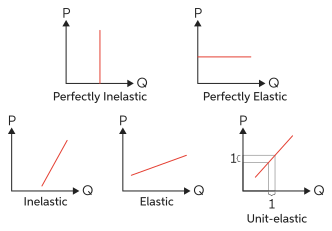
What Affects Supply Elasticity
A few factors decide how responsive producers can be:
- Price of alternative inputs. If the inputs a firm needs can be shifted to or from other uses easily, supply tends to be more elastic.
- Time for production to adjust. Over a longer period, firms can hire, build, or change methods, so supply is usually more elastic in the long run than the short run.
- Spare capacity and inventories. Firms with unused capacity or stockpiled goods can respond faster to price changes.
- Mobility of inputs. The easier it is to move workers and resources into producing the good, the more elastic supply becomes.
How to Use This on the AP Microeconomics Exam
Problem Solving
- Always set up the formula as percentage change in quantity over percentage change in price. Do not divide raw quantity change by raw price change.
- Show your work step by step. Calculate each percentage change first, then divide.
- Use the magnitude of the result to label supply as elastic, inelastic, or unit elastic, and state what that means in words.
Free Response
- When a question asks you to explain elasticity, connect the number to producer behavior. For example, "Es is greater than 1, so a price increase causes a larger percentage increase in quantity supplied."
- If a graph is required, label your axes (Price and Quantity) and your supply curve clearly. Vertical means perfectly inelastic, horizontal means perfectly elastic.
- When asked about the long run, explain that more time lets firms adjust inputs, making supply more elastic.
Common Trap
- Slope is not elasticity. A straight supply line can have different elasticity values at different points, and elasticity depends on percentage changes, not just steepness.
Common Misconceptions
- Misconception: A steeper supply curve is always inelastic.Actually: Steepness reflects slope, not elasticity. Elasticity is based on percentage changes, so the same curve can show different elasticity values.
- Misconception: PES uses the change in quantity divided by the change in price.Actually: It uses the percentage change in each, not the raw numbers.
- Misconception: Supply elasticity is fixed for a good.Actually: It changes with time and conditions. The same good is usually more elastic in the long run because producers have more time to adjust.
- Misconception: Perfectly elastic means infinite quantity at any price.Actually: It means producers supply any amount at one specific price and nothing if price drops below it.
- Misconception: A negative answer is possible for supply elasticity.Actually: Because price and quantity supplied move in the same direction, PES is normally positive.
Related AP Microeconomics Guides
Practice Questions for 2.4
1 of 10
The graph above shows the supply curve for a product.
Based on the graph, what is the price elasticity of supply when the price increases from $10 to $12?
A.
1.0
B.
2.5
C.
0.1
D.
10.0
E.
0.4
Vocabulary
The following words are mentioned explicitly in the AP® course framework for this topic.Term | Definition |
|---|---|
alternative inputs | Substitute factors of production that can be used in place of other inputs in the production process, affecting the elasticity of supply. |
elastic supply | A supply condition where the magnitude of price elasticity of supply is greater than 1, indicating that quantity supplied is highly responsive to price changes. |
elasticity | A measure of the responsiveness of quantity demanded or supplied to changes in price or other economic variables. |
inelastic supply | A supply condition where the magnitude of price elasticity of supply is less than 1, indicating that quantity supplied is not very responsive to price changes. |
measures of elasticity | Quantitative calculations used to determine the degree of responsiveness of economic variables to changes in factors such as price, income, or other determinants. |
percentage change in price | The proportional change in price from one level to another, expressed as a percentage. |
percentage change in quantity supplied | The proportional change in the amount supplied from one level to another, expressed as a percentage. |
price change | A shift in the market price of a good or service that affects consumer and producer behavior. |
price elasticity of supply | A measure of the responsiveness of quantity supplied to changes in price, calculated as the percentage change in quantity supplied divided by the percentage change in price. |
quantity supplied | The amount of a good or service that producers are willing and able to offer for sale at a specific price. |
total expenditure | The total amount consumers spend on a good or service, calculated as price multiplied by quantity purchased. |
total revenue | The total income a firm receives from selling its goods or services, calculated as price multiplied by quantity sold. |
unit elastic supply | A supply condition where the magnitude of price elasticity of supply equals 1, indicating that the percentage change in quantity supplied equals the percentage change in price. |
Frequently Asked Questions
What is price elasticity of supply?
Price elasticity of supply measures how responsive quantity supplied is to a change in price. In AP Microeconomics, PES is calculated as percentage change in quantity supplied divided by percentage change in price.
What is the price elasticity of supply formula?
The price elasticity of supply formula is PES = percentage change in quantity supplied / percentage change in price. If a graph or table gives two points, calculate the percentage change in quantity supplied and the percentage change in price before dividing.
What does elastic supply mean?
Supply is elastic when PES is greater than 1. That means quantity supplied changes by a larger percentage than price. Elastic supply usually happens when producers can adjust output quickly or shift inputs easily.
What does inelastic supply mean?
Supply is inelastic when PES is less than 1. That means quantity supplied changes by a smaller percentage than price. Inelastic supply often happens when producers face capacity limits, scarce inputs, or short-run production constraints.
What factors affect price elasticity of supply?
Price elasticity of supply depends on the availability of inputs, time to adjust production, spare capacity, inventories, and how easily resources can move into producing the good. Supply is usually more elastic in the long run because firms have more time to respond.
How does price elasticity of supply show up on the AP Micro exam?
AP Micro questions may ask you to calculate PES from data, identify elastic or inelastic ranges, interpret a supply graph, or explain how producer constraints affect responsiveness. Always use percentage changes and explain the number in terms of quantity supplied responding to price.
See Fiveable more often in Google
Mark Fiveable as a preferred source and Google is more likely to show you our guides in Top Stories, with a "preferred" badge in AI Mode and AI Overviews.