3.1 The Production Function

🤑AP Microeconomics Unit 3 Review
3.1 The Production Function
🤑 AP Microeconomics
The production function shows how a firm turns inputs like labor and capital into output. In the short run at least one input is fixed, so adding more of a variable input eventually triggers diminishing marginal returns, while in the long run every input can change.
Production Function Summary
The production function explains the relationship between inputs and output in the short run and long run. In the short run, at least one input is fixed, so adding more of a variable input changes total product, marginal product, and average product.
For AP Microeconomics, the most important pattern is diminishing marginal returns: as a firm adds more of one input while holding other inputs constant, marginal product eventually falls. Returns to scale is different because it describes what happens in the long run when all inputs change together.
Why This Matters for the AP Microeconomics Exam
Unit 3 is one of the most heavily weighted parts of AP Microeconomics, and the production function is where it all starts. Once you can read a production table and explain how marginal product drives total product, the cost curves in later topics make much more sense.
On the exam you will likely:
- Define inputs, outputs, total product, marginal product, and average product, often with a graph or table.
- Explain how production and cost connect in the short run versus the long run.
- Calculate marginal product and average product from data in a table or graph.
These are exactly the skills that show up in multiple-choice questions and in the explanation parts of free-response questions, so getting comfortable here pays off across the whole unit.
Key Takeaways
- The production function links inputs to output. Short run means at least one input is fixed; long run means all inputs are variable.
- Marginal product (MP) is the extra output from one more unit of a variable input. Average product (AP) is total output divided by the number of input units.
- The law of diminishing marginal returns says that as you add more of one input while holding others constant, MP eventually falls.
- When MP is rising, total product rises faster; when MP falls but stays positive, total product still rises but more slowly; when MP turns negative, total product falls.
- Returns to scale describe long-run output changes when all inputs scale together: increasing, constant, or decreasing.
What Is the Production Function?
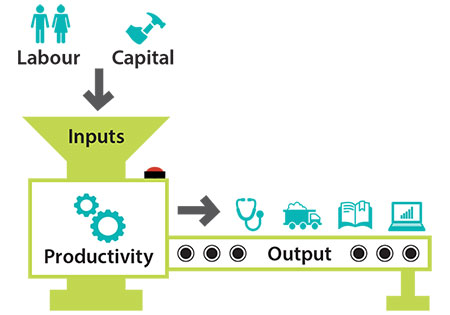
In AP Microeconomics, production is the process of turning inputs into output. An input, also called a factor of production, is any resource a firm uses to make its product. The common factors are land, labor, and capital, but the exact inputs depend on the firm. A pizza shop, for example, uses flour, yeast, tomatoes, workers, and an oven to produce pizzas.
The production function describes the relationship between those inputs and the output a firm can make. It works in two time frames:
- Short run: at least one input is fixed (often capital, like the size of the building or number of ovens). The firm can only change variable inputs, usually labor.
- Long run: every input is variable. The firm can change its workers, its equipment, and its facility size.
This short run versus long run distinction matters a lot, because diminishing marginal returns is a short-run idea, while returns to scale is a long-run idea. Keep them separate.
Inputs, Fixed and Variable
A fixed input does not change with output in the short run, like the building a firm rents. A variable input does change with output, like the number of workers or the amount of flour. In the long run there are no fixed inputs, because the firm has time to adjust everything.
Measuring Productivity
There are three main ways to measure how much a firm produces from its inputs.
Total product (TP) is the total amount of output produced with a given set of inputs. It is the simplest measure: with some inputs, you get some total output.
Average product (AP) is total product divided by the number of units of an input. If 2 workers produce 50 units, average product is 25 units per worker.
Marginal product (MP) is the extra output from adding one more unit of a variable input. If 2 workers produce 50 units and 3 workers produce 60, the marginal product of the third worker is 10 units. Marginal product is useful because it tells you how much each added input is actually contributing.
How TP, MP, and AP Move Together

These three measures are connected, and the exam often tests whether you can describe the relationship:
- When marginal product is rising, total product is increasing at an increasing rate (the TP curve gets steeper).
- When marginal product is falling but still positive, total product is still increasing, just at a slower rate (the TP curve flattens).
- When marginal product hits zero, total product is at its maximum.
- When marginal product turns negative, total product is decreasing.
The Law of Diminishing Marginal Returns

The law of diminishing marginal returns says that as a firm adds more of one variable input while holding other inputs constant, the marginal product of that input eventually decreases. This is a short-run idea because it depends on at least one input being fixed.
A firm can see increasing marginal returns at first, where each new input adds more output than the last. But eventually it reaches a point where each new input adds less, and marginal product falls.
Here is how that plays out for a pizza shop hiring workers:
- 1st worker: output goes to 10 pizzas, so MP = 10.
- 2nd worker: output goes to 25 pizzas, so MP = 15 (increasing marginal returns).
- 3rd worker: output goes to 30 pizzas, so MP = 5 (diminishing marginal returns).
- 4th worker: output stays at 30 pizzas, so MP = 0.
- 5th worker: the space is so crowded output drops to 25 pizzas, so MP = -5 (negative marginal returns).
Notice that total product keeps rising until MP hits zero, then falls once MP turns negative. The cause is the fixed input: more and more workers are sharing the same fixed space and equipment, so each added worker eventually contributes less.
Returns to Scale
Returns to scale is a long-run idea, because it looks at what happens when a firm changes all of its inputs at the same time. The question is how output responds when every input is scaled up together.
- Increasing returns to scale: output more than doubles when all inputs double.
- Constant returns to scale: output exactly doubles when all inputs double.
- Decreasing returns to scale: output less than doubles when all inputs double.
Do not confuse this with diminishing marginal returns. Diminishing marginal returns changes only one input while holding others fixed (short run). Returns to scale changes all inputs together (long run).
How to Use This on the AP Microeconomics Exam
Problem Solving
Most production function questions hand you a table of inputs and outputs. Practice these steps:
- To find marginal product, take the change in total product and divide by the change in the variable input (usually a change of one worker).
- To find average product, divide total product by the number of input units.
- Track where MP starts to fall. That is the onset of diminishing marginal returns, even if total product is still rising.
- Remember that total product is at its maximum exactly where MP equals zero.
Free Response
When a free-response question asks you to explain, do not just state a number. Say what is happening and why. For example: "Marginal product falls after the third worker because the firm's capital is fixed in the short run, so each additional worker has less equipment to work with." Tying the result back to a fixed input shows the reasoning graders want.
Common Trap
Watch your wording on short run versus long run. If a prompt fixes one input and changes another, the relevant idea is diminishing marginal returns, not returns to scale. If all inputs change together, it is returns to scale. Mixing these up is one of the easiest ways to lose points.
Common Misconceptions
- Misconception: Diminishing marginal returns means output is falling.Actually: Diminishing marginal returns does not mean output is falling. When marginal product is positive but shrinking, total product is still going up, just more slowly. Output only falls once MP turns negative.
- Misconception: Diminishing marginal returns and decreasing returns to scale are the same.Actually: Diminishing marginal returns and decreasing returns to scale are not the same. The first is short run and changes one input at a time. The second is long run and changes all inputs together.
- Misconception: Average product and marginal product are the same.Actually: Average product and marginal product are different. Average product spreads total output across all input units; marginal product measures only the output added by the latest unit.
- Misconception: The short run is a set amount of time.Actually: The short run is not a set amount of time. It is defined by having at least one fixed input, not by days or months. The long run begins once every input can be adjusted.
- Misconception: More workers always means more efficiency.Actually: More workers does not always mean more efficiency. Because of diminishing marginal returns, adding workers to a fixed amount of capital eventually lowers the extra output each worker provides.
Related AP Microeconomics Guides
Practice Questions for 3.1
1 of 10
The graph above shows a firm's initial short-run cost curves.
A government imposes a $2 per-unit tax on a firm's output and gives the firm a $1,000 lump-sum subsidy. Which best describes the firm's cost-curve shifts?
A.
MC, AVC, and ATC all shift downward because the subsidy lowers total cost.
B.
MC shifts upward, while AVC and ATC both shift downward from the subsidy.
C.
ATC shifts downward at all quantities, while MC and AVC stay unchanged.
D.
MC and AVC shift upward, AFC shifts downward, and ATC may move either way.
E.
MC stays unchanged, while AVC and ATC shift upward from the tax.
Vocabulary
The following words are mentioned explicitly in the AP® course framework for this topic.Term | Definition |
|---|---|
average product | The output per unit of input, calculated by dividing total product by the quantity of input used. |
cost | The monetary expense incurred in producing goods and services, including both fixed and variable expenses. |
diminishing marginal returns | The principle that as a firm employs more of one variable input while holding other inputs constant, the marginal product of that input eventually decreases. |
long run | A time period in which all factors of production are variable, allowing firms to enter or exit markets and adjust all inputs. |
long-run costs | Production costs in the period when all factors of production are variable and can be adjusted. |
marginal product | The additional output produced by employing one more unit of a variable input, holding all other inputs constant. |
outputs | The goods or services produced by a firm using inputs. |
production | The process of creating goods and services using inputs such as labor, capital, and raw materials. |
production function | The relationship between the quantities of inputs used by a firm and the quantity of output produced, showing how output changes with different input levels in both the short run and long run. |
productivity | The output produced per unit of factor input, which influences a firm's decision to hire factors of production. |
scarce resources | Productive inputs and materials that are limited in supply relative to the demand for them, requiring allocation decisions. |
short run | A time period in which at least one factor of production is fixed, and firms can only adjust variable inputs to change output levels. |
short-run costs | Production costs in the period when at least one factor of production is fixed, including both fixed and variable costs. |
total product | The total quantity of output produced by a firm at different levels of input usage. |
Frequently Asked Questions
What is the production function in AP Microeconomics?
The production function explains the relationship between inputs and output. It shows how a firm uses resources such as labor and capital to produce goods or services in the short run and long run.
What is marginal product?
Marginal product is the extra output produced by adding one more unit of a variable input, holding other inputs constant. It is calculated as the change in total product divided by the change in the input.
What is average product?
Average product is total product divided by the number of units of an input. It shows output per unit of input, such as output per worker.
What is diminishing marginal returns?
Diminishing marginal returns occur in the short run when a firm adds more of one variable input while at least one other input is fixed, causing marginal product to eventually fall.
How are diminishing marginal returns and returns to scale different?
Diminishing marginal returns is a short-run concept because one input changes while another is fixed. Returns to scale is a long-run concept because all inputs change together.
What is a common mistake on production function questions?
A common mistake is thinking diminishing marginal returns means total product immediately falls. Total product can still rise while marginal product is positive but falling; total product falls only when marginal product becomes negative.
See Fiveable more often in Google
Mark Fiveable as a preferred source and Google is more likely to show you our guides in Top Stories, with a "preferred" badge in AI Mode and AI Overviews.