4.4 Monopolistic Competition

🤑AP Microeconomics Unit 4 Review
4.4 Monopolistic Competition
🤑 AP Microeconomics
Monopolistic competition is a market structure with many firms selling differentiated products, low barriers to entry and exit, and some price making power. Firms can earn positive, negative, or zero economic profit in the short run, but free entry and exit push economic profit to zero in the long run, leaving the firm with excess capacity and a price above marginal cost.
Monopolistic Competition Graph for AP Micro
On an AP Micro monopolistic competition graph, the firm faces a downward-sloping demand curve with marginal revenue below demand. Profit-maximizing output is where MR = MC, and price is found by moving up to the demand curve at that quantity.
In the short run, the firm can earn profit, take a loss, or break even. In the long run, entry and exit shift each firm's demand and MR until demand is tangent to ATC, so economic profit is zero. The long-run tangency happens above minimum ATC, which shows excess capacity and productive inefficiency.
Why This Matters for the AP Microeconomics Exam
Monopolistic competition sits between perfect competition and monopoly, so it shows up when the exam tests whether you can compare market structures and explain efficiency. You should be ready to draw and label the firm's short-run graph with profit or loss, show the long-run adjustment as firms enter or exit, and explain why the long-run outcome is both allocatively inefficient and productively inefficient. Questions may ask you to identify profit-maximizing output and price, mark areas like profit or loss, and reason through cause and effect when profits trigger entry.
Key Takeaways
- Many firms sell differentiated products, often using advertising and other non-price competition to stand out.
- Low barriers to entry and exit mean firms can move in and out of the market freely.
- The firm faces a downward-sloping demand curve, so marginal revenue lies below demand and the firm sets output where MR = MC.
- Short-run economic profit can be positive, negative, or zero; free entry and exit drive economic profit to zero in the long run.
- In long-run equilibrium the demand curve is tangent to ATC above minimum ATC, so the firm has excess capacity (productive inefficiency).
- Price is greater than marginal cost, which creates allocative inefficiency and deadweight loss.
What is Monopolistic Competition?
Monopolistic competition is an imperfect market structure where many firms compete by selling related but differentiated products. It borrows traits from both perfect competition and monopoly. Common real-world examples used to illustrate this structure include fast-food restaurants, clothing brands, jewelers, hair salons, and furniture stores. These are applications of the concept, not required AP content.
Characteristics of Monopolistic Competition
- Many firms of various sizes. Unlike a monopoly, the market has many competitors.
- Price makers. Each firm has some market power, so it can set price within limits instead of taking a market price.
- Low barriers to entry and exit. Like perfect competition, firms can enter or leave easily.
- Differentiated products. Each firm sells a related but distinct product. Every fast-food restaurant sells food, but the specific products differ.
- Non-price competition. Because products are differentiated, firms compete through advertising, branding, and product features rather than only price.
- Break even in the long run. Free entry and exit push economic profit to zero, so firms earn normal profit in the long run.
- Inefficient when unregulated. Like a monopoly, the outcome includes deadweight loss because price is above marginal cost.
- Excess capacity in the long run. The firm does not produce where price equals minimum ATC, so it is productively inefficient.
Characteristics Compared to Other Market Structures
Monopolistic competition shares some features with perfect competition and others with monopoly. The chart below lines up which traits resemble each structure.
| Like Perfect Competition | Like Monopoly |
|---|---|
| Many firms | Market power / firms are "price makers" |
| Low barriers to entry and exit | Demand above MR (downward-sloping demand) |
| Firms compete | Non-price competition |
| Firms break even in the long run | Allocatively and productively inefficient |
Non-Price Competition
Firms in monopolistic competition use brand names, packaging, and logos to stand out and stay recognizable. A well-known logo or a reputation for service helps a firm distinguish its product from close substitutes. These branding examples are applications, not required AP content.
Firms also compete on product attributes and services, highlighting features that set their product apart from rivals in the market.
Advertising is another key tool. Firms advertise to build demand for their product and to shape how consumers compare it to substitutes.
Graphing Monopolistic Competition
A monopolistically competitive firm can earn positive, negative, or zero economic profit in the short run, and it breaks even in the long run because of low barriers to entry and exit. The short-run graph looks a lot like a monopoly graph, with one main difference: the demand curve is more elastic because there are many close substitutes from other firms.
You find profit-maximizing output the same way as in a monopoly. Set output where MR = MC, then go up to the demand curve to read the price. Remember that the demand curve lies above marginal revenue, so price ends up greater than marginal cost.

Monopolistic Competition Earning a Profit
When the firm earns a profit, ATC sits below the price at the profit-maximizing quantity. The gap between price and ATC, multiplied by quantity, is the profit area.

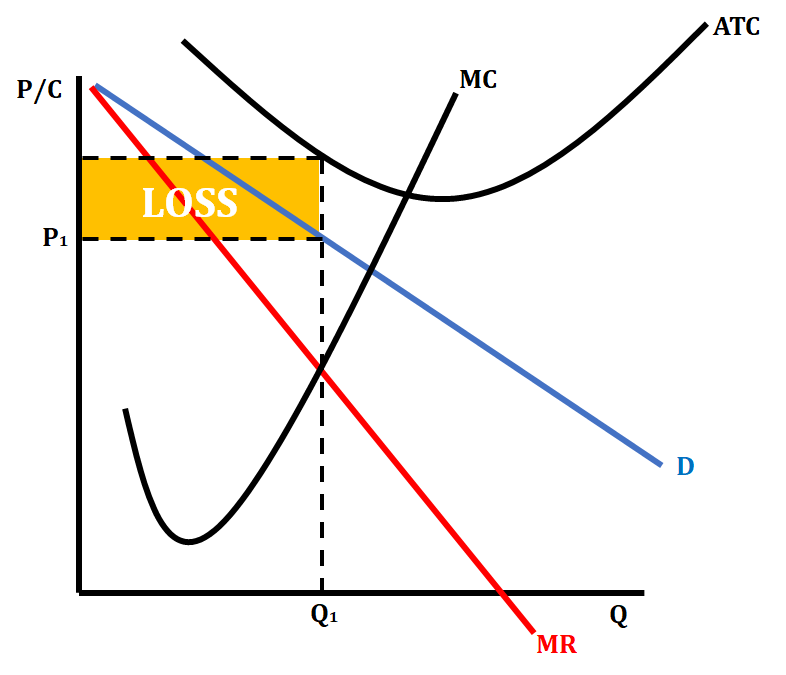
Monopolistic Competition Earning a Loss
When the firm earns a loss, ATC sits above the price at the profit-maximizing quantity. The gap between ATC and price, multiplied by quantity, is the loss area.
Monopolistic Competition in the Long Run
In long-run equilibrium, the ATC curve is tangent to the demand curve at the profit-maximizing quantity. Make sure the tangency is on the downward-sloping (economies of scale) part of ATC, not at minimum ATC. Tangency above minimum ATC is what shows the firm is productively inefficient and operating with excess capacity.

Going from Short Run to Long Run
When firms earn short-run profit, that profit attracts new firms to enter. Entry gives consumers more close substitutes and takes market share from existing firms, so each firm's demand and MR curves shift left together until demand is tangent to ATC and economic profit is zero.
When firms earn a short-run loss, some firms exit. Exit leaves fewer close substitutes and more market share for the firms that stay, so demand and MR shift right together until demand is tangent to ATC and economic profit is again zero.

This adjustment is the same logic you used in perfect competition. Firms respond to profits or losses by entering or exiting, which shifts the firm's demand and MR until economic profit returns to zero.
Excess Capacity
Excess capacity is the difference between the firm's long-run output and the output that would minimize average total cost. In long-run equilibrium, a monopolistically competitive firm produces less than the quantity at minimum ATC, so it is productively inefficient. Because price is also greater than marginal cost, the firm is allocatively inefficient too. A firm with no excess capacity would be producing at minimum ATC.

How to Use This on the AP Microeconomics Exam
Free Response
- Draw the firm's graph with demand, MR, MC, and ATC. Label profit-maximizing quantity where MR = MC and read price up on the demand curve.
- For a short-run profit, place ATC below price; for a loss, place ATC above price. Shade the correct rectangle and identify it as profit or loss.
- For the long run, draw ATC tangent to demand on the downward-sloping section, not at minimum ATC. This shows zero economic profit with excess capacity.
- When asked about the move from short run to long run, explain that profit triggers entry (demand and MR shift left) and loss triggers exit (demand and MR shift right) until economic profit is zero.
Problem Solving
- To find profit or loss, compare price to ATC at the profit-maximizing quantity, then multiply the per-unit gap by quantity.
- Identify allocative inefficiency by comparing price to marginal cost. Because price is greater than marginal cost, there is deadweight loss.
Common Trap
- Do not draw the long-run tangency at minimum ATC. That would wrongly show productive efficiency. The tangency belongs on the downward-sloping part of ATC.
Common Misconceptions
- Misconception: Monopolistic competition is a type of monopoly.Actually: It is not. The name refers to the downward-sloping demand each differentiated firm faces, but the market has many competing firms with low barriers to entry and exit.
- Misconception: Firms keep earning profit in the long run.Actually: Free entry erases economic profit. In long-run equilibrium, firms earn zero economic profit (normal profit).
- Misconception: Long-run equilibrium means the firm is efficient.Actually: It still produces below minimum ATC (excess capacity) and charges a price above marginal cost, so it is both productively and allocatively inefficient.
- Misconception: Marginal revenue equals price.Actually: Because demand slopes downward, marginal revenue lies below demand, so price is greater than marginal revenue at the profit-maximizing quantity.
- Misconception: Advertising always lowers prices.Actually: Advertising is non-price competition used to differentiate products and shape demand, not a guarantee of lower prices.
Related AP Microeconomics Guides
Practice Questions for 4.4
1 of 10
The graph above shows a monopolistically competitive firm in long-run equilibrium.
Calculate the firm's price markup over marginal cost and identify what this indicates about the market's allocative efficiency.
A.
The markup is , indicating allocative efficiency because the firm is earning zero economic profit in the long run.
B.
The markup is , indicating allocative inefficiency because the marginal benefit to consumers exceeds the marginal cost of production.
C.
The markup is $10, indicating the firm is allocatively efficient because it earns zero economic profit
D.
The markup is , indicating allocative inefficiency because the firm is producing at a quantity where average total cost is not minimized.
E.
The markup is , indicating allocative efficiency because the price equals the average total cost at the profit-maximizing quantity.
Vocabulary
The following words are mentioned explicitly in the AP® course framework for this topic.Term | Definition |
|---|---|
advertising | A marketing strategy used by firms to promote their products and create product differentiation in the minds of consumers. |
allocative inefficiency | A market condition where the price does not equal marginal cost, resulting in a suboptimal allocation of resources and deadweight loss. |
average total costs | The total cost of production divided by the quantity of output produced. |
consumer surplus | The difference between the maximum price consumers are willing to pay for a good and the actual price they pay, representing the benefit consumers receive from purchasing at market price. |
deadweight loss | The loss of economic efficiency that occurs when equilibrium is not at the socially optimal quantity, resulting in reduced total surplus. |
differentiated products | Goods that are perceived as distinct from competitors' products due to differences in quality, features, branding, or other characteristics. |
economic profit | The difference between total revenue and total economic cost, including both explicit and implicit costs. |
equilibrium | The market condition where the quantity supplied equals the quantity demanded, resulting in a stable price with no tendency to change. |
excess capacity | The situation where a firm produces at a level below the output that minimizes average total costs, leaving productive capacity unused. |
firm decision making | The process by which firms determine production levels and pricing strategies to maximize profit or minimize losses. |
free entry and exit | The ability of firms to enter or leave a market without significant barriers or restrictions. |
imperfectly competitive markets | Markets where individual firms have some degree of market power and can influence prices, including monopolistic competition, oligopoly, and monopoly. |
marginal costs | The additional cost incurred from producing one more unit of output. |
monopolistic competition | A market structure with many firms producing differentiated products, free entry and exit, and some degree of market power. |
producer surplus | The difference between the actual price received by a producer and the minimum price at which they are willing to supply a good, representing the benefit producers receive from selling at market price. |
profit | The difference between total revenue and total cost, representing the financial gain or loss from economic activity. |
Frequently Asked Questions
What is monopolistic competition in AP Micro?
Monopolistic competition is an imperfect market structure with many firms, differentiated products, low barriers to entry and exit, and some price-making power. Firms can earn profit or take losses in the short run, but entry and exit push economic profit to zero in the long run.
How do you draw a monopolistic competition graph?
Draw downward-sloping demand with marginal revenue below it, then add MC and ATC. Set output where MR = MC, move up to demand to find price, and compare price with ATC at that quantity to show profit, loss, or zero economic profit.
Where is profit-maximizing output in monopolistic competition?
Profit-maximizing output is where marginal revenue equals marginal cost, or MR = MC. The price is not read from MC; it is found by moving up from that quantity to the demand curve.
What happens in the long run in monopolistic competition?
In the long run, free entry and exit shift each firm's demand and MR curves until demand is tangent to ATC. At that point, the firm earns zero economic profit but still produces with excess capacity.
Why does monopolistic competition have excess capacity?
Excess capacity exists because the long-run output is smaller than the quantity that would minimize ATC. The firm produces on the downward-sloping part of ATC, so it is not productively efficient.
Is monopolistic competition allocatively efficient?
No. A monopolistically competitive firm charges a price greater than marginal cost, so the output level is allocatively inefficient and creates deadweight loss.
See Fiveable more often in Google
Mark Fiveable as a preferred source and Google is more likely to show you our guides in Top Stories, with a "preferred" badge in AI Mode and AI Overviews.