← back to ap microeconomics

ap microeconomics unit 2 study guides

supply and demand

unit 2 review

Supply and demand form the backbone of microeconomics, explaining how markets determine prices and quantities of goods and services. This unit explores the forces that shape market outcomes, including consumer preferences, production costs, and external factors. Students will learn about market equilibrium, elasticity, and the effects of price controls. Understanding these concepts is crucial for analyzing real-world economic issues and making informed decisions as consumers, producers, and policymakers.

Key Concepts

  • Supply represents the quantity of a good or service that producers are willing and able to offer at various prices
  • Demand represents the quantity of a good or service that consumers are willing and able to purchase at various prices
  • Market equilibrium occurs when the quantity supplied equals the quantity demanded, resulting in a stable price
  • Elasticity measures the responsiveness of supply or demand to changes in price or other factors (income, prices of related goods)
  • Price controls, such as price ceilings and price floors, can distort market outcomes and lead to shortages or surpluses
  • Shifts in supply or demand curves occur when factors other than price change, causing the entire curve to move
  • Movements along supply or demand curves happen when only the price changes, leading to a change in quantity supplied or demanded

Supply and Demand Curves

  • Supply curves are typically upward-sloping, indicating that as price increases, producers are willing to supply more of a good or service
    • This relationship is known as the law of supply
    • Higher prices incentivize producers to increase production to maximize profits
  • Demand curves are typically downward-sloping, indicating that as price increases, consumers are willing to purchase less of a good or service
    • This relationship is known as the law of demand
    • Higher prices reduce the affordability of goods and services, leading to lower quantity demanded
  • The slope of the supply or demand curve represents the elasticity of supply or demand
    • Steeper curves indicate less elastic (more inelastic) supply or demand
    • Flatter curves indicate more elastic supply or demand
  • Factors that can shift the supply curve include changes in input prices, technology, expectations, and the number of sellers
  • Factors that can shift the demand curve include changes in income, preferences, expectations, and the prices of related goods (substitutes or complements)

Market Equilibrium

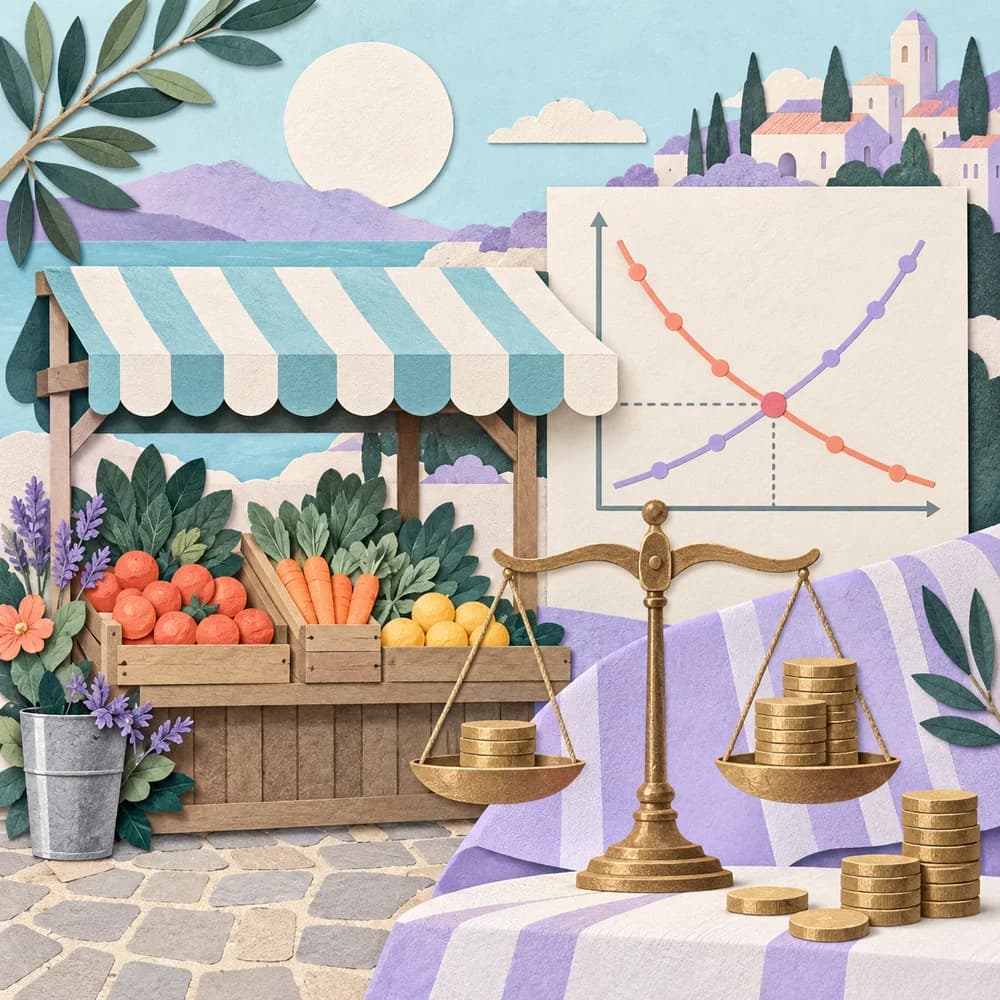
  • Market equilibrium is the point where the supply and demand curves intersect, determining the equilibrium price and quantity
  • At equilibrium, there is no shortage or surplus, and there is no tendency for price or quantity to change
  • The equilibrium price is the price at which the quantity supplied equals the quantity demanded
  • The equilibrium quantity is the quantity bought and sold at the equilibrium price
  • If the market price is above the equilibrium price, a surplus will occur, putting downward pressure on the price
  • If the market price is below the equilibrium price, a shortage will occur, putting upward pressure on the price
  • Changes in supply or demand can lead to a new equilibrium price and quantity

Shifts vs. Movements

  • A shift in the supply or demand curve occurs when a factor other than price changes, causing the entire curve to move to a new position
    • For example, an increase in consumer income may shift the demand curve to the right, indicating a higher quantity demanded at every price level
  • A movement along the supply or demand curve happens when only the price changes, leading to a change in the quantity supplied or demanded
    • For example, a decrease in the price of a good will lead to a movement along the demand curve to a higher quantity demanded
  • It is essential to distinguish between shifts and movements to accurately analyze changes in market conditions
  • Shifts in supply or demand can lead to new equilibrium prices and quantities, while movements along the curves do not change the equilibrium

Elasticity

  • Elasticity measures the responsiveness of supply or demand to changes in price or other factors
  • Price elasticity of demand (PED) measures the percentage change in quantity demanded in response to a percentage change in price
    • Elastic demand (PED > 1) indicates that quantity demanded is highly responsive to price changes
    • Inelastic demand (PED < 1) indicates that quantity demanded is less responsive to price changes
    • Unit elastic demand (PED = 1) indicates that the percentage change in quantity demanded equals the percentage change in price
  • Price elasticity of supply (PES) measures the percentage change in quantity supplied in response to a percentage change in price
    • Elastic supply (PES > 1) indicates that quantity supplied is highly responsive to price changes
    • Inelastic supply (PES < 1) indicates that quantity supplied is less responsive to price changes
  • Income elasticity of demand measures the responsiveness of demand to changes in consumer income
  • Cross-price elasticity of demand measures the responsiveness of demand for one good to changes in the price of another good (substitute or complement)

Price Controls and Market Interventions

  • Price controls are government-imposed restrictions on the prices that can be charged in a market
  • A price ceiling is a legal maximum price that can be charged for a good or service
    • If the price ceiling is set below the equilibrium price, it will lead to a shortage (quantity demanded > quantity supplied)
    • Examples of price ceilings include rent controls and maximum prices for essential goods during emergencies
  • A price floor is a legal minimum price that can be charged for a good or service
    • If the price floor is set above the equilibrium price, it will lead to a surplus (quantity supplied > quantity demanded)
    • Examples of price floors include minimum wages and agricultural price supports
  • Taxes and subsidies can also affect market outcomes
    • A tax increases the cost of production, shifting the supply curve to the left and leading to a higher equilibrium price and lower equilibrium quantity
    • A subsidy reduces the cost of production, shifting the supply curve to the right and leading to a lower equilibrium price and higher equilibrium quantity

Real-World Applications

  • Understanding supply and demand is crucial for businesses when making production and pricing decisions
    • Firms must consider the elasticity of demand for their products to optimize revenue and profits
    • Changes in market conditions, such as shifts in consumer preferences or input prices, require firms to adapt their strategies
  • Policymakers use the principles of supply and demand to analyze the potential impacts of regulations, taxes, and subsidies on markets
    • For example, assessing the effects of a minimum wage increase on employment and prices in the labor market
    • Evaluating the efficiency and distributional consequences of price controls or other market interventions
  • Consumers can make more informed purchasing decisions by understanding how prices are determined by the interaction of supply and demand
    • Anticipating how changes in market conditions may affect the availability and prices of goods and services
    • Considering the elasticity of demand when making budgeting and consumption choices

Common Mistakes to Avoid

  • Confusing shifts in supply or demand with movements along the curves
    • Remember that shifts are caused by factors other than price, while movements are caused by price changes alone
  • Misinterpreting the effects of price controls
    • Price ceilings lead to shortages, not surpluses, and price floors lead to surpluses, not shortages
  • Ignoring the role of elasticity in determining the magnitude of changes in price and quantity
    • More elastic supply or demand will result in larger changes in quantity and smaller changes in price compared to less elastic supply or demand
  • Failing to account for the indirect effects of market interventions, such as taxes or subsidies
    • Consider how these interventions may affect incentives, resource allocation, and market efficiency
  • Assuming that all markets operate identically
    • Different goods and services may have unique supply and demand characteristics, such as the degree of competition, the availability of substitutes, or the presence of externalities

Frequently Asked Questions

What topics are covered in AP Microeconomics Unit 2 (Supply and Demand)?

Unit 2 (Supply and Demand) covers topics 2.1–2.9 — the full unit is on Fiveable’s site (https://library.fiveable.me/ap-micro/unit-2). You’ll study demand and supply: laws, shifts, and determinants. Then price elasticity of demand and supply. Other elasticities: income and cross-price. Market equilibrium and consumer/producer surplus follow. You’ll also learn disequilibrium and how equilibrium changes. Government intervention includes price controls, taxes, subsidies, and deadweight loss. Finally, international trade topics like tariffs and quotas appear. The unit counts for about 20–25% of the exam and emphasizes graphing, elasticity calculations, and area work for surplus and deadweight loss. Practice drawing labeled graphs and doing percent-change elasticity problems. For focused review, try Fiveable’s unit guide (https://library.fiveable.me/ap-micro/unit-2), 1,000+ practice questions (https://library.fiveable.me/practice/micro), plus cheatsheets and cram videos.

How much of the AP Micro exam is Unit 2 (Supply and Demand)?

You’ll see about 20–25% of the AP Microeconomics exam come from Unit 2 (Supply and Demand). The unit usually takes roughly 13–15 class periods and covers demand, supply, price elasticity (demand & supply), other elasticities, market equilibrium, consumer/producer surplus, changes in equilibrium, and government intervention. Because it’s a big chunk of the exam, get comfortable with graphing shifts, calculating elasticities, and interpreting surplus and policy impacts. See Fiveable’s Unit 2 study guide at https://library.fiveable.me/ap-micro/unit-2. For targeted practice and quick review, Fiveable also has 1,000+ practice questions at https://library.fiveable.me/practice/micro and cheatsheets/cram videos for Unit 2.

What's the hardest part of AP Micro Unit 2?

Students usually find price elasticity and its link to graphs and tax incidence the toughest part (see the unit overview at https://library.fiveable.me/ap-micro/unit-2). Calculating different elasticities — price, cross-price, and income — plus choosing arc vs. point formulas trips people up. Interpreting what elasticity values mean for total revenue is another sticky spot. Graph skills are challenging too: predicting equilibrium shifts, redrawing consumer/producer surplus, and showing how taxes or subsidies split burdens between buyers and sellers. The best fix is mixed practice: algebraic elasticity problems and graph-based scenarios together. For clear walkthroughs and practice, check Fiveable’s Unit 2 guides, cheatsheets, and practice questions (https://library.fiveable.me/practice/micro).

How should I study Unit 2 for AP Microeconomics (best review strategies and resources)?

Start with the Unit 2 study guide (https://library.fiveable.me/ap-micro/unit-2). It covers demand, supply, elasticities, equilibrium, surplus, disequilibrium, and government intervention (CED topics 2.1–2.9). Focus on: (1) sketching and labeling supply/demand shifts and calculating new equilibrium price/quantity. (2) Practicing elasticity formulas (PED, PES, cross, income) and interpreting coefficients. (3) Doing lots of graph-based FRQs and MCQs under time pressure. (4) Memorizing key relationships: inelastic vs. elastic revenue effects, surplus, and deadweight loss. (5) Making a one-page cheatsheet of formulas and common shift scenarios. Use targeted practice (https://library.fiveable.me/practice/micro) for question banks, watch Fiveable cram videos for quick refreshers, and time yourself on past FRQs until graphs and calculations feel automatic.

Where can I find AP Micro Unit 2 notes, worksheets, or a PDF?

You can find AP Micro Unit 2 notes and study materials on Fiveable’s Unit 2 page (https://library.fiveable.me/ap-micro/unit-2). That page has a full unit study guide covering Supply and Demand (topics 2.1–2.9), plus cheatsheets and cram videos handy for quick review. Fiveable also offers 1,000+ practice questions (https://library.fiveable.me/practice/micro) if you want application problems. For official course framing and exam weight (20–25%), check the College Board’s Unit 2 CED on Supply and Demand — it lists elasticity, equilibrium, consumer/producer surplus, and government intervention. Use the Fiveable unit link for downloadable notes and structured worksheets, and the practice page to drill problems tied to Unit 2 concepts.

Are there Unit 2 FRQs for AP Microeconomics and where can I practice them?

Yes — the College Board posts past free-response questions with scoring guidelines and sample responses, which is perfect for practicing timing and seeing how graders score answers (https://apcentral.collegeboard.org/courses/ap-microeconomics/exam/past-exam-questions). Unit 2 (Supply & Demand) topics to focus on include elasticity, equilibrium changes, consumer and producer surplus, and government interventions. For varied practice, use a unit study guide and mixed-question sets so you see different ways questions can be asked. When you work FRQs, spend a few minutes planning your response, then write full answers under timed conditions that match the current exam structure. Afterward, compare your work to sample responses and scoring rubrics to target where you can tighten explanations or improve graphs.

Is Unit 2 on supply and demand tested heavily on multiple-choice or free-response in AP Micro?

You’ll see Unit 2 (Supply & Demand) show up in both sections of the AP Micro exam. It commonly appears among multiple-choice items and is often the subject of at least one FRQ, usually asking for graphs, shifts in equilibrium, and short calculations or explanations. The exact number of questions and the weight can change year to year, so rely on College Board materials (the CED and past exams) for current weighting. Study discrete multiple-choice skills like elasticity calculations and shift analysis. Also practice FRQ-style graphing, labeling shifts and new equilibria, and writing concise explanations that connect the math and the graphs.

Where can I find AP Micro Unit 2 quizzes or Quizlet sets for practice?

Yes, Quizlet has flashcard sets you can start with — try this Unit 2 set (https://quizlet.com/208016713/ap-microeconomics-unit-2-review-flash-cards/). For official practice and full FRQs, the College Board’s past exam questions are the best resource (https://apcentral.collegeboard.org/courses/ap-microeconomics/exam/past-exam-questions). Search Quizlet for “AP Micro Unit 2” to compare multiple sets; pick ones with good ratings or comprehensive terms. For deeper practice beyond flashcards, Fiveable and unit study guides will give you worked examples, mixed-question drills, and timed practice to build speed and accuracy. Combine quick flash review with full FRQs to cover both recall and application.