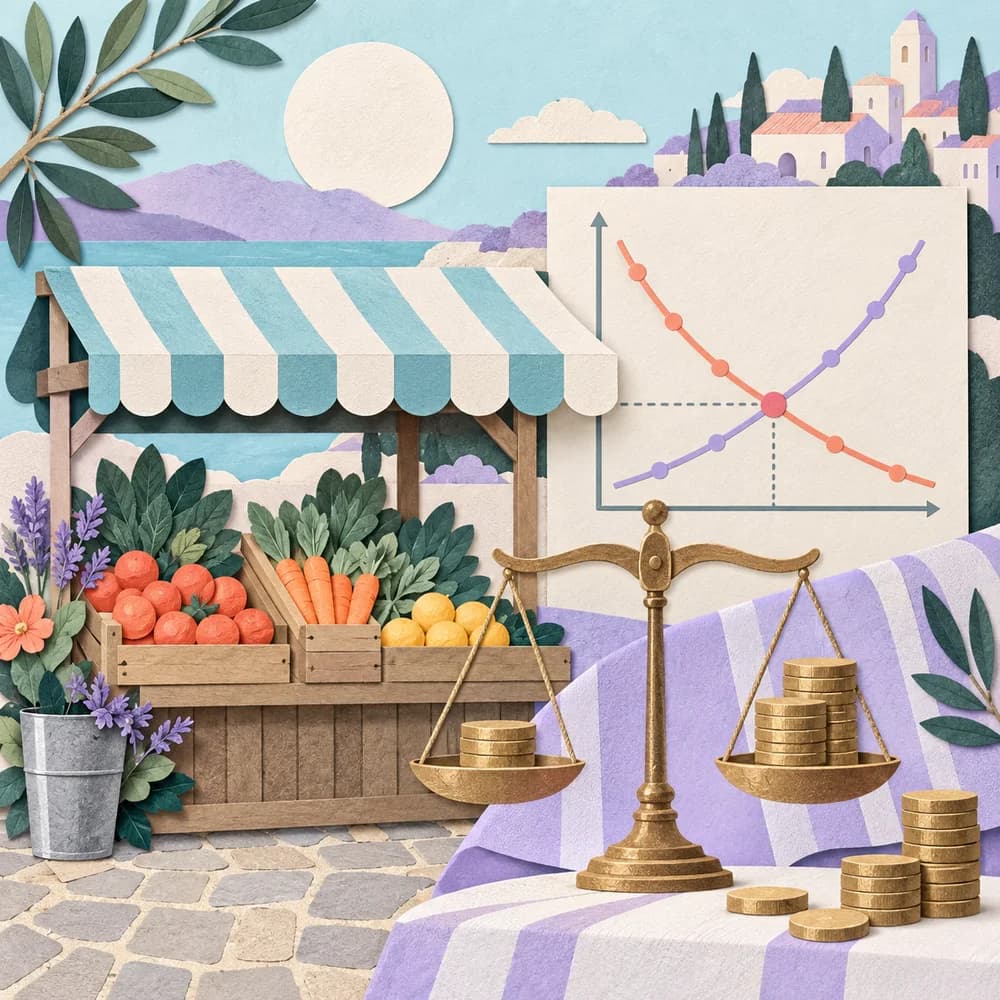
The AP Microeconomics exam is a scored 1 to 5 assessment with a multiple-choice section and a free-response section, and this page includes an AP micro score calculator to estimate where you stand. AP Micro covers supply and demand, market structures, factor markets, and market failure. Use the resources here to review AP Micro FRQ strategies alongside the multiple-choice content before exam day.
The AP Micro progress check pulls MCQ and FRQ questions directly from the topics covered in each unit, testing your ability to interpret graphs, analyze market structures, and apply core economic reasoning. The MCQ part checks conceptual recall and graph reading, while the FRQ part asks you to walk through multi-step economic scenarios in writing. Topics that show up most often include supply and demand, elasticity, production and costs, perfect competition, monopoly, and factor markets. Each part mirrors the format of the real ap micro exam, so completing progress checks is one of the best ways to gauge where you stand before test day. For matched practice questions and study guides tied to these exact topics, visit AP Micro Exam.
Practicing ap micro frq questions means working through multi-part prompts that ask you to draw and label graphs, calculate values like elasticity or profit, and explain economic outcomes in complete sentences. The topics that generate FRQs most often are perfect competition, monopoly, price discrimination, factor markets, and externalities. The best approach is to write out full responses by hand, then check your work against a scoring rubric. Pay close attention to what each part of the prompt is actually asking, since partial credit is awarded per task. Skipping a label on a graph or leaving out a written explanation can cost points even if your graph is correct. You can find FRQ practice aligned to these topics at AP Micro Exam.
The best place to find AP Micro practice questions, including MCQ and practice test sets, is AP Micro Exam, where questions are organized by topic so you can target specific areas like cost curves, market structures, or factor markets. For MCQ practice, look for questions that ask you to read graphs, identify equilibrium changes, or compare market outcomes. For a full practice test experience, work through timed sets that mix topics the way the real ap micro exam does. Using an ap micro score calculator after a practice set helps you estimate your current score and spot which topics need more attention before exam day.
Start your AP Micro study plan by using an ap micro score calculator on a practice set to find your baseline, then build a schedule around the topics where you lost the most points. The ap micro exam rewards students who can move fluidly between written explanations and accurate graphs, so practice both skills together rather than separately. Here are concrete steps that work well: - **Review core graphs first.** Supply and demand, cost curves for perfect competition and monopoly, and factor market graphs appear constantly. Redraw them from memory until they feel automatic. - **Practice FRQs with rubrics.** Write out full responses, then score yourself honestly. One missed label or missing sentence can drop your score. - **Do timed MCQ sets.** AP Micro MCQs are fast-paced. Timed practice builds the habit of moving quickly without second-guessing every answer. - **Connect concepts across units.** Questions often link elasticity to tax incidence, or production costs to profit maximization. Seeing those connections early saves time on test day. All of these resources are available at AP Micro Exam.