2.8 The Effects of Government Intervention in Markets

🤑AP Microeconomics Unit 2 Review
2.8 The Effects of Government Intervention in Markets
🤑 AP Microeconomics
Supply and Demand
Determinants of Supply and Demand
2.1
Demand
2.2
Supply
2.3
Price Elasticity of Demand
2.4
Price Elasticity of Supply
2.5
Other Elasticities
2.6
Market Equilibrium and Consumer and Producer Surplus
2.7
Market Disequilibrium and Changes in Equilibrium
2.8
The Effects of Government Intervention in Markets
2.9
International Trade and Public Policy
Government intervention in markets includes price ceilings, price floors, taxes, subsidies, and quantity controls like quotas. Each one changes the price buyers pay, the quantity traded, and how surplus is split between consumers and producers, and in an efficient market each one creates deadweight loss.
Why This Matters for the AP Microeconomics Exam
This topic shows up whenever you need to analyze how a policy changes an efficient market. On the exam you may be asked to draw or read supply and demand graphs with a price control or a tax, calculate new prices and quantities, and find areas for consumer surplus, producer surplus, tax revenue, government subsidy cost, and deadweight loss.
It also builds the policy-analysis thinking you reuse later in the course, including international trade in 2.9 and government intervention in different market structures in Unit 6. Getting comfortable with shifts versus movements, binding versus nonbinding controls, and tax incidence here makes those later topics much easier.
Key Takeaways
- A price ceiling only changes the market if it is set below equilibrium price (binding), which causes a shortage; a price floor only changes the market if it is set above equilibrium price (binding), which causes a surplus.
- A per-unit tax raises the price buyers pay, lowers the price sellers keep, and the vertical gap between those two prices is the size of the tax (the tax wedge).
- A subsidy works in the opposite direction, lowering the price buyers pay and raising the price sellers receive, and it costs the government money.
- Tax revenue is the per-unit tax multiplied by the quantity actually traded; a subsidy's budget cost is the per-unit subsidy multiplied by the new quantity.
- Any of these interventions in an already efficient market reduces allocative efficiency and creates deadweight loss.
- The relatively more inelastic side of the market bears more of a per-unit tax; an even split requires the elasticities of supply and demand to be roughly equal.
Price Controls: Ceilings and Floors
A market brings buyers and sellers together, but the government can step in and change market outcomes. Two of the most common tools are price controls and per-unit taxes.
Price Ceilings
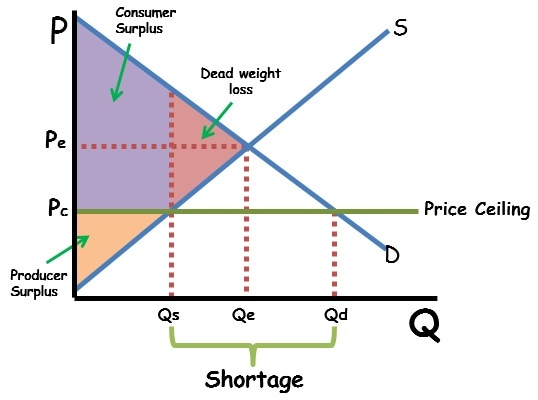
A price ceiling is a legal maximum price. Sellers can charge any price up to the ceiling but not above it. Rent control is a common example of a price ceiling.
A price ceiling only changes the market when it is set below equilibrium price. That is called a binding ceiling. If the ceiling is set above equilibrium, sellers just charge the equilibrium price and nothing changes, which is a nonbinding ceiling.
A binding ceiling creates a shortage (excess demand). At the low legal price, quantity demanded is high but quantity supplied is low, so buyers want more than sellers will provide. Because trades happen at the lower quantity, total surplus shrinks and the lost consumer and producer surplus becomes deadweight loss. In the real world, persistent shortages under a binding ceiling can also push some buyers and sellers into a black market.
Price Floors
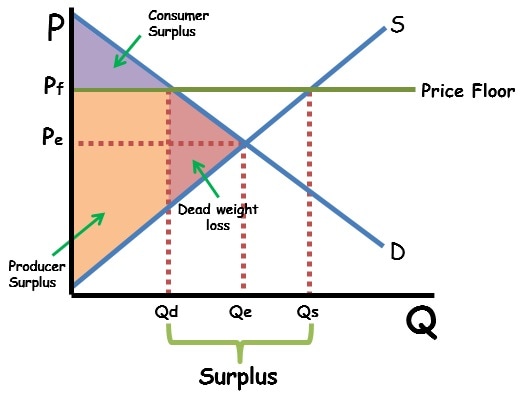
A price floor is a legal minimum price. Sellers cannot legally sell below it. The minimum wage is a common example, since it sets the lowest legal price for labor.
A price floor only changes the market when it is set above equilibrium price (binding). If it is set below equilibrium, sellers already get more than the floor, so it does nothing (nonbinding).
A binding floor creates a surplus (excess supply). At the high legal price, quantity supplied is high but quantity demanded is low, so sellers want to sell more than buyers will buy. Trades happen at this lower quantity, and the lost surplus is deadweight loss.
Nonbinding Controls
A price control only affects the market if it excludes the equilibrium price. A ceiling above equilibrium or a floor below equilibrium does nothing, because the market just settles at equilibrium anyway. The exam often tests this on purpose by giving you a nonbinding control to see if you know it has no effect.
Taxes and Subsidies
Per-Unit vs. Lump-Sum Taxes
A per-unit tax (also called an excise tax) is charged on every unit produced or sold. A lump-sum tax is a fixed amount that does not depend on quantity. This section focuses on per-unit taxes, since those shift the supply curve.
Graphing a Per-Unit Tax
A per-unit tax acts like an increase in production costs, so it shifts the supply curve up by the amount of the tax (you can think of it as a leftward shift). The new supply curve is often labeled S + Tax.
Here is how to read the graph after a per-unit tax:
- The price buyers pay rises to where the S + Tax curve meets demand.
- The price sellers keep falls to the original supply curve at the new quantity.
- The vertical gap between those two prices equals the per-unit tax. This gap is the tax wedge.
- Consumer surplus is the area under demand and above the price buyers pay.
- Producer surplus is the area above the original supply curve and below the price sellers keep.
- Tax revenue is the rectangle equal to the per-unit tax multiplied by the new (lower) quantity traded.
- Deadweight loss is the triangle between the two curves, from the new quantity out to the original equilibrium quantity.
A useful check: the price buyers pay goes up by less than the full tax, and the price sellers keep goes down by the rest. Together those two changes add up to the full per-unit tax.
Subsidies
A subsidy is the opposite of a tax. A per-unit subsidy lowers the price buyers pay and raises the price sellers receive, and it increases the quantity traded. A subsidy given to producers shifts supply to the right (lower effective costs); a consumer voucher subsidy shifts demand to the right.
Instead of raising revenue, a subsidy is a cost to the government. The budget cost equals the per-unit subsidy multiplied by the new quantity traded. Like a tax, a subsidy applied to an already efficient market moves output away from the efficient quantity and creates deadweight loss.
Tax Incidence
Tax incidence is about who actually bears the burden of a per-unit tax. There is a difference between statutory incidence (who legally sends the tax to the government) and economic incidence (who actually pays through higher prices or lower revenue). Even if a tax is legally placed on sellers, buyers usually end up sharing the burden through a higher price.
Elasticity and Tax Incidence

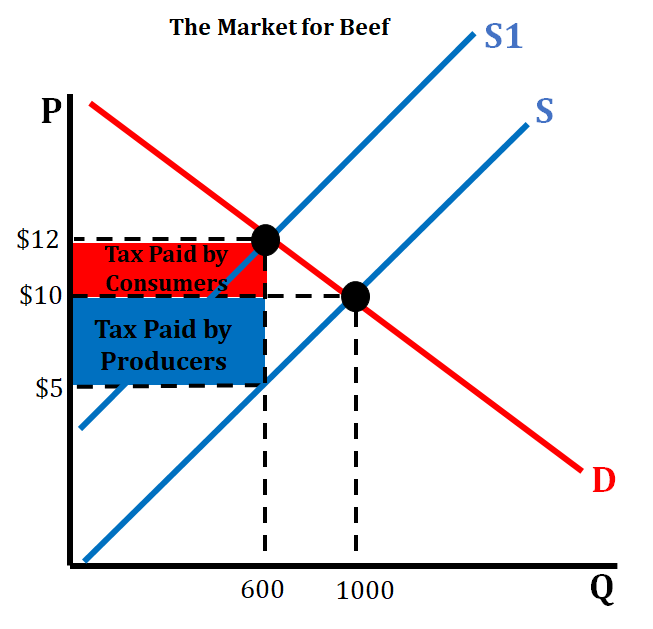
Who bears more of the tax depends on the elasticities of supply and demand. The key rule:
- The side of the market that is relatively more inelastic bears more of the per-unit tax.
- The side that is relatively more elastic bears less of it.
- An even split happens only when supply and demand have roughly equal elasticities.
Be careful with the "both are elastic" idea. Both sides being relatively elastic does not by itself mean the tax is split evenly. What matters is how the two elasticities compare to each other. If demand is more inelastic than supply, consumers bear more of the tax. If demand is more elastic than supply, consumers bear less.
Memory aid: think EPIC. When demand is comparatively Elastic, more of the burden falls on Producers. When demand is comparatively Inelastic, more of the burden falls on Consumers.
How to Use This on the AP Microeconomics Exam
Free Response
When a policy is introduced, set up a clean supply and demand graph and label everything. Draw the price control as a horizontal line, or draw the tax as a second supply curve labeled S + Tax. Show the new price and quantity clearly, then shade and identify each area the question asks for: consumer surplus, producer surplus, tax revenue or subsidy cost, and deadweight loss. Points are often lost for missing labels or shifting the wrong curve.
Problem Solving
For calculations:
- Tax revenue = per-unit tax x new quantity.
- Subsidy cost = per-unit subsidy x new quantity.
- Surplus and deadweight loss areas are usually triangles or rectangles, so use area = 1/2 x base x height for triangles and length x width for rectangles.
- Find the price buyers pay and the price sellers keep separately; their difference equals the tax.
Common Trap
Watch for a nonbinding price control. If a ceiling sits above equilibrium or a floor sits below equilibrium, the correct answer is that the market stays at equilibrium with no change. Also remember that a shift versus a movement matters: a tax or subsidy shifts a curve, while a price control is a horizontal line that you compare against the original equilibrium.
Common Misconceptions
- Misconception: A price ceiling automatically lowers prices for everyone.Actually: A price ceiling does not automatically lower prices for everyone. If it is nonbinding (above equilibrium), it has no effect at all.
- Misconception: A binding price ceiling causes a surplus, and a binding price floor causes a shortage.Actually: A binding price ceiling causes a shortage, not a surplus; a binding price floor causes a surplus, not a shortage. Students often flip these.
- Misconception: The price buyers pay after a tax rises by the full amount of the tax.Actually: The price buyers pay after a tax does not rise by the full amount of the tax. It rises by part of the tax, and sellers absorb the rest.
- Misconception: Tax incidence is decided by who legally pays the tax.Actually: Tax incidence is not decided by who legally pays the tax. The legal side and the side that actually bears the burden can be different, and elasticity determines the split.
- Misconception: If both supply and demand are elastic, the tax is split 50/50.Actually: "Both supply and demand are elastic" does not guarantee a 50/50 tax split. The split depends on how the two elasticities compare, not on whether both are simply elastic.
- Misconception: A subsidy is free.Actually: A subsidy is not free. It increases quantity but costs the government money and still creates deadweight loss when applied to an already efficient market.
- Misconception: Deadweight loss is the same as tax revenue.Actually: Deadweight loss is not the same as tax revenue. Revenue is collected by the government; deadweight loss is surplus that disappears entirely because some mutually beneficial trades no longer happen.
Related AP Microeconomics Guides
Practice Questions for 2.8
1 of 10
The graph above illustrates a market where the government has intervened by establishing a binding price floor at $80.
Calculate the size of the market disequilibrium and the deadweight loss caused by this price floor.
A.
Shortage of 4 units; deadweight loss is .
B.
Surplus of 4 units; deadweight loss is .
C.
Surplus of 4 units; deadweight loss is .
D.
Shortage of 4 units; deadweight loss is $20.
E.
Surplus of 6 units; deadweight loss is .
Vocabulary
The following words are mentioned explicitly in the AP® course framework for this topic.Term | Definition |
|---|---|
allocative efficiency | An economic outcome where price equals marginal cost and resources are allocated to their highest-valued uses. |
consumer behavior | The decisions and actions of buyers in response to changes in prices, income, and other economic factors. |
deadweight loss | The loss of economic efficiency that occurs when equilibrium is not at the socially optimal quantity, resulting in reduced total surplus. |
government policies | Actions and regulations implemented by government to influence economic activity and market outcomes. |
incentives | Factors that motivate economic actors to make particular choices or take specific actions. |
market outcomes | The results of market activity, including equilibrium price and quantity, consumer surplus, producer surplus, and deadweight loss. |
price ceilings | A government-imposed maximum price above which a good cannot be sold, preventing prices from rising to equilibrium. |
price floors | A government-imposed minimum price below which a good cannot be sold, preventing prices from falling to equilibrium. |
price regulation | Government policies that control the prices firms can charge for goods and services. |
producer behavior | The decisions and actions of sellers in response to changes in prices, costs, and other economic factors. |
quantity regulation | Government policies that control the quantity of goods and services that can be produced or traded in a market. |
subsidies | Government payments or incentives that can be used to encourage production or consumption of goods that generate positive externalities. |
subsidy incidence | The distribution of benefits from a subsidy between buyers and sellers, determined by the relative elasticity of supply and demand. |
tax incidence | The distribution of the tax burden between buyers and sellers, determined by the relative elasticity of supply and demand. |
taxes | Mandatory payments to the government that can be used to discourage production or consumption of goods that generate negative externalities. |
Frequently Asked Questions
What is government intervention in AP Micro?
Government intervention includes policies such as price ceilings, price floors, per-unit taxes, subsidies, and quantity controls. These policies change incentives, prices, quantities, surplus, and efficiency.
When is a price ceiling binding?
A price ceiling is binding when it is set below equilibrium price. It lowers the legal price, reduces quantity supplied, raises quantity demanded, and creates a shortage.
When is a price floor binding?
A price floor is binding when it is set above equilibrium price. It raises the legal price, reduces quantity demanded, raises quantity supplied, and creates a surplus.
How does a per-unit tax affect a market?
A per-unit tax creates a tax wedge between the price buyers pay and the price sellers receive. Quantity traded falls, tax revenue is collected, and deadweight loss is created in an otherwise efficient market.
Who bears the burden of a tax?
Tax incidence depends on elasticity. The relatively more inelastic side of the market bears more of the tax, regardless of which side legally pays it.
Why does government intervention create deadweight loss?
In a market that was already efficient, intervention moves quantity away from the efficient equilibrium. The lost gains from trades that no longer happen become deadweight loss.
See Fiveable more often in Google
Mark Fiveable as a preferred source and Google is more likely to show you our guides in Top Stories, with a "preferred" badge in AI Mode and AI Overviews.