1.2 Materials, Processes, and Techniques in Prehistoric Art

🖼AP Art History Unit 1 Review
1.2 Materials, Processes, and Techniques in Prehistoric Art
🖼 AP Art History
TLDR
Topic 1.2 in AP Art History is about how prehistoric artists made art, meaning the materials they chose, the tools and steps they used, and how those choices shaped the final work. You should be able to connect a medium like jade, terra cotta, bone, or rock pigment to the techniques used and explain how those decisions affect the look and possible purpose of a work. The required works for this topic include the Camelid sacrum, Running horned woman, Beaker with ibex motifs, Anthropomorphic stele, Jade cong, and the Lapita Terra cotta fragment.
Why This Matters for the AP Art History Exam
This topic builds the visual analysis skill the exam tests most often: explaining how artistic choices about materials, technique, and form shape a work of art. That skill shows up in the multiple-choice section and in free-response questions, including questions that ask you to analyze works beyond the image set. If you can look at an object and reason from its medium and method to its form and likely function, you can write strong attribution and analysis responses.
Prehistoric art is a good place to build this skill because there is little written evidence. You often have to argue from the object itself: what it is made of, how it was shaped, and what that suggests. Keep interpretations careful and use words like "may" or "possibly" when function is debated.
Key Takeaways
- Prehistoric artists worked across many media: rock pigment, carved bone and ivory, jade, and fired ceramics.
- Africa and Asia developed key media early, and Asia's biggest contribution to early world art was ceramic technology.
- Common two-dimensional work included geometric patterns and animal or human imagery on rock surfaces; three-dimensional work included figurines and large stone monuments.
- Technique follows material: pigment is ground and applied, stone and bone are carved, jade is abraded and drilled, and clay is shaped and fired.
- For the required works, connect medium plus technique to form, then propose a careful interpretation of function.
- Keep function claims tentative for prehistoric works unless context clearly supports them.
Materials Used in Prehistoric Art
Prehistoric artists used what their local environment offered, which is why media vary so much by region.
- Stone surfaces and natural pigments: ocher, charcoal, and manganese were ground and applied to rock to make color.
- Carved natural materials: animal bone and ivory were shaped into figurines and objects.
- Jade: in prehistoric China, ritual objects were carved from this hard stone, beginning a tradition that lasted about 5,000 years.
- Fired clay: ceramics were a major technology, with some of the earliest pieces produced by the Jomon culture in Japan.
The choice of a permanent material like stone, hardened clay, or jade often reflected what was durable and available nearby.
Processes and Techniques by Medium
Different media call for different steps. Matching technique to material is the core skill of this topic.
- Rock painting: grind pigment such as ocher or charcoal, then apply it to a prepared rock surface. Some images are also carved or incised before painting.
- Bone and ivory: carve and shape using stone tools, sometimes following the natural form of the material.
- Jade carving: jade is too hard to cut easily, so it is shaped through abrasion, drilling, and polishing rather than simple cutting.
- Ceramics: clay is shaped by hand or, later, on the potter's wheel, then decorated by incising or painting, then fired to harden it. Refined vessel shapes became possible after the potter's wheel was adopted in the fourth millennium BCE.
A reliable exam move is to name the medium, then the technique, then explain how that shaped the form and surface.
Required Works for Topic 1.2
Camelid sacrum in the shape of a canine
- Location: Tequixquiac, central Mexico
- Date: 14,000-7000 bce
- Medium: Bone
This work is carved from the sacrum bone of a camelid, an animal in the same family as the llama. The artist worked with the bone's natural curved shape so it reads as a canine, or dog-like, head. It is an example of early American art adapting an animal image to the natural contours of the material. One interpretation connects bone carving like this to early ritual or symbolic life, but keep function claims tentative.
Running horned woman
- Location: Tassili n'Ajjer, Algeria
- Date: 6000-4000 bce
- Medium: Pigment on rock
This is a rock painting made by applying pigment to a rock surface. The figure wears a horned headdress and body markings, and the form mixes naturalistic and abstract qualities. One interpretation is that the figure relates to ritual practice or a possible supernatural being, but the exact meaning is debated. Focus your analysis on how the pigment-on-rock medium and the painted line create the figure.
Beaker with ibex motifs
- Location: Susa, Iran
- Date: 4200-3500 bce
- Medium: Painted terra cotta
This vessel is fired clay decorated with painted animal motifs, including stylized ibex (a wild mountain goat). The decoration shows how artists turned animal forms into clean, geometric shapes that fit the curved surface of the vessel. Iran was an early center of ceramic production, and refined vessel forms developed there over time. Describe how the painted design organizes the surface into bands and emphasizes the central animal motif.
Anthropomorphic stele
- Location: Arabian Peninsula
- Date: Fourth millennium bce
- Medium: Sandstone
This is a carved sandstone monument shaped to suggest a human figure (anthropomorphic means human-like). Memorial and funerary stelae appear across Neolithic Asia, including the Arabian Peninsula. The carving reduces the human form to simplified features and a flat, frontal shape. Treat any specific funerary or memorial function as one interpretation rather than certain fact.
Jade cong
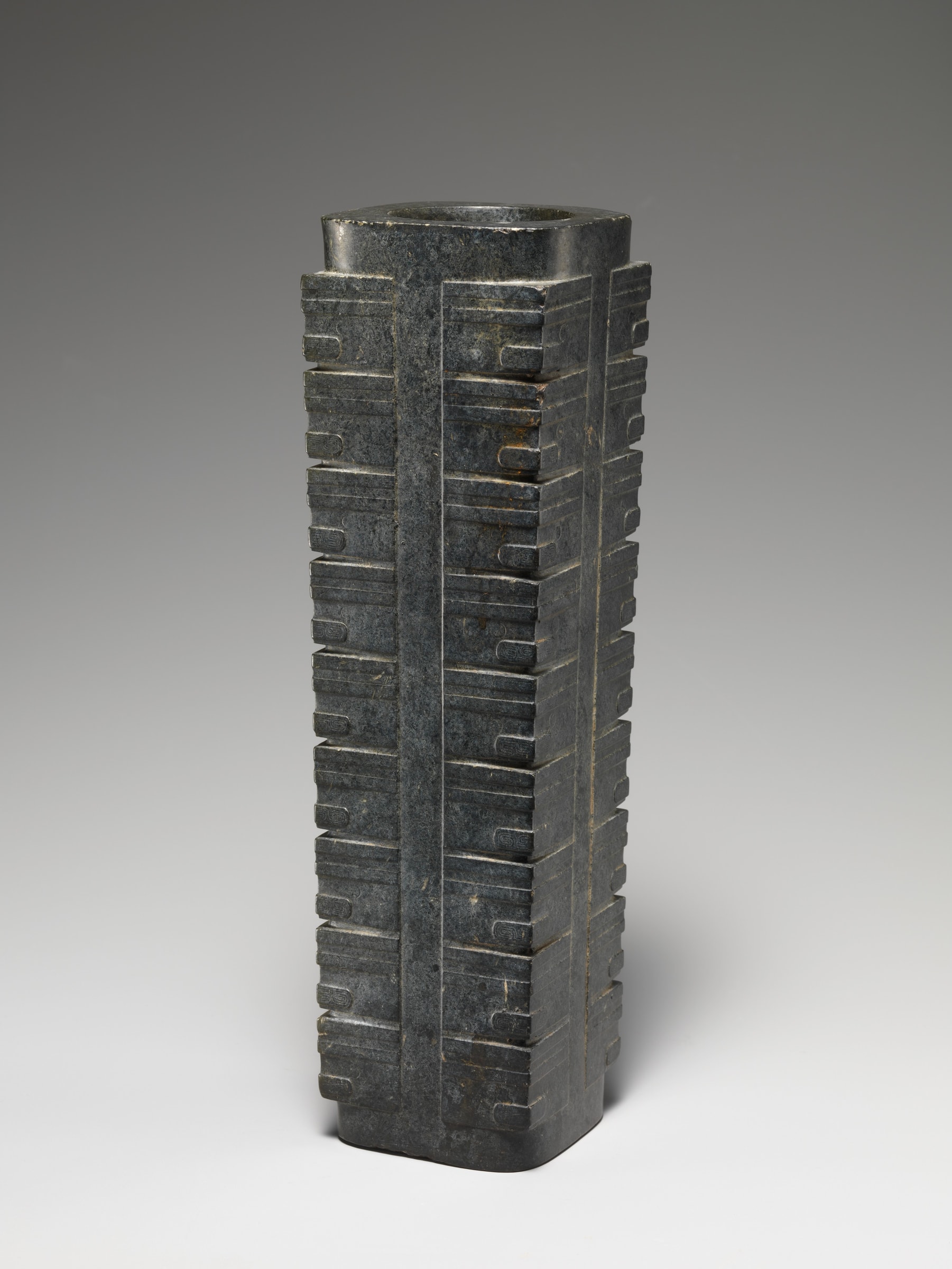
- Location: Liangzhu, China
- Date: 3300-2200 bce
- Medium: Carved jade
A cong has a square outer form with a circular inner channel running through it. Because jade is extremely hard, it was shaped through abrasion, drilling, and polishing rather than simple carving, which makes the precise form and smooth surface impressive. This work belongs to a long Chinese tradition of ritual jade objects. One common interpretation links the cong to ritual use and ideas about earth and heaven, but present that as interpretation, not certainty.
Terra cotta fragment (Lapita)
- Location: Lapita, Reef Islands, Solomon Islands
- Date: 1000 bce
- Medium: Terra cotta (incised)
This is a piece of fired clay pottery with incised geometric designs. The Lapita peoples moved eastward across the Pacific and made pottery with these distinctive incised patterns, which appear across the region in multiple media. Focus on how the geometric designs were cut into the clay surface before firing and how those patterns organize the fragment.
How to Use This on the AP Art History Exam
Multiple Choice
Expect questions that show an image and ask about medium, technique, or how a material shaped the work. Practice naming the medium quickly, then reasoning from it. For example, hard stone like jade means abrasion and polishing, not quick cutting.
Free Response
Some questions ask you to analyze works beyond the image set using only what you see. Use the same chain every time: identify the likely medium, describe the technique it suggests, then explain how that shaped the form and surface. Add a careful interpretation of function using "may" or "possibly" when the purpose is uncertain.
Visual Analysis
Describe specific visual elements, then connect them to process. Instead of saying a pot is "decorated," say the design was incised into the clay before firing, then explain how the pattern organizes the surface.
Common Trap
Do not stop at description. The skill is explaining how the artistic decision shaped the work, so always link material and technique to the form you see.
Common Misconceptions
- "Prehistoric art is all from Europe." Early art is found worldwide, and Africa and Asia developed important media early. Lascaux is famous, but it is one example among many regions.
- "The Beaker with ibex motifs comes from the European Beaker culture." This required work is from Susa, Iran, and is painted terra cotta. Do not confuse it with the separate European Beaker culture pottery.
- "The Camelid sacrum is Moche art from Peru." It is from Tequixquiac in central Mexico and dates to roughly 14,000-7000 bce, far earlier than the Moche. Keep its location and date precise.
- "The jade cong is a circular tube." Its outer form is square with a circular inner channel. Describe both parts accurately.
- "We know exactly what these works were for." For most prehistoric works, function is interpreted, not proven. Use cautious wording and base claims on the object and supplied context.
- "Jade was cut like soft stone." Jade is very hard and was shaped by abrasion, drilling, and polishing, which is why these objects show skilled, slow work.
Related AP Art History Guides
Frequently Asked Questions
What is AP Art History 1.2 about?
AP Art History 1.2 focuses on the materials, processes, and techniques used in prehistoric art. You should connect medium and method to form, function, cultural context, and available resources.
What materials did prehistoric artists use?
Prehistoric artists used materials such as pigment, stone, bone, jade, terra cotta, and other locally available resources. The choice of material often shaped the work's durability, meaning, and function.
Why do materials matter for AP Art History analysis?
Materials matter because they reveal what resources a culture had, what technologies artists used, and how the object may have functioned. Medium is often evidence for both context and meaning.
What required works are in this topic?
This topic connects to required prehistoric works such as the Camelid sacrum, Running horned woman, Beaker with ibex motifs, Anthropomorphic stele, Jade cong, and Terra cotta fragment from the Lapita culture.
How should I discuss function in prehistoric art?
Discuss function by connecting the object's form, material, location, and possible use. For prehistoric works, be careful to use evidence and avoid claiming certainty when scholars only have limited context.
How is prehistoric art tested on AP Art History?
Prehistoric art can appear in image identification, comparison, short-response, and contextual analysis questions. Strong answers explain how materials and processes support meaning, function, or cultural context.