6.4 Unit 6 Required Works

🖼AP Art History Unit 6 Review
6.4 Unit 6 Required Works
🖼 AP Art History
Unit 6 covers 14 required African works from about 1100 to 1980 CE, ranging from the stone walls of Great Zimbabwe to Olowe of Ise's carved veranda post. The main skill here is contextual analysis: explaining how a work's purpose, patron, and cultural setting shaped the choices an artist made.
Why This Matters for the AP Art History Exam
Unit 6 makes up about 6% of the exam, but it carries a lot of weight for one specific skill: contextual analysis. These works push you to explain how and why context influenced an artist's decisions, and how those decisions shaped how an audience received the work. A common trap is slipping into pure visual description (listing materials or style) when the question wants you to connect those choices to belief systems, leadership, performance, or community.
This unit is also strong practice for attribution questions, where you justify which culture or tradition an unknown work belongs to by comparing it to a work you know. Because the African image set is small compared to the continent's vast traditions, you may also see unfamiliar works that ask you to apply visual analysis on the spot.
Keep in mind that much African art is meant to be performed, used, or activated rather than just displayed. Masks, power figures, and stools come alive in ceremony, dance, and ritual, so functions and audiences matter as much as form.
Key Takeaways
- Know all 14 works by title, culture/people, location, approximate date, and medium. Identification points are quick and reliable.
- Focus on contextual analysis: explain how purpose, patron, and cultural setting shaped artistic choices, not just what the work looks like.
- Many works are tied to leadership and authority (Golden Stool, Ndop figure, Benin wall plaque, veranda post).
- Several works are meant to be performed or used in ceremony (Pwo mask, Mblo mask, Bundu mask, Aka elephant mask, power figure).
- Some interpretations are debated. Use "possibly" or "one interpretation" for contested meanings rather than stating them as fact.
- Practice attribution by spotting shared features (idealized faces, regalia, materials) between an unknown work and a work you already know.
Required Works
Conical Tower and Circular Wall of Great Zimbabwe

- Culture/Location: Shona peoples, Southeastern Zimbabwe
- Date: c. 1000-1400 CE
- Medium: Coursed granite blocks
Form: Built from coursed granite blocks (cut stone laid in level rows), with sloped sides on the conical tower.
Function: Served as a royal complex and trading center. The royal elite may have lived within the walls.
Content: The conical tower stands roughly 32 feet tall with tapering, sloped sides and no interior chambers.
Context:
- The large size of the tower signals wealth and power. One interpretation is that it resembles a granary (a building for storing grain), connecting it to ideas of prosperity and successful harvests.
- The name Zimbabwe means "houses of stone." This structure stands out among African architecture because it is built from stone rather than adobe or organic materials.
Great Mosque of Djenné
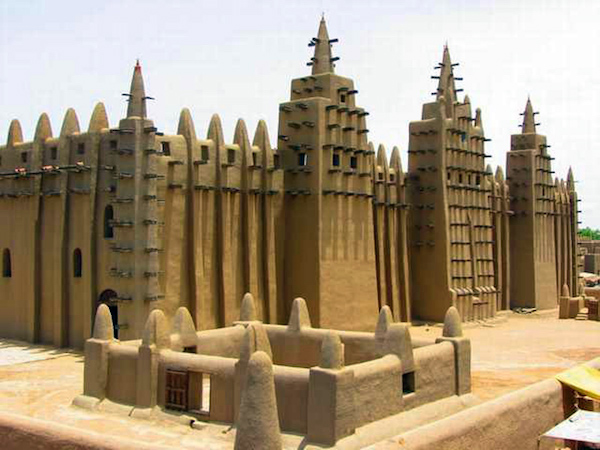
- Culture/Location: Mali
- Date: Founded c. 1200 CE; rebuilt 1906-1907 CE
- Medium: Adobe
Form: Built from adobe (sun-dried mud brick and mud plaster).
Function: A mosque where Muslims gather to pray and worship.
Content:
- Follows the tradition of Islamic mosques, with a mihrab that points toward Mecca.
- Wooden beams called torons project from the walls and serve as built-in scaffolding for maintenance.
- Minarets call worshippers to prayer; columns are topped with ostrich eggs, often read as symbols of purity and fertility.
- A hypostyle hall (an interior space with a roof supported by many columns) provides room for the umma (Muslim community) to pray.
Context:
- Daily prayer facing Mecca is one of the core practices of Islam.
- Because the mosque is made from natural materials, it needs constant upkeep against weather. The town holds an annual festival, Crépissage de la Grande Mosquée, where residents gather to re-plaster the mosque together.
Wall Plaque, from Oba's Palace

- Culture/Location: Edo peoples, Kingdom of Benin (Nigeria)
- Date: 16th century CE
- Medium: Cast brass
Form: Cast brass plaque in relief.
Function: Decorated the palace of the oba (king) and displayed his power and wealth.
Content:
- Uses hierarchy of scale, so the most important figure, the king, is the largest.
- The king appears with his attendants around him.
Context:
- Comes from the Edo peoples of the Kingdom of Benin (present-day Nigeria).
- The use of brass reflects trade networks, especially with the Portuguese, who supplied metal in exchange for goods.
Sika Dwa Kofi (Golden Stool)
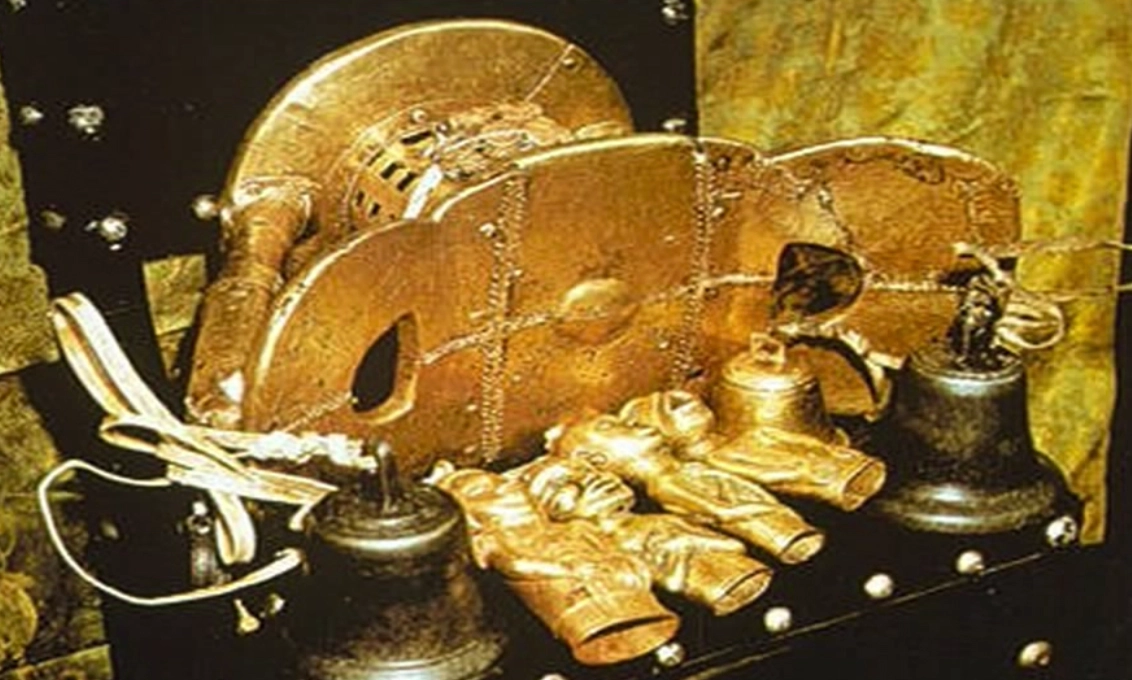
- Culture/Location: Ashanti peoples, south central Ghana
- Date: c. 1700 CE
- Medium: Gold over wood and cast-gold attachments
Form: Gold over a wooden core, with cast-gold attachments.
Function: A sacred symbol of the Ashanti nation, said to contain the soul of the people. Used during special occasions such as enthronement ceremonies, where the king is raised over the stool rather than seated on it.
Content: Bells hang from the side of the stool to warn the king of danger.
Context:
- Stools carry deep meaning for the Ashanti, who believe a part of one's soul can reside in a stool. This stool is so sacred it is never allowed to touch the ground and rests on its own throne.
- Only the king may be near it, and no one is allowed to sit on it.
Ndop (Portrait Figure) of King Mishe miShyaang maMbul

- Culture/Location: Kuba peoples, Democratic Republic of the Congo
- Date: c. 1760-1780 CE
- Medium: Wood
Form: Carved wood with a smooth, polished surface.
Function: Commemorates the king and his accomplishments.
Content:
- A non-idealized seated figure of the king wearing royal regalia, legs crossed, seated on a platform.
- The large head emphasizes the king's intelligence.
- The calm, composed face suggests patience and shows the king as removed from everyday "mortal" affairs.
Context:
- The figure was kept in a shrine.
- Its shine comes from oils rubbed onto the wood to protect it from insects.
- A symbol carved at the figure's base (an emblem associated with this ruler) identifies it as King Mishe miShyaang maMbul.
Power Figure (Nkisi n'kondi)

- Culture/Location: Kongo peoples, Democratic Republic of the Congo
- Date: c. late 19th century CE
- Medium: Wood and metal
Form: Carved wood studded with metal nails and blades.
Function: Held a spirit that could be called on to help with human affairs.
Content:
- A standing human figure in an alert pose.
- Nails and metal pieces are driven into the body throughout the sculpture.
Context:
- The nkisi (spirit) contained in the figure can be activated to assist with serious matters such as oaths, agreements, or disputes.
- Each nail was driven in to call upon the spirit, often to seal an agreement or settle a conflict.
Female (Pwo) Mask

- Culture/Location: Chokwe peoples, Democratic Republic of the Congo
- Date: Late 19th to early 20th century CE
- Medium: Wood, fiber, pigment, and metal
Form: Carved wood with added fiber, pigment, and metal.
Function: Worn by men who portrayed women in ritual dances.
Content:
- Closed eyes with enlarged sockets and a slender nose.
- Braided fibers form the hair.
Context:
- The Chokwe were a matrilineal society, and these masks honor female ancestors.
- The facial features represent an ideal woman in Chokwe society. The eyes suggest wisdom and modesty (she is so knowledgeable she does not need sight), the large forehead reads as intelligence, and the white around the eyes may signal a connection to the spiritual world.
Portrait Mask (Mblo)

- Culture/Location: Baule peoples, Côte d'Ivoire
- Date: Early 20th century CE
- Medium: Wood and pigment
Form: Carved wood with pigment.
Function: Worn at ritual dances to honor a specific individual.
Content: Facial features include arched eyebrows, a broad forehead, heavy-lidded downcast eyes, a slender elongated nose, a small mouth, an elaborate coiffure (hairstyle), and an overall elongated facial structure.
Context:
- Made by the Baule peoples of Côte d'Ivoire (Ivory Coast).
- This is an idealized portrait, and the features represent valued traits in Baule society, including modesty, wisdom, and good character.
Bundu Mask

- Culture/Location: Sande Society, Mende peoples (forests of Sierra Leone and Liberia)
- Date: 19th to 20th century CE
- Medium: Wood, cloth, and fiber
Form: Carved wood with cloth and fiber.
Function: Worn by elders of the Sande Society during initiation ceremonies that bring young girls into the society and celebrate their passage into adulthood.
Content: Facial features include small eyes, small ears, a small mouth, a smooth broad forehead, an elaborate hairstyle, and rings around the neck.
Context:
- The mask portrays the ideal Mende woman. Small eyes and ears can be read as a woman who avoids gossip and keeps secrets, and the elaborate hair signals wealth and care.
- The high, broad forehead suggests wisdom. One interpretation reads the neck rings as a sign of health, well-being, or prosperity; some accounts connect them to pregnancy. Frame this as one interpretation rather than a fixed meaning.
Ikenga (Shrine Figure)

- Culture/Location: Igbo peoples, Nigeria
- Date: c. 19th to 20th century CE
- Medium: Wood
Form: Carved wood.
Function: Commissioned by men for their private homes or shrines as a symbol of personal achievement.
Content:
- Ikenga means "strong right arm." A tool or weapon in the figure's hand points to physical strength and accomplishment.
- Ram's horns signal power and strength.
Context: The figure honors masculine attributes such as success, strength, and personal accomplishment.
Lukasa (Memory Board)

- Culture/Location: Mbudye Society, Luba peoples, Democratic Republic of the Congo
- Date: c. 19th to 20th century CE
- Medium: Wood, beads, and metal
Form: Carved wood decorated with beads and metal.
Function: Helps the reader recall key parts of Luba history and stories.
Content:
- Beads and shells are arranged across the board, with placement and color cueing specific people, places, and events.
- Zoomorphic (animal-shaped) elements are carved into the sides.
Context:
- Used by trained historians of the Mbudye Society, who have the special skill to "read" these boards.
- Each board is unique, and the same board can prompt different details depending on who is reading it.
Aka Elephant Mask

- Culture/Location: Bamileke peoples, Cameroon (western grassfields region)
- Date: c. 19th to 20th century CE
- Medium: Wood, woven raffia, cloth, and beads
Form: Woven raffia and cloth covered with beadwork, worn with a carved element.
Function: Worn by members of high-ranking society (the Kuosi) during important ceremonies.
Content: A composite human-animal (anthropomorphic) form with a human face and elephant features such as a long trunk and large ears, which signal power and strength.
Context: Beads were valuable to the Bamileke, so the dense beadwork and elephant imagery served as signs of wealth, status, and prestige.
Reliquary Figure (Byeri)

- Culture/Location: Fang peoples, southern Cameroon
- Date: c. 19th to 20th century CE
- Medium: Wood
Form: Carved wood with a polished surface.
Function: Placed on reliquaries (containers holding ancestral relics) to guard against harmful spirits.
Content:
- Hands folded near the body suggest calm and tranquility.
- A prominent navel can be read as a symbol of continuity and lineage.
- An elongated body with rounded, infant-like proportions.
Context:
- Like the Ndop figure, this sculpture was rubbed with oil to add shine and protect it from insects.
- The figure was meant to be portable, fitting the Fang peoples' more mobile way of life.
Veranda Post of Enthroned King and Senior Wife (Opo Ogoga)

- Culture/Location: Olowe of Ise, Yoruba peoples
- Date: c. 1910-1914 CE
- Medium: Wood and pigment
Form: Carved wood with pigment.
Function: Helped support a veranda (porch-like structure) in the king's palace while also serving as palace decoration and a statement of royal power.
Content:
- The senior wife stands behind the king and crowns him.
- Hierarchy of scale makes her larger than the king, emphasizing her importance as a supporter of his authority. (This is a useful cross-cultural comparison with King Menkaure and Queen from Unit 2.)
- Smaller figures include the king's junior wife and a flute-playing figure, possibly identified by one interpretation as Eshu, the Yoruba trickster deity.
Context: The carver was Olowe of Ise, one of the most celebrated Yoruba artists, whose work is recognized by name (a reminder that many African artists were known and respected, even when outsiders treated such art as anonymous).
How to Use This on the AP Art History Exam
Identification
Lock in title, culture/people, location, approximate date, and medium for all 14 works. These details earn fast points and anchor any longer response. Watch for easy-to-confuse pairs, such as the three idealized masks (Pwo, Mblo, Bundu) and the two oiled wood figures (Ndop and byeri).
Contextual Analysis
When a question asks how context shaped a work, do not stop at describing materials or style. Start by naming a visual element, then explain why it was chosen and how the cultural setting drove that choice. For example:
- Hierarchy of scale in the Benin plaque and veranda post reflects ideas about authority and rank.
- The use of brass in Benin and beads in the Aka mask reflects trade networks and the value of imported materials.
- Oiled, polished surfaces on the Ndop and byeri figures connect to care, protection, and respect for the object's role.
Attribution
For attribution questions, compare an unknown work to one you know by spotting shared features: idealized facial types, royal regalia, performance use, or specific materials. Name the visible evidence, then connect it to a tradition. Your goal is a reasonable, evidence-based claim, not a guess.
Common Trap
The biggest trap is confusing visual analysis with contextual analysis. Listing the medium or describing the face is visual analysis. Explaining how Chokwe matrilineal values shaped the choice to honor a female ancestor with an idealized face is contextual analysis. Questions about context want the second kind of thinking.
Common Misconceptions
- African art is not anonymous by default. Outsiders often labeled it that way, but artists like Olowe of Ise were known and celebrated. Missing names usually reflect collecting practices, not a lack of authorship.
- These works are not just objects to look at. Many masks, figures, and stools are meant to be performed, worn, or activated in ceremony. Function and audience are central, not optional.
- "Primitive" is wrong and outdated. African traditions are sophisticated, diverse, and shaped by centuries of trade and cultural exchange across the continent and beyond.
- Some meanings are debated. Treat contested readings (like the Bundu neck rings or the Eshu figure on the veranda post) as one interpretation, not settled fact.
- The Golden Stool is not a seat. It is a sacred symbol that holds the soul of the Ashanti nation and is never sat on or allowed to touch the ground.
- Great Zimbabwe is stone, which is unusual. Many other works in this unit use adobe, wood, or fiber, so do not assume African monumental architecture is always made the same way.
Related AP Art History Guides
Frequently Asked Questions
How many AP Art History Unit 6 required works are there?
AP Art History Unit 6 includes 14 required works from Africa, roughly 1100 to 1980 CE. You should know each work's title, culture or people, location, date, medium, and function.
What are the AP Art History Unit 6 required works?
Unit 6 includes works such as Great Zimbabwe, Great Mosque of Djenne, Benin wall plaque, Sika Dwa Kofi, Ndop, power figure, Pwo mask, Mblo mask, Bundu mask, Aka elephant mask, Reliquary figure, Veranda post, and related African works in the image set.
What skill matters most for AP Art History Unit 6?
Contextual analysis matters most. You need to explain how belief systems, leadership, performance, patronage, materials, and cultural setting shape each work's form and meaning.
Why is performance important in Unit 6 African art?
Many Unit 6 works are meant to be used, activated, danced, worn, or viewed in ceremony rather than treated as static museum objects. Function and audience are part of the meaning.
Which Unit 6 works connect to leadership and authority?
Works such as Sika Dwa Kofi, Ndop, the Benin wall plaque, and Olowe of Ise's veranda post connect strongly to leadership, political authority, rank, and legitimacy.
How should I study AP Art History Unit 6?
Drill identification details, then group works by themes such as leadership, ritual use, performance, materials, and cultural context. Practice supporting claims with both visual and contextual evidence.