10.5 Unit 10 Required Works

🖼AP Art History Unit 10 Review
10.5 Unit 10 Required Works
🖼 AP Art History
TLDR
Unit 10 of AP Art History covers 27 required works of Global Contemporary art made from 1980 to the present. These works show how globalization, new technology, and an expanding, more inclusive art world reshaped what art can be, using materials from porcelain seeds to video installations and cut-paper silhouettes. Knowing each work's artist, date, medium, and the ideas it responds to prepares you to identify, analyze, and compare them on the exam.
Why This Matters for the AP Art History Exam
Unit 10 is about 11% of the exam and includes works 224 through 250. These works reward you for connecting visual or contextual analysis to the larger meaning an artist is communicating. Many pieces respond directly to earlier art or traditions, so you often cannot fully explain them without naming the reference, like Cindy Sherman reworking a Renaissance and Baroque subject in Untitled (#228).
The free-response section asks you to make a defensible claim and back it with specific evidence from form, content, and context. Vague statements lose points here. Unit 10 also fits comparison and continuity-and-change tasks well, since many works mix traditional materials or formats with modern technology and global perspectives.
Key Takeaways
- Global contemporary art moves past older definitions of what counts as "art," supported by digital technology and global awareness.
- The art world has grown more inclusive since the 1960s, with artists across nationalities, ethnicities, genders, and sexual orientations challenging who gets centered in art history.
- Appropriation and "mash-ups" let artists revalue or critique culturally loaded images and objects.
- Iconic buildings and computer-aided design turned architecture into a global trademark for cities.
- For each required work, lock in the artist, date, medium, and the main idea or commentary the work delivers.
- Use specific visual evidence, not generalizations, when you argue what a work means.
Unit 10 Required Works
These are the 27 required works for Unit 10, with their identifying information. Get comfortable with the title, artist or architect, date, and medium for each one.
| # | Title | Artist / Architect | Location | Date | Medium |
|---|---|---|---|---|---|
| 224 | The Gates | Christo and Jeanne-Claude | New York City, U.S. | 1979-2005 ce | Mixed-media installation |
| 225 | Vietnam Veterans Memorial | Maya Lin | Washington, D.C., U.S. | 1982 ce | Granite |
| 226 | Horn Players | Jean-Michel Basquiat | - | 1983 ce | Acrylic and oil paintstick on three canvas panels |
| 227 | Summer Trees | Song Su-nam | - | 1983 ce | Ink on paper |
| 228 | Androgyne III | Magdalena Abakanowicz | - | 1985 ce | Burlap, resin, wood, nails, and string |
| 229 | A Book from the Sky | Xu Bing | - | 1987-1991 ce | Mixed-media installation |
| 230 | Pink Panther | Jeff Koons | - | 1988 ce | Glazed porcelain |
| 231 | Untitled (#228), from the History Portraits series | Cindy Sherman | - | 1990 ce | Chromogenic color print |
| 232 | Dancing at the Louvre, from The French Collection, Part I; #1 | Faith Ringgold | - | 1991 ce | Acrylic on canvas, tie-dyed, pieced fabric border |
| 233 | Trade (Gifts for Trading Land with White People) | Jaune Quick-to-See Smith | - | 1992 ce | Oil and mixed media on canvas |
| 234 | Earth's Creation | Emily Kame Kngwarreye | - | 1994 ce | Synthetic polymer paint on canvas |
| 235 | Rebellious Silence, from the Women of Allah series | Shirin Neshat (artist); Cynthia Preston (photographer) | - | 1994 ce | Ink on photograph |
| 236 | En la Barberia no se Llora (No Crying Allowed in the Barbershop) | Pepon Osorio | - | 1994 ce | Mixed-media installation |
| 237 | Pisupo Lua Afe (Corned Beef 2000) | Michel Tuffery | - | 1994 ce | Mixed media |
| 238 | Electronic Superhighway | Nam June Paik | - | 1995 ce | Mixed-media installation (49-channel closed-circuit video, neon, steel, electronic components) |
| 239 | The Crossing | Bill Viola | - | 1996 ce | Video/sound installation |
| 240 | Guggenheim Museum Bilbao | Frank Gehry (architect) | Spain | 1997 ce | Titanium, glass, and limestone |
| 241 | Pure Land | Mariko Mori | - | 1998 ce | Color photograph on glass |
| 242 | Lying with the Wolf | Kiki Smith | - | 2001 ce | Ink and pencil on paper |
| 243 | Darkytown Rebellion | Kara Walker | - | 2001 ce | Cut paper and projection on wall |
| 244 | The Swing (after Fragonard) | Yinka Shonibare | - | 2001 ce | Mixed-media installation |
| 245 | Old Man's Cloth | El Anatsui | - | 2003 ce | Aluminum and copper wire |
| 246 | Stadia II | Julie Mehretu | - | 2004 ce | Ink and acrylic on canvas |
| 247 | Preying Mantra | Wangechi Mutu | - | 2006 ce | Mixed media on Mylar |
| 248 | Shibboleth | Doris Salcedo | - | 2007-2008 ce | Installation |
| 249 | MAXXI National Museum of XXI Century Arts | Zaha Hadid (architect) | Rome, Italy | 2009 ce | Glass, steel, and cement |
| 250 | Kui Hua Zi (Sunflower Seeds) | Ai Weiwei | - | 2010-2011 ce | Sculpted and painted porcelain |
Notes on Selected Works
The summaries below pull together the identifying data with widely accepted context for each work. Identifying data (title, artist, date, medium) is what you must know for certain. The interpretive points describe common readings of each work, which you can use as evidence in your arguments.
Horn Players (Jean-Michel Basquiat, 1983)
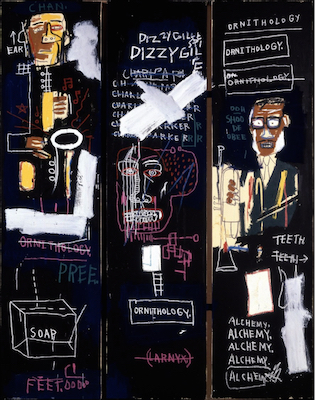
Identifying data: acrylic and oil paintstick on three canvas panels.
- Shows figures playing horns set against layered text, images, and symbols.
- Basquiat's bold lines and energetic mark-making connect to street art and his interest in jazz and Black cultural figures.
- One common reading: the work uses personal and cultural references to comment on race and identity in contemporary America.
Androgyne III (Magdalena Abakanowicz, 1985)
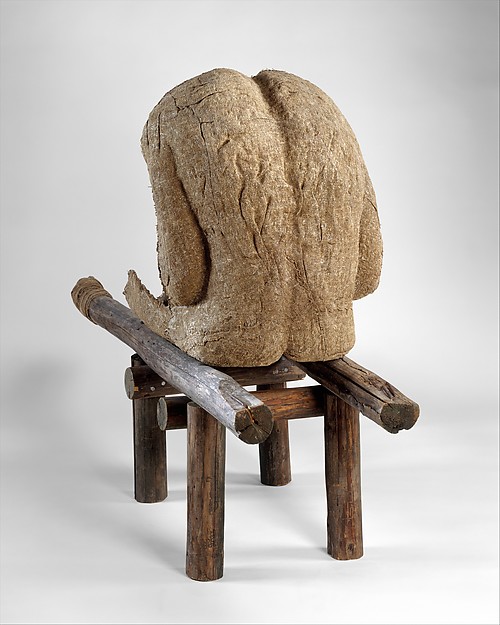
Identifying data: burlap, resin, wood, nails, and string.
- Part of a series of abstract, humanlike figures.
- The figure lacks specific features, which many viewers connect to ideas about shared human experience.
- Abakanowicz's use of fiber and organic materials reflects her broader focus on the human form.
Dancing at the Louvre (Faith Ringgold, 1991)

Identifying data: acrylic on canvas with a tie-dyed, pieced fabric border, from the series The French Collection, Part I; #1.
- A story quilt that places Black figures dancing inside the Louvre.
- Combines the quilting tradition with painting and narrative text.
- Often read as commentary on who is represented in major museums and in the story of fine art.
Electronic Superhighway (Nam June Paik, 1995)
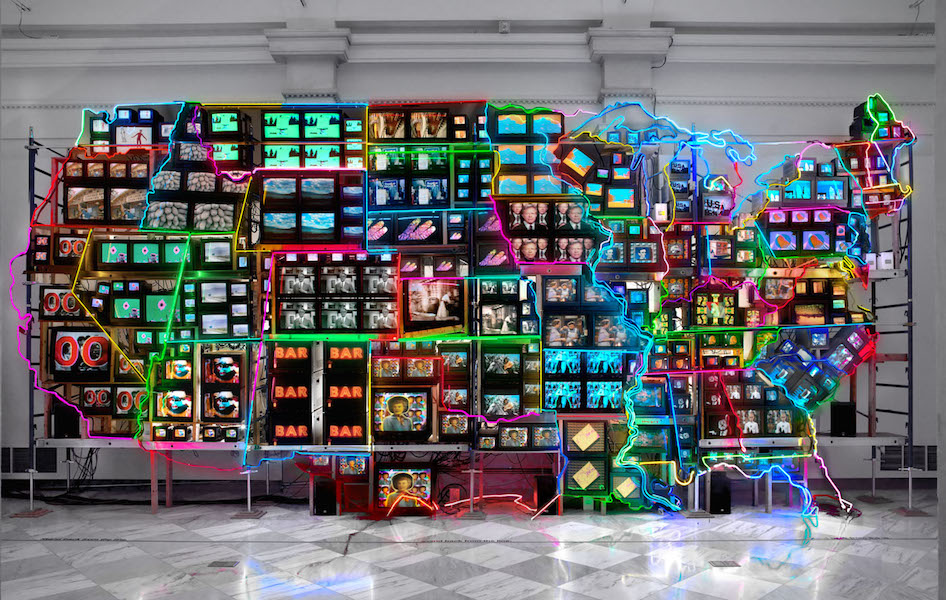
Identifying data: mixed-media installation with a 49-channel closed-circuit video installation, neon, steel, and electronic components.
- Maps the United States with neon outlines and running video on dozens of screens.
- Paik, an early video artist, explored how electronic media shape how we experience place and information.
- A clear example of how digital and electronic technology became central to contemporary art.
Stadia II (Julie Mehretu, 2004)

Identifying data: ink and acrylic on canvas, large-scale.
- Layers abstract marks, architectural lines, and flag-like forms that suggest stadiums and crowds.
- The dense, overlapping forms create a sense of motion and energy.
- Often read as a comment on globalization, spectacle, and shared public spaces.
Vietnam Veterans Memorial (Maya Lin, 1982)
Identifying data: granite, located on the National Mall, Washington, D.C.
- Two long, polished black granite walls set into the earth, inscribed with the names of those who died or went missing.
- The reflective surface lets visitors see themselves among the names.
- Added context, not part of the official identifying data: the abstract design was controversial when chosen, and it shifted how public memorials could look and feel.
Summer Trees (Song Su-nam, 1983)
Identifying data: ink on paper.
- Vertical bands of ink in varied tones suggest a grove of trees.
- Song Su-nam was a leader of the Sumukhwa (ink painting) movement in Korea.
- Connects East Asian ink traditions with modern abstraction.
A Book from the Sky (Xu Bing, 1987-1991)
Identifying data: mixed-media installation of printed books and scrolls.
- Thousands of invented characters that look like Chinese but carry no meaning.
- Hand-carved and printed using traditional woodblock methods.
- Often read as a question about language, communication, and cultural authority.
Untitled (#228), from the History Portraits series (Cindy Sherman, 1990)
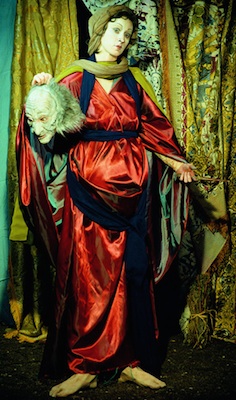
Identifying data: chromogenic color print.
- Sherman casts herself as the heroine in a scene based on the biblical story of Judith.
- She rebuilds a Renaissance and Baroque subject through staged photography, using cues like red robes and dramatic drapery.
- A strong example for comparison and appropriation questions, since it reworks an older tradition in a new medium.
Earth's Creation (Emily Kame Kngwarreye, 1994)
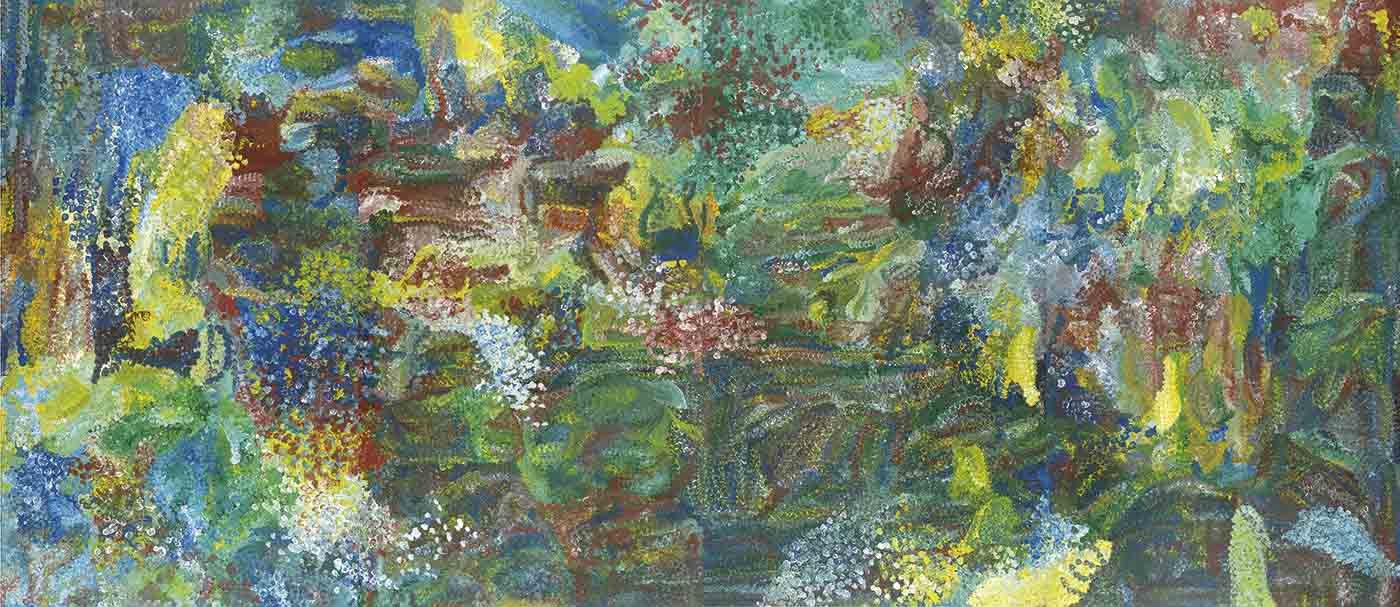
Identifying data: synthetic polymer paint on canvas, four panels.
- Built from dense, layered dabs of color across a large surface.
- Kngwarreye was an Anmatyerre artist from the Utopia community in Australia.
- Her work connects to her cultural ties to land while using modern acrylic paint.
Guggenheim Museum Bilbao (Frank Gehry, 1997)
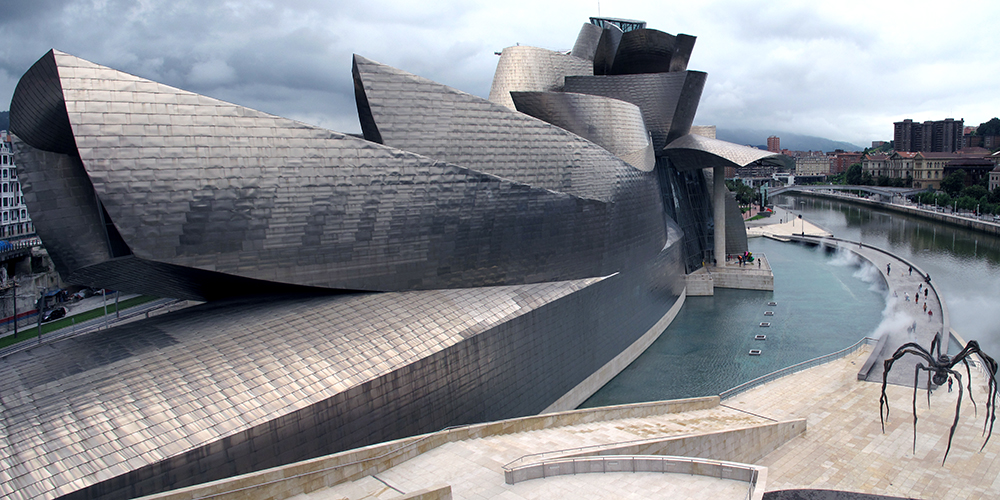
Identifying data: titanium, glass, and limestone, in Bilbao, Spain.
- Curving titanium-clad forms that catch light and reject straight, boxy lines.
- Built with computer-aided design that made its complex shapes possible.
- A leading example of how an iconic building can become a trademark and draw tourism to a city.
Pure Land (Mariko Mori, 1998)
Identifying data: color photograph on glass.
- Mori appears as a floating, deity-like figure in a glowing, otherworldly scene.
- Blends Buddhist imagery with futuristic, technology-driven visuals.
- Often read as a meeting point of spiritual tradition and contemporary technology.
Darkytown Rebellion (Kara Walker, 2001)

Identifying data: cut paper and projection on wall.
- Black cut-paper silhouettes act out a violent scene, with colored light projected over and onto viewers.
- Walker uses the old-fashioned silhouette format to confront the history of slavery in the United States.
- The projection pulls the viewer into the scene rather than letting them stay outside it.
Shibboleth (Doris Salcedo, 2007-2008)

Identifying data: installation at Tate Modern.
- A long crack running the length of the museum floor.
- Salcedo used the divide to speak about borders, exclusion, and the experience of immigrants and outsiders.
- The title refers to a word or marker used to separate one group from another.
MAXXI National Museum of XXI Century Arts (Zaha Hadid, 2009)

Identifying data: glass, steel, and cement, in Rome, Italy.
- Flowing, curving galleries that blur the line between inside and outside.
- Hadid used sweeping, fluid forms made possible by advanced design and engineering.
- Shows how contemporary museum architecture can be a destination in itself.
Kui Hua Zi (Sunflower Seeds) (Ai Weiwei, 2010-2011)

Identifying data: sculpted and painted porcelain.
- Millions of individually hand-made porcelain sunflower seeds spread across a floor.
- Made by many craftspeople in Jingdezhen, a Chinese city known for porcelain.
- Often read as a comment on the individual versus the mass, and on labor, history, and political power in China.
Trade (Gifts for Trading Land with White People) (Jaune Quick-to-See Smith, 1992)

Identifying data: oil and mixed media on canvas.
- Combines painting, collage, news clippings, and hanging found objects like toys and sports memorabilia.
- Smith, a Native American artist, references unfair trades and stereotypes tied to Indigenous land and identity.
- Often read as a critique of how Native cultures are commercialized and misrepresented.
Rebellious Silence, from the Women of Allah series (Shirin Neshat, 1994)
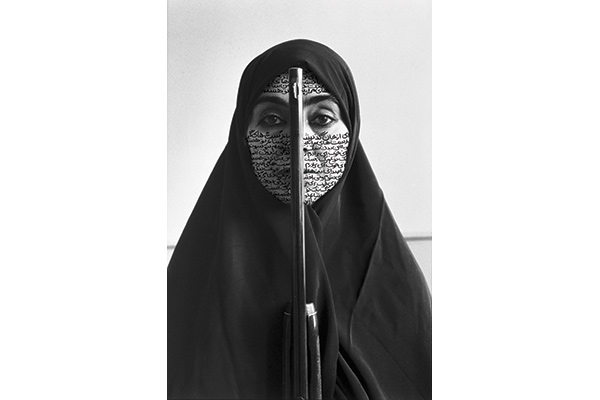
Identifying data: ink on photograph; photographed by Cynthia Preston.
- A black-and-white portrait of a veiled woman, her face split by a vertical rifle, with Farsi text written across the skin.
- Neshat explores gender, faith, and identity in relation to women in Iran.
- The dividing line of the rifle creates tension between the woman and the viewer.
En la Barberia no se Llora (No Crying Allowed in the Barbershop) (Pepon Osorio, 1994)
Identifying data: mixed-media installation.
- A barbershop filled with objects, images, and references to masculinity and Puerto Rican identity.
- Osorio packs the space with detail, inviting viewers to read the room like a layered story.
- Often read as a look at how ideas about manhood are taught and reinforced.
Pisupo Lua Afe (Corned Beef 2000) (Michel Tuffery, 1994)
Identifying data: mixed media.
- A life-size bull built from flattened corned-beef tins.
- Tuffery references how imported canned foods changed diet and trade in the Pacific.
- Often read as a comment on colonial influence, consumption, and Pacific identity.
Lying with the Wolf (Kiki Smith, 2001)

Identifying data: ink and pencil on paper.
- A large drawing of a nude woman resting calmly beside a wolf.
- Smith often explores the body, nature, and stories from myth and folklore.
- The peaceful pairing suggests a bond between human and animal rather than threat.
The Swing (after Fragonard) (Yinka Shonibare, 2001)
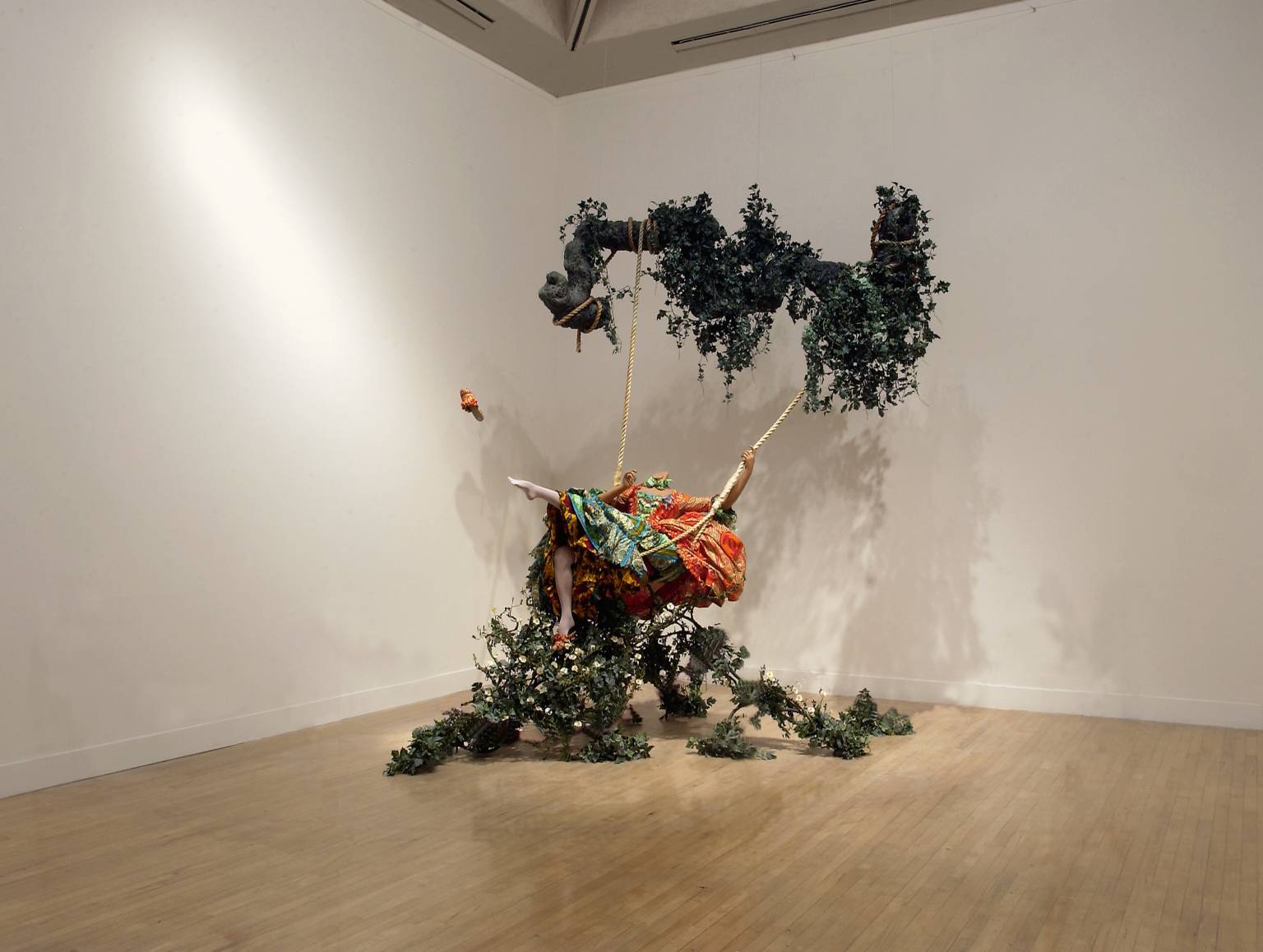
Identifying data: mixed-media installation.
- Recreates a famous Rococo painting as a sculpture, with a headless figure dressed in colorful Dutch wax fabric.
- The fabric, often linked to African identity, was tied to European colonial trade.
- Often read as a critique of class, colonialism, and the wealth behind European art.
Old Man's Cloth (El Anatsui, 2003)
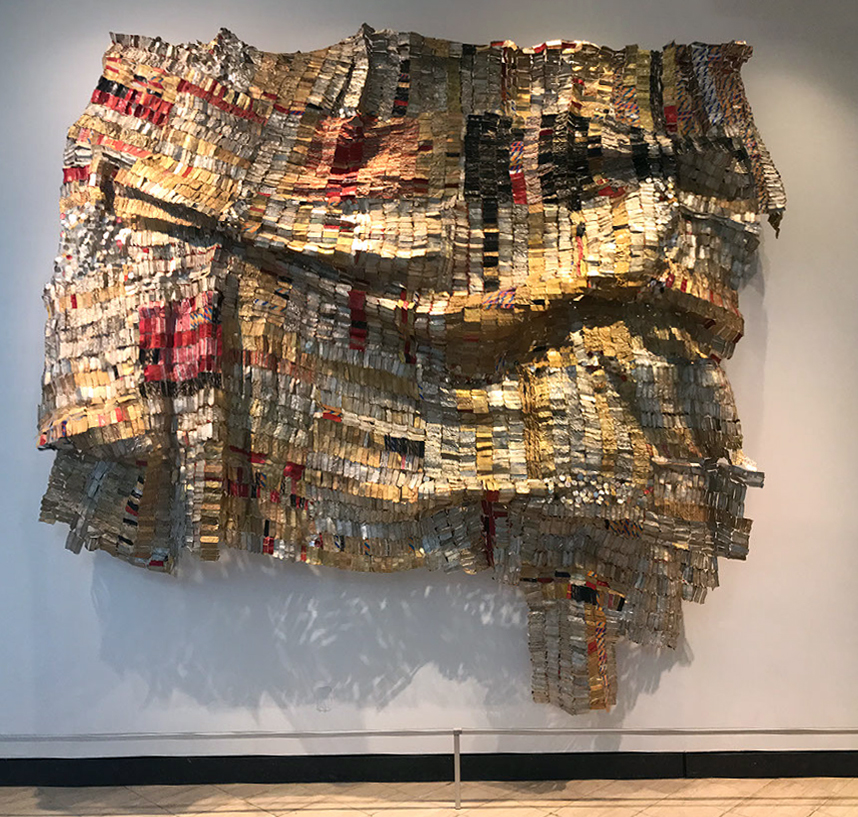
Identifying data: aluminum and copper wire.
- A large, flexible hanging made from flattened liquor-bottle caps stitched together with wire.
- Drapes like cloth and references West African textile traditions such as kente.
- Often read as a comment on trade, consumption, and the history connecting Africa, Europe, and the Americas.
Preying Mantra (Wangechi Mutu, 2006)
Identifying data: mixed media on Mylar.
- A collaged female figure built from cut images, paint, and varied textures, reclining in a stylized landscape.
- Mutu blends references to the body, nature, and media images.
- Often read as commentary on how women, and especially Black women, are pictured and consumed.
The Gates (Christo and Jeanne-Claude, 1979-2005)
Identifying data: mixed-media installation in New York City.
- Thousands of saffron-colored fabric panels hung from gates along the paths of Central Park.
- A temporary work that existed only briefly before being removed.
- Often used as an example of ephemeral art that changes how people experience a public space.
The Crossing (Bill Viola, 1996)
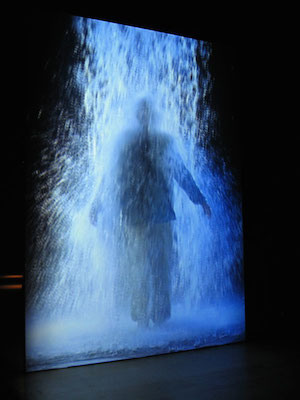
Identifying data: video/sound installation.
- Two large projections show a figure overwhelmed, one by fire and one by water.
- Viola slows time and uses sound to create an intense, almost spiritual experience.
- Often read as a meditation on transformation, destruction, and renewal.
How to Use This on the AP Art History Exam
Identification
For each work, be able to name the title, artist or architect, date, and medium without hesitating. The exam expects accurate attribution, so practice with flashcards until the identifying data is automatic.
Visual Analysis
Describe what you actually see: materials, color, scale, composition, and technique. Then explain how those choices shape meaning. For example, the reflective granite of the Vietnam Veterans Memorial places visitors among the names, which supports its theme of loss and reflection.
Comparison
Many Unit 10 works pair well for comparison. Untitled (#228) reworks a Renaissance and Baroque subject in photography, while The Swing (after Fragonard) reworks a Rococo painting as sculpture. Both fit appropriation and continuity-and-change prompts. Choose specific points of comparison rather than general ones.
Free Response
Make a defensible claim, then support it with specific evidence from form, content, and context. Use connecting words like "because" or "through" to tie evidence to your claim. Saying a work "shows globalization" is too vague; explain how a specific material or image does that, like the corned-beef tins in Pisupo Lua Afe pointing to imported foods in the Pacific.
Common Misconceptions
- "Contemporary art has no rules or context." These works are often direct responses to earlier art, traditions, or events, so naming the reference is part of the analysis.
- "Mixed media just means messy." Materials are deliberate choices. Porcelain seeds, bottle caps, and corned-beef tins each carry specific meaning tied to labor, trade, or culture.
- "Global contemporary means only European and American art." Since 1980, artists from Africa, Asia, Oceania, and First Nations communities have received major attention, and the unit reflects that global range.
- "Untitled (#228) is from the Untitled Film Stills series." It is from the History Portraits series and reworks a biblical subject from Renaissance and Baroque art.
- "Earth's Creation shows a specific snake or single creation scene." Stick to what is supported: dense layered color by an Anmatyerre artist connected to her ties to land. Avoid inventing exact iconography.
- "You can support a stronger score with general statements." The free-response section rewards specific, relevant evidence, not broad claims about meaning.
Related AP Art History Guides
- Unit 10 Overview: Global Contemporary, 1980 CE to Present
- 10.3 Interactions Within and Across Cultures in Global Contemporary Art
- 10.1 Materials, Processes, and Techniques in Global Contemporary Art
- 10.4 Theories and Interpretations of Global Contemporary Art
- 10.2 Purpose and Audience in Global Contemporary Art
Frequently Asked Questions
How many required works are in AP Art History Unit 10?
AP Art History Unit 10 includes 27 required works, numbered 224 through 250, from Global Contemporary art.
What time period does AP Art History Unit 10 cover?
Unit 10 covers Global Contemporary art from 1980 CE to the present, including installations, photography, video, architecture, mixed media, and other contemporary forms.
What should I memorize for Unit 10 required works?
For each work, know the title, artist or architect, date, medium, and the main context or idea that helps explain its meaning.
Why is Unit 10 important for the AP Art History exam?
Unit 10 is about 11 percent of the AP Art History exam and is useful for comparison, visual analysis, and questions about globalization, identity, technology, and contemporary materials.
Which themes are common in Global Contemporary required works?
Common themes include globalization, identity, appropriation, technology, public memory, migration, gender, colonial history, labor, and the expanded definition of art.
How should I use Unit 10 works in FRQs?
Use specific visual, contextual, or material evidence. Instead of saying a work shows globalization, explain how a material, reference, location, or audience supports that claim.