9.1 Concentration Boundary Layers

❤️🔥Heat and Mass Transfer Unit 9 Review
9.1 Concentration Boundary Layers
❤️🔥 Heat and Mass Transfer
Concentration Boundary Layers
When a fluid flows over a surface that has a different species concentration, a thin region forms where the concentration transitions from the surface value to the bulk fluid value. This region is the concentration boundary layer, and it controls how fast mass transfers between the surface and the fluid. Understanding its behavior is essential for designing equipment like absorption columns, membrane separators, and catalytic reactors.

Top images from around the web for Concept and Formation
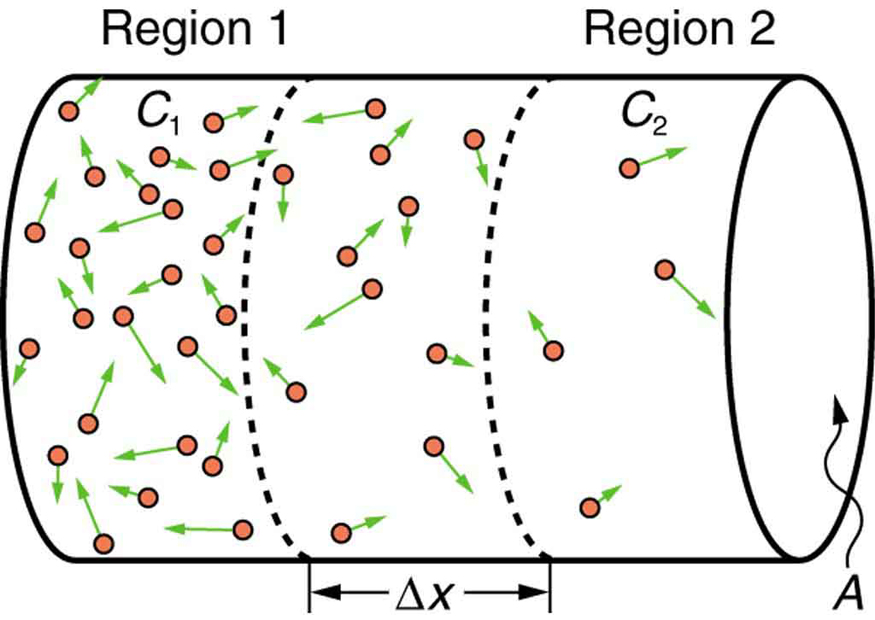
Molecular Transport Phenomena: Diffusion, Osmosis, and Related Processes | Physics View original
Is this image relevant?
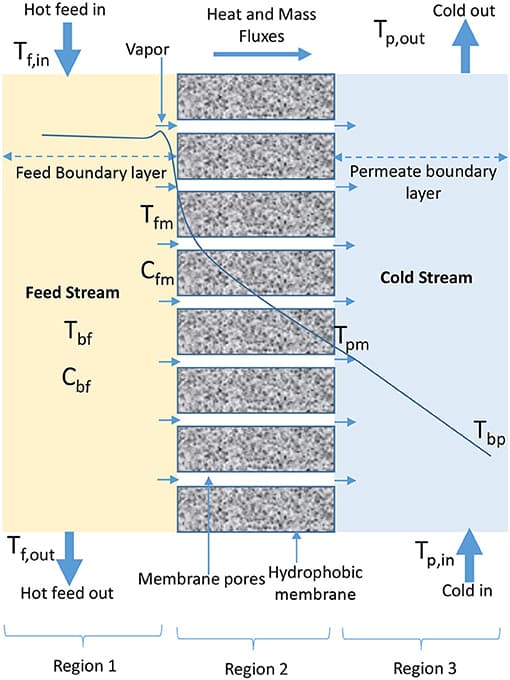
Frontiers | Heat and Mass Transport in Modeling Membrane Distillation Configurations: A Review View original
Is this image relevant?
Molecular Transport Phenomena: Diffusion, Osmosis, and Related Processes | Physics View original
Is this image relevant?
Frontiers | Heat and Mass Transport in Modeling Membrane Distillation Configurations: A Review View original
Is this image relevant?
Concept and Formation
A concentration boundary layer develops because species diffuse between the surface and the flowing fluid. Diffusion moves species from regions of high concentration to low concentration, creating a gradient near the surface.
The boundary layer thickness () is defined as the distance from the surface where the concentration reaches 99% of the bulk fluid concentration. Almost all the resistance to mass transfer sits inside this thin layer, so its thickness directly determines how fast species move between the surface and the fluid.
This is directly analogous to the velocity boundary layer in fluid mechanics:
- A velocity boundary layer is where fluid velocity changes from zero at the surface (no-slip condition) to the free-stream velocity.
- A concentration boundary layer is where species concentration changes from the surface concentration () to the bulk concentration ().
Both layers feature steep gradients and reduced mixing compared to the bulk flow.
Key Characteristics
- Steep concentration gradients exist normal to the surface. The concentration changes rapidly over a very short distance.
- Molecular diffusion dominates transport within the boundary layer, rather than convective mixing.
- The Sherwood number () is the mass transfer analog of the Nusselt number () in heat transfer. It relates the convective mass transfer coefficient to the diffusive transport rate:
where is the mass transfer coefficient, is a characteristic length, and is the mass diffusivity.
Factors Influencing Boundary Layer Thickness
Flow and Transport Properties
The concentration boundary layer thickness depends on the competition between diffusion (which thickens the layer) and convection (which thins it).
- Fluid velocity: Higher velocities enhance mixing near the surface, sweeping away diffusing species and producing a thinner boundary layer.
- Diffusion coefficient: A smaller diffusion coefficient means species spread more slowly, so the boundary layer stays thinner because diffusion can't penetrate as far into the flow.
- Distance from the leading edge: The boundary layer starts extremely thin at the leading edge and grows downstream as diffusion has more time to act.
The Schmidt number () captures the relative importance of momentum and mass transport:
where is the kinematic viscosity and is the mass diffusivity. A high means momentum diffuses much faster than mass, so the concentration boundary layer is thinner than the velocity boundary layer. For gases, , so the two layers have similar thickness. For liquids, can be on the order of 1000, meaning the concentration boundary layer is much thinner.
Surface and Reaction Effects
- Surface roughness promotes turbulence and mixing near the wall. Roughness elements disrupt the smooth boundary layer, thinning it and increasing mass transfer rates compared to a smooth surface.
- Chemical reactions at the surface change the local concentration and therefore reshape the boundary layer:
- A reaction that consumes species at the surface steepens the concentration gradient and thins the boundary layer.
- A reaction that produces species at the surface flattens the gradient and thickens the boundary layer.
- Temperature gradients can couple with mass transfer through the Soret effect (thermodiffusion), where species migrate in response to a temperature difference. Depending on the sign of the Soret coefficient, this can push species toward or away from the surface, modifying the concentration profile.
Applications
Mass Transfer Equipment Design
Concentration boundary layers directly limit performance in many engineering systems:
- Absorption columns separate gases or liquids by selective absorption into a solvent. The boundary layer on the liquid film surface controls how fast the solute transfers.
- Membrane separators rely on selective permeation through a membrane. Concentration polarization (boundary layer buildup on the membrane surface) can significantly reduce flux.
- Catalytic reactors require reactants to reach the catalyst surface and products to leave it. If the boundary layer is thick, mass transfer rather than reaction kinetics becomes the bottleneck.
Common techniques for reducing boundary layer thickness and boosting mass transfer:
- Increase fluid velocity to enhance convective mixing.
- Add turbulence promoters (baffles, packing materials) to disrupt the boundary layer.
- Use active mixing devices (stirrers, impellers) to generate forced convection near the surface.
Modeling and Analysis
The mass flux across a concentration boundary layer follows Fick's first law:
where is the mass flux, is the diffusion coefficient, and is the concentration gradient evaluated at the surface.
The mass transfer coefficient () provides a more practical way to calculate flux without knowing the exact concentration profile:
You can estimate from empirical correlations that relate three dimensionless numbers:
- Sherwood number (): convective-to-diffusive mass transport ratio
- Reynolds number (): inertial-to-viscous force ratio
- Schmidt number (): momentum-to-mass diffusivity ratio
A typical correlation for flow over a flat plate in laminar conditions takes the form:
To find the full concentration profile within the boundary layer, you solve the species conservation equation with both diffusion and convection terms, applying boundary conditions at the surface () and far from the surface ().
For more complex situations involving high mass transfer rates or surface reactions, simpler models are often used:
- Film theory assumes a stagnant film of thickness near the surface where transport occurs purely by diffusion. This gives .
- Penetration theory treats mass transfer as unsteady diffusion into a fluid element that is periodically replaced at the surface. This gives , where is the contact time.
Each model has trade-offs in accuracy and complexity, but both provide useful estimates when the full boundary layer solution is impractical.
See Fiveable more often in Google
Mark Fiveable as a preferred source and Google is more likely to show you our guides in Top Stories, with a "preferred" badge in AI Mode and AI Overviews.