7.2 Multidimensional Steady-State Diffusion

❤️🔥Heat and Mass Transfer Unit 7 Review
7.2 Multidimensional Steady-State Diffusion
❤️🔥 Heat and Mass Transfer
Multidimensional Steady-State Diffusion
Multidimensional steady-state diffusion extends the one-dimensional treatment of Fick's law to systems where concentration gradients exist in two or three spatial directions simultaneously. Most real engineering geometries don't reduce neatly to a single axis, so this framework is essential for analyzing diffusion in composite materials, porous media, catalytic pellets, and environmental transport problems.

Top images from around the web for Extending Concepts to Multidimensional Systems
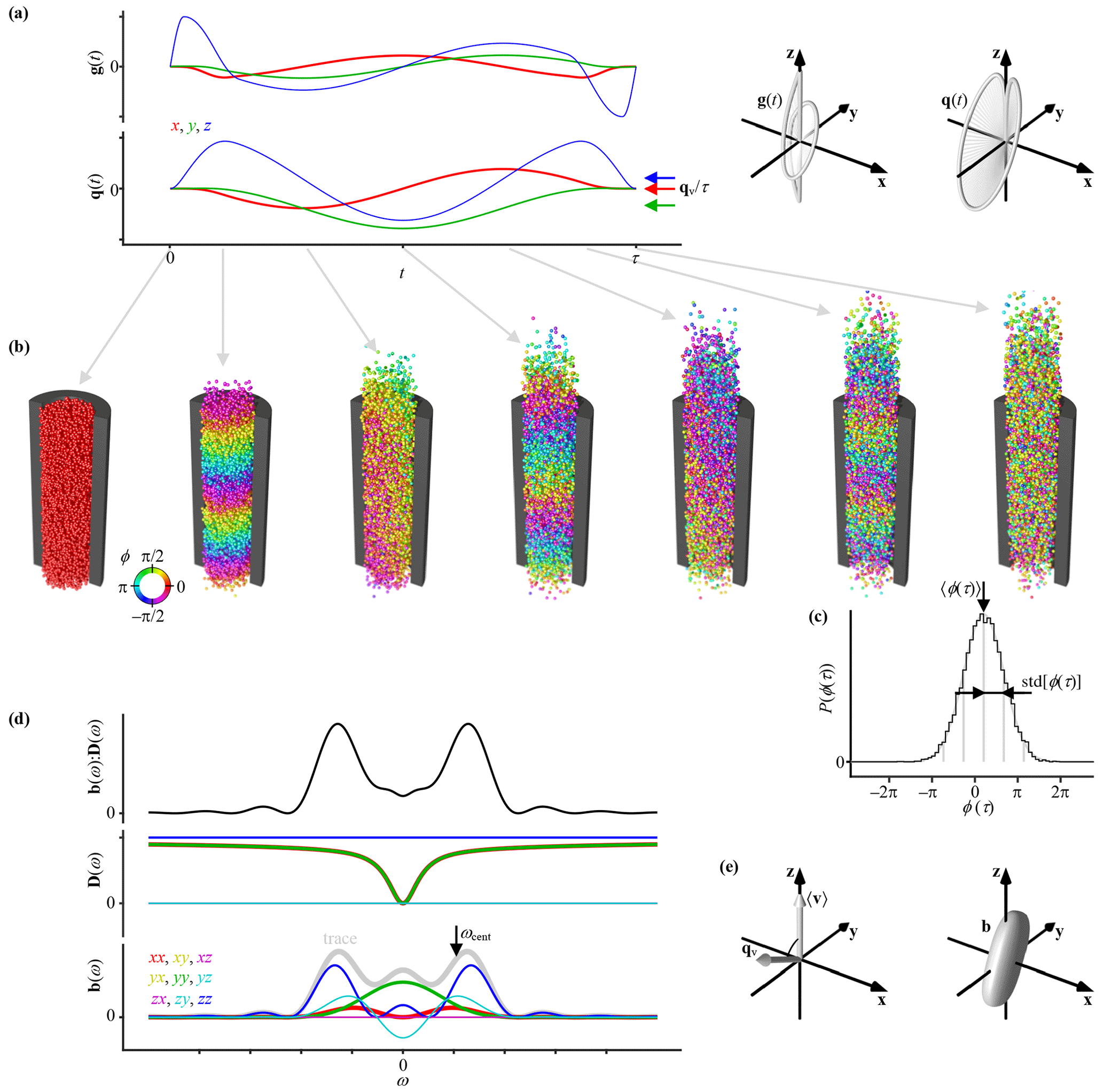
MR - Multidimensional encoding of restricted and anisotropic diffusion by double rotation of the ... View original
Is this image relevant?
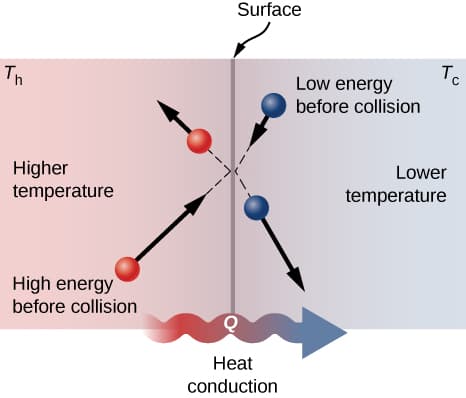
1.6 Mechanisms of Heat Transfer – University Physics Volume 2 View original
Is this image relevant?
Fick's laws of diffusion - Wikipedia View original
Is this image relevant?
MR - Multidimensional encoding of restricted and anisotropic diffusion by double rotation of the ... View original
Is this image relevant?
1.6 Mechanisms of Heat Transfer – University Physics Volume 2 View original
Is this image relevant?
Extending Concepts to Multidimensional Systems
The general vector form of Fick's first law for multidimensional diffusion is:
where:
- is the diffusive flux vector (with components in each spatial direction)
- is the diffusion coefficient
- is the concentration gradient vector
Each component of the flux corresponds to the concentration gradient in that direction. For example, in Cartesian coordinates: , , .
When the diffusion coefficient differs by direction (), you have anisotropic diffusion. This shows up in materials with directional microstructure, like wood, fiber-reinforced composites, or layered soils where species move more easily along certain axes than others.
For isotropic diffusion, , and the flux expression simplifies considerably.
Steady state means the concentration at every point is constant in time: . Combined with conservation of mass (no chemical reaction), this gives the continuity equation:
This says the divergence of the flux is zero: whatever mass flows into a differential volume element must flow out. Substituting Fick's first law into this continuity equation produces the governing PDE for steady-state diffusion:
For isotropic, constant , this reduces to Laplace's equation: . If you've seen Laplace's equation in heat conduction, the math here is identical with concentration replacing temperature.
Solving Multidimensional Diffusion Problems
Solving these problems requires two things: the governing equation in the appropriate coordinate system and a complete set of boundary conditions.
Boundary condition types:
- Dirichlet (constant concentration): The concentration is fixed at a boundary surface, e.g., a gas-liquid interface held at saturation concentration.
- Neumann (constant flux): The mass flux is specified at the boundary, e.g., a known evaporation rate from a surface.
- Robin (mixed): A linear combination of concentration and flux is specified, analogous to a convective boundary condition in heat transfer.
You need enough boundary conditions to close the problem in every active spatial dimension.
Analytical solution methods work for simple, regular geometries with straightforward boundary conditions:
- Separation of variables — Assume the solution is a product of functions, each depending on only one coordinate (e.g., ). Substitute into Laplace's equation, separate, and solve the resulting ODEs individually. Apply boundary conditions to determine constants and eigenvalues.
- Laplace transforms — Transform the PDE in one variable to reduce dimensionality, solve the resulting simpler equation, then invert.
Numerical methods become necessary for irregular geometries, spatially varying , or complex boundary conditions:
- Finite difference methods discretize the domain onto a grid and approximate derivatives with algebraic differences.
- Finite element methods divide the domain into elements of arbitrary shape, making them well-suited for complex geometries.
Fick's Law in Multidimensions
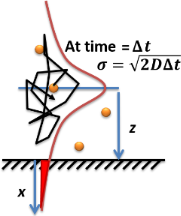
Concentration Profiles
The concentration profile depends on the geometry, boundary conditions, and whether diffusion is isotropic or anisotropic. The choice of coordinate system should match the geometry of the problem:
- Cartesian coordinates for rectangular slabs, blocks, or channels
- Cylindrical coordinates for pipes, fibers, or any system with axial symmetry
- Spherical coordinates for droplets, catalyst pellets, or bubbles
Symmetry is your best tool for simplification. A long cylindrical rod with uniform boundary conditions along its length and around its circumference reduces to only, turning a 3D problem into a 1D ODE.
Diffusive Fluxes
Once you know the concentration profile, you calculate flux components directly from Fick's first law by taking partial derivatives.
For anisotropic materials, the flux vector is generally not parallel to the concentration gradient . This is because different diffusion coefficients in different directions "steer" the flux away from the gradient direction. (In the fully general anisotropic case, becomes a tensor rather than a scalar, but for most undergraduate treatments, direction-dependent scalar coefficients suffice.)
The total flux magnitude is found from the Euclidean norm:
Geometry and Boundary Conditions in Diffusion
Influence of Geometry
The coordinate system you choose determines the specific form of :
- Cartesian:
- Cylindrical:
- Spherical:
Always look for symmetry first. If concentration doesn't vary with or , those terms drop out and the problem becomes much more tractable.
Boundary Conditions
Boundary conditions are what make each diffusion problem unique. The same Laplace equation governs a huge range of physical situations; the BCs determine the actual concentration field.
For problems with irregular geometries where analytical solutions aren't feasible, two useful analytical approximation techniques exist:
- Method of images: Place fictitious sources or sinks to satisfy boundary conditions at flat surfaces, similar to the technique used in electrostatics.
- Superposition principle: Since Laplace's equation is linear, you can add solutions. Break a complex problem into simpler sub-problems, solve each, and sum the results.
Sources and Sinks
When mass is generated or consumed within the domain, the governing equation gains a source term:
where is the volumetric rate of mass generation (positive for sources, negative for sinks).
- Sources (): increase local concentration. Examples include dissolution of a solid phase or a chemical reaction producing a species.
- Sinks (): decrease local concentration. Examples include a first-order chemical reaction consuming a reactant () or absorption into a second phase.
With sources or sinks, the governing equation becomes Poisson's equation rather than Laplace's equation, and the solution methods are similar but require particular solutions in addition to homogeneous ones.
See Fiveable more often in Google
Mark Fiveable as a preferred source and Google is more likely to show you our guides in Top Stories, with a "preferred" badge in AI Mode and AI Overviews.