12.1 Turbulent Heat and Mass Transfer

❤️🔥Heat and Mass Transfer Unit 12 Review
12.1 Turbulent Heat and Mass Transfer
❤️🔥 Heat and Mass Transfer
Turbulent heat and mass transfer describes how chaotic fluid motion dramatically increases the rate at which heat and species are transported compared to orderly, laminar flow. This topic is central to the design of heat exchangers, cooling systems, and chemical reactors, where engineers must balance improved transfer rates against the energy cost of driving turbulent flow.
Turbulent Flow Characteristics and Impacts

Top images from around the web for Characteristics of Turbulent Flow
AMT - Assets - Eddies in motion: visualizing boundary-layer turbulence above an open boreal ... View original
Is this image relevant?
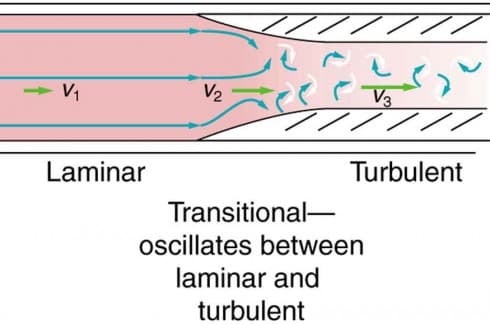
The Onset of Turbulence | Physics View original
Is this image relevant?
Fluid Dynamics – University Physics Volume 1 View original
Is this image relevant?
AMT - Assets - Eddies in motion: visualizing boundary-layer turbulence above an open boreal ... View original
Is this image relevant?
The Onset of Turbulence | Physics View original
Is this image relevant?
Characteristics of Turbulent Flow
Turbulent flow features chaotic, time-varying fluctuations in velocity, pressure, and temperature. These fluctuations produce eddies across a wide range of sizes and frequencies, and it's these eddies that are responsible for the enhanced mixing and transport you see in turbulent flows. The largest eddies extract energy from the mean flow, while progressively smaller eddies transfer that energy down the cascade until the smallest eddies dissipate it as heat through viscous effects.
The Reynolds number () quantifies the ratio of inertial to viscous forces and determines whether flow will be laminar or turbulent:
- For internal flows (pipes, channels), the transition to turbulence typically occurs around
- For external flows over a flat plate, the critical value is roughly
Higher means inertial forces increasingly dominate, making the flow more prone to turbulence.
Impact on Heat and Mass Transfer
Turbulent mixing transports fluid particles across streamlines far more effectively than molecular diffusion alone, which is why turbulent flows have significantly higher heat and mass transfer coefficients than laminar flows.
Several factors influence the degree of enhancement:
- Flow velocity: Higher velocities increase and turbulence intensity, directly boosting transfer rates.
- Surface roughness: Rough surfaces introduce disturbances that trip the boundary layer into turbulence earlier and increase the effective surface area for transfer.
- Geometry: Complex geometries such as heat exchanger fins, packed beds, and baffled channels force flow disruptions that promote turbulent mixing.
- Fluid properties: Viscosity, thermal conductivity, and diffusivity all affect how readily turbulence enhances transport.
Turbulent Boundary Layers and Convective Transfer

Structure of Turbulent Boundary Layers
A turbulent boundary layer is not uniformly chaotic. It has three distinct regions, each with different transport mechanisms:
- Viscous (laminar) sublayer: A very thin region immediately adjacent to the wall where viscous shear dominates. The velocity profile here is nearly linear, and molecular diffusion controls heat and mass transfer.
- Buffer layer: A transitional zone where both viscous and turbulent effects contribute comparably. This region is notoriously difficult to model because neither mechanism can be neglected.
- Fully turbulent (log-law) region: The outermost and thickest part of the boundary layer, characterized by a logarithmic velocity profile. Turbulent eddies dominate transport here, and molecular diffusion is negligible by comparison.
The overall boundary layer thickness grows along the flow direction, which means local heat and mass transfer coefficients vary with position. Near the leading edge (where the boundary layer is thin), coefficients tend to be highest.
Convective Heat and Mass Transfer in Turbulent Flows
Because turbulent eddies carry packets of fluid with different temperatures or concentrations across the boundary layer, the effective diffusivity in turbulent flow is much larger than the molecular diffusivity. This is why turbulent boundary layers yield higher convective transfer coefficients than laminar ones.
Practical applications that rely on this enhancement include:
- Heat exchangers (shell-and-tube, plate-fin): turbulent flow on both fluid sides maximizes the overall heat transfer coefficient.
- Electronics and turbine blade cooling: turbulent convection efficiently removes concentrated heat loads from small surfaces.
- Chemical reactors (packed bed, fluidized bed): turbulent mass transfer improves species transport to catalyst surfaces, increasing reaction rates.
Estimating Turbulent Transfer Coefficients

Empirical Correlations for Internal Flows
Because turbulence is too complex to solve analytically in most practical geometries, engineers rely on empirical correlations. The two most common for fully developed turbulent flow in smooth circular pipes are:
Dittus-Boelter equation:
where for heating and for cooling. This correlation is valid for , , and (fully developed flow).
Sieder-Tate equation:
The viscosity ratio corrects for the fact that fluid viscosity near the heated (or cooled) wall differs from the bulk value. This makes the Sieder-Tate equation more accurate when there is a large temperature difference between the fluid and the wall.
These correlations should only be used within their stated ranges of , , and . Applying them outside those ranges can introduce significant error.
Analogies and Correlations for External Flows
For external flows, transfer coefficients are often estimated using analogies that link momentum, heat, and mass transfer:
Reynolds analogy (simplest form, valid when ):
where is the Stanton number and is the Fanning friction factor. This assumes the turbulent transport mechanisms for momentum and heat are identical.
Chilton-Colburn analogy (more general, valid for ):
Here and are the Colburn j-factors for heat and mass transfer, is the Prandtl number, and (the Schmidt number) replaces when estimating mass transfer. This analogy is especially useful because it lets you estimate mass transfer coefficients from heat transfer data (or vice versa) without running separate experiments.
Common empirical correlations for specific external geometries:
- Flat plate (local, turbulent): , where is based on the distance from the leading edge.
- Tube banks (Zukauskas correlation): , where the constants and depend on the tube arrangement (inline vs. staggered) and the range. Values of and are tabulated in reference texts.
Enhancing Heat and Mass Transfer Rates
Turbulence-Enhancing Techniques
When natural turbulence levels are insufficient, engineers use passive or active techniques to intensify mixing:
Surface modifications:
- Roughness elements (sand-grain roughness, grooves, dimples) trip the boundary layer into turbulence earlier and increase the effective transfer area.
- Rough-walled tubes are commonly used in heat exchangers specifically for this purpose.
Flow inserts (turbulence promoters):
- Twisted tapes generate swirl and secondary flows inside tubes, promoting cross-stream mixing.
- Coiled wires create periodic flow disturbances along the tube wall.
- Static mixers (baffles, helical elements) repeatedly split and recombine the flow, enhancing turbulence in chemical reactors and process piping.
Evaluation of Turbulence-Enhancing Techniques
The benefit of any enhancement technique is quantified by comparing transfer performance with and without the enhancement:
- Enhancement factor: the ratio of the enhanced Nusselt number (or Sherwood number) to the baseline value. A factor of 2 means the technique doubles the transfer coefficient.
- Performance data come from both experimental measurements and computational (CFD) simulations across a range of and geometries.
The critical trade-off is that increased turbulence almost always increases the pressure drop, which raises pumping power and operating cost. A technique that triples heat transfer but increases pressure drop tenfold may not be economically viable.
Optimization studies aim to find the design parameters (roughness height, tape twist ratio, wire pitch) that maximize the ratio of heat/mass transfer enhancement to pressure drop penalty. This balance between transfer performance and energy cost is ultimately what determines whether a given technique is worth implementing.
See Fiveable more often in Google
Mark Fiveable as a preferred source and Google is more likely to show you our guides in Top Stories, with a "preferred" badge in AI Mode and AI Overviews.