5.1 Types of Heat Exchangers

❤️🔥Heat and Mass Transfer Unit 5 Review
5.1 Types of Heat Exchangers
❤️🔥 Heat and Mass Transfer
Heat Exchanger Types
Heat exchangers transfer thermal energy between two or more fluids without allowing them to mix. Selecting the right type for a given application depends on understanding how each design is constructed, how the fluids flow through it, and what trade-offs come with each option.

Top images from around the web for Construction-based Classification
Heat exchanger - Wikipedia View original
Is this image relevant?
Shell and tube heat exchanger - Wikipedia View original
Is this image relevant?
Intercambiador de calor - Wikipedia, la enciclopedia libre View original
Is this image relevant?
Heat exchanger - Wikipedia View original
Is this image relevant?
Shell and tube heat exchanger - Wikipedia View original
Is this image relevant?
Construction-Based Classification
There are three broad families of heat exchangers based on how they're built: tubular, plate, and extended surface.
Tubular Heat Exchangers
These are the most common family. The fluid streams are separated by tube walls.
- Double pipe heat exchangers use two concentric pipes. One fluid flows through the inner pipe while the other flows through the annular space between the pipes. They're simple and inexpensive, making them a good fit for small-scale applications with modest heat duty.
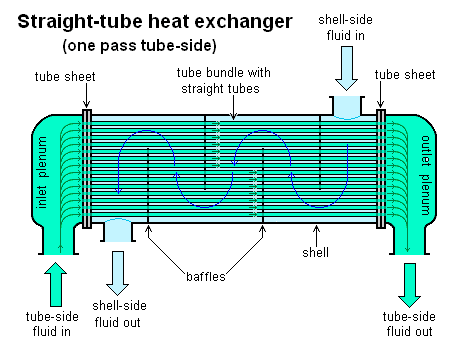
- Shell and tube heat exchangers pack a bundle of tubes inside a cylindrical shell. One fluid flows through the tubes; the other flows over and around them on the shell side. Baffles inside the shell direct flow and promote turbulence. These are the workhorse of chemical and power industries because they handle high pressures, high temperatures, and large flow rates.
- Spiral tube heat exchangers coil the tube bundle into a spiral shape. The geometry naturally promotes turbulence, which improves heat transfer, especially with viscous fluids that would otherwise flow in laminar regimes.
Plate Heat Exchangers
A plate heat exchanger stacks a series of thin, corrugated metal plates together. Fluids flow through alternate channels between the plates in either counter-current or cross-flow arrangements. The corrugations serve two purposes: they increase surface area and they trip the flow into turbulence at lower velocities.
Plates are sealed with gaskets or welding. Gasketed designs can be taken apart easily for cleaning, which is why they're popular in food, dairy, and pharmaceutical processing where hygiene standards are strict.
Extended Surface (Finned) Heat Exchangers
When one of the fluids has a low heat transfer coefficient (like air or another gas), fins are added to increase the effective surface area on that side.
- Plate-fin heat exchangers sandwich corrugated fins between flat plates. The result is a very compact, lightweight unit with a large surface-area-to-volume ratio. You'll find these in cryogenic systems (air separation, LNG) and aerospace applications where weight matters.
- Tube-fin heat exchangers attach fins to the outside of tubes. The finned side faces the gas stream while liquid flows inside the tubes. Automotive radiators, air conditioning condensers, and refrigeration evaporators all use this design.
Flow Arrangement-Based Classification
How the hot and cold fluids move relative to each other has a direct impact on the temperature profile and the maximum heat transfer effectiveness the exchanger can achieve.
- Parallel flow: Both fluids enter at the same end and flow in the same direction. The outlet temperature of the cold fluid can never exceed the outlet temperature of the hot fluid, which limits effectiveness.
- Counter flow: Fluids enter at opposite ends and flow in opposite directions. This arrangement produces the highest mean temperature difference for a given set of inlet/outlet temperatures, so it achieves the greatest effectiveness of any two-stream configuration.
- Cross flow: Fluids flow perpendicular to each other. Effectiveness falls between parallel and counter flow. Automotive radiators and air-cooled condensers commonly use this arrangement because it's practical for gas-to-liquid heat transfer where the gas flows across a tube bank.
Regenerative Heat Exchangers
Regenerators work differently from the types above. Instead of transferring heat through a wall separating two simultaneous fluid streams, they use a heat storage medium (a matrix) that alternately absorbs heat from the hot stream and releases it to the cold stream.
- Rotary regenerators (heat wheels) use a slowly rotating matrix. As it turns, one sector is exposed to the hot gas and the other to the cold gas. These are common in power plant air preheaters and waste heat recovery systems.
- Fixed matrix regenerators keep the matrix stationary while valves alternate the hot and cold streams through it. They're suited for high-temperature applications like steel and glass manufacturing.

Working Principles
Each heat exchanger type has distinct mechanisms that govern its thermal performance.
Double Pipe: Heat transfers through the inner pipe wall by conduction, driven by the temperature difference between the two fluid streams. The overall heat transfer coefficient, , depends on the convection coefficients on both sides, the pipe wall's thermal conductivity, and any fouling resistance. These units work in either parallel or counter-flow mode.
Shell and Tube: The tube-side fluid flows inside the tubes while the shell-side fluid flows across and along the tube bundle. Baffles on the shell side force the fluid to change direction repeatedly, which increases turbulence and the shell-side heat transfer coefficient. Tube configurations include straight tubes, U-tubes, and helical coils. Shell types are designated by TEMA standards (E, F, G, H, J, K, X), each offering different flow patterns and pass arrangements.
Plate: Fluids flow through narrow channels formed between corrugated plates. The corrugation pattern creates turbulence even at relatively low flow velocities, which boosts heat transfer and helps reduce fouling buildup. The thin plates and high turbulence give plate exchangers very high heat transfer coefficients relative to their size.
Plate-Fin: Corrugated fins between parallel plates create many small flow channels. Different fin geometries (plain, perforated, serrated) can be selected to balance heat transfer enhancement against pressure drop. Multiple flow arrangements (counter-flow, cross-flow, multi-pass) are possible within a single compact unit.
Tube-Fin: Liquid flows inside the tubes while gas (usually air) flows across the finned exterior. The fins compensate for the gas side's inherently low heat transfer coefficient by dramatically increasing surface area. Fin styles include plain, wavy, and louvered, and tubes can be arranged in staggered or in-line patterns depending on the pressure drop and heat transfer targets.
Applications
- Double pipe: Oil cooling, steam heating, and small-scale process heat transfer where simplicity and low cost matter more than high capacity.
- Shell and tube: Oil coolers, condensers, and evaporators in refrigeration; feedwater heaters and condensers in power plants; process heating and cooling in chemical and petrochemical plants. This is the most widely used type across heavy industry.
- Plate: Pasteurization and sterilization of milk and dairy products; heating and cooling of beverages (beer, juice); heat recovery in food processing. Their easy disassembly makes them ideal where frequent cleaning is required.
- Plate-fin: Gas liquefaction and vaporization in air separation and LNG plants; fuel cell thermal management and cryogenic cooling in aerospace; charge air coolers and EGR coolers in automotive engines.
- Tube-fin: Air conditioning and refrigeration condensers and evaporators; air-cooled heat exchangers in process plants; automotive radiators and oil coolers.

Advantages and Limitations
| Type | Advantages | Limitations |
|---|---|---|
| Double pipe | Simple, low cost, easy to maintain; handles high pressure and large pressure differences between streams | Limited surface area, not suited for high-volume processes; higher cost per unit area than larger types; hard to clean internally |
| Shell and tube | Handles high pressures and temperatures; wide material selection; modular design allows capacity expansion | Can be bulky and expensive at large scale; prone to fouling, especially with dirty or corrosive fluids |
| Plate | Very high heat transfer coefficients; compact; easy to disassemble and clean | Gasket materials limit pressure and temperature range; gasket failure risks leakage and cross-contamination; not suited for fluids with particulates or fibers |
| Plate-fin | Extremely compact and lightweight; very high surface-area-to-volume ratio | Narrow channels clog easily; susceptible to fouling; higher pressure drops increase pumping power |
| Tube-fin | Large surface area on the gas side; versatile across HVAC, refrigeration, and process applications | Fin surfaces accumulate dirt, dust, or frost over time; higher gas-side pressure drop increases fan power |
Heat Exchanger Selection
Choosing the right heat exchanger involves balancing several interrelated factors. Here's a structured approach:
Selection Factors
- Fluid properties. Viscosity, density, thermal conductivity, and fouling tendency all influence which designs will perform well. Highly viscous fluids, for example, benefit from geometries that promote turbulence (corrugated plates, spiral tubes).
- Operating conditions. Temperature and pressure ratings narrow the field. A plate exchanger with elastomer gaskets won't survive the conditions inside a power plant feedwater heater, but a shell and tube unit will.
- Required heat duty and allowable pressure drop. Calculate the needed heat transfer rate using energy balance equations and compare it against what each type can deliver. Every design has a pressure drop cost; make sure pumping or fan power stays within budget.
- Space and weight constraints. Where footprint or mass is limited (offshore platforms, aircraft, vehicles), compact designs like plate-fin or printed circuit heat exchangers become attractive.
- Maintenance and cleaning. If the fluids foul easily, choose a design that's straightforward to clean. Gasketed plate exchangers can be opened and scrubbed; double pipe units can be rodded out. Shell and tube units with removable tube bundles offer reasonable access.
- Material compatibility. The materials of construction must resist corrosion, erosion, and chemical attack from both fluid streams. Consider pH, chloride content, dissolved gases, and temperature when selecting alloys. Protective coatings or cathodic protection may be needed in aggressive environments.
- Cost. Evaluate both capital cost (fabrication, materials, installation) and operating cost (energy for pumps/fans, maintenance, downtime). The cheapest exchanger to buy isn't always the cheapest to own.
Design Considerations
- Scalability. Modular designs (shell and tube, gasketed plate) allow capacity expansion by adding units in parallel or series. Think about whether future process changes might require more heat transfer capacity.
- Installation and operation. Account for the physical space needed, piping connections, support structures, and accessibility for maintenance crews. Evaluate control strategies and instrumentation for safe, efficient operation.
- Standards compliance. Follow relevant codes such as ASME (pressure vessel and piping design), TEMA (shell and tube exchanger standards), and API (petroleum industry guidelines). Application-specific best practices from trade associations and manufacturers are also valuable resources during the design process.
See Fiveable more often in Google
Mark Fiveable as a preferred source and Google is more likely to show you our guides in Top Stories, with a "preferred" badge in AI Mode and AI Overviews.