1.2 Fourier's Law of Heat Conduction

❤️🔥Heat and Mass Transfer Unit 1 Review
1.2 Fourier's Law of Heat Conduction
❤️🔥 Heat and Mass Transfer
Heat conduction is how thermal energy moves through materials, and Fourier's Law gives you the math to describe it. This law connects heat flux to the temperature gradient and the material's thermal conductivity, making it possible to predict exactly how much heat flows through a given material under specific conditions.
Understanding Fourier's Law is foundational for everything that follows in heat transfer. Whether you're sizing insulation for a building wall or designing a heat sink for a processor, this is the equation you'll keep coming back to.
Fourier's Law of Heat Conduction

Top images from around the web for Mathematical Representation and Physical Meaning
5.10 Conduction – Douglas College Physics 1207 View original
Is this image relevant?
I-1 Genesis of Fourier Analysis - Utopie View original
Is this image relevant?
5.10 Conduction – Douglas College Physics 1207 View original
Is this image relevant?
I-1 Genesis of Fourier Analysis - Utopie View original
Is this image relevant?
Mathematical Representation and Physical Meaning
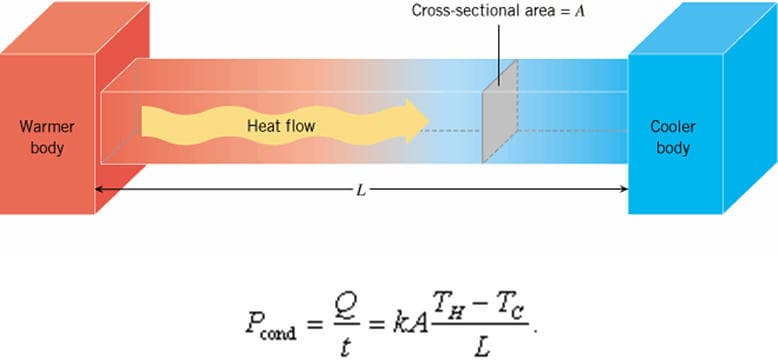
Fourier's Law states that the rate of heat conduction through a material is proportional to the negative temperature gradient and the area perpendicular to that gradient. In its one-dimensional form for heat flux:
where:
- is the heat flux (), the rate of heat transfer per unit area
- is the thermal conductivity (), a property of the material
- is the temperature gradient () in the x-direction
The negative sign is there for a physical reason: heat naturally flows from hot to cold. Since temperature decreases in the direction of heat flow, is negative in that direction. The negative sign in the equation makes come out positive in the direction heat actually moves.
If you need the total rate of heat transfer (in Watts) rather than just the flux, multiply by the cross-sectional area:
Applications and Importance
Fourier's Law shows up across engineering, physics, and materials science whenever you need to quantify conduction. Specific uses include:
- Thermal insulation design: Determining how thick a wall or insulating layer needs to be to limit heat loss
- Heat exchangers: Predicting conduction through tube walls and fins
- Electronic cooling: Calculating how quickly heat moves away from a chip through its substrate and heat sink
- Energy-efficient buildings: Modeling heat flow through composite walls, windows, and roofing
It also serves as the starting point for more complex analyses. The heat diffusion equation (which governs transient and multi-dimensional conduction) is derived directly from Fourier's Law combined with energy conservation.
Factors Influencing Heat Conduction
Material Properties
Thermal conductivity () measures how readily a material conducts heat. The range across common materials is enormous:
- Good conductors have high values. Copper sits around and aluminum around . Metals conduct well because free electrons carry thermal energy efficiently.
- Insulators have low values. Fiberglass insulation is roughly , and still air is about . These materials resist heat flow because they lack free electrons and have structures that impede phonon transport.
Thermal conductivity depends on composition, density, molecular structure, and temperature. For most pure metals, decreases slightly as temperature rises. For many non-metallic solids and gases, increases with temperature. Always check whether the problem expects you to treat as constant or temperature-dependent.
Geometric and Temperature Factors
Several geometric and boundary factors control how much heat actually flows:
- Temperature gradient (): A steeper gradient drives more heat flow. This gradient depends on the temperature difference imposed across the material and the material's thickness.
- Cross-sectional area (): A larger area perpendicular to the heat flow direction means more total heat transfer (). The flux stays the same, but the total rate scales directly with area.
- Thickness (): For a fixed temperature difference, a thicker slab has a smaller temperature gradient (), which reduces the heat transfer rate. This is exactly why adding more insulation helps.
- Temperature difference (): The driving force for conduction. Double the temperature difference across a slab and you double the heat flux, all else being equal.
Applying Fourier's Law for Steady-State Conduction

One-Dimensional Steady-State Conduction
For a plane slab with constant , no internal heat generation, and steady-state conditions (nothing changing with time), the temperature profile is linear. Fourier's Law simplifies to:
where is the higher temperature, is the lower temperature, and is the slab thickness. Written this way (with ), comes out positive in the direction from hot to cold.
Example 1: Finding heat flux
A steel plate () is 0.1 m thick. One face is at 120°C and the other at 100°C.
That's 10 kW per square meter of plate area.
Example 2: Finding temperature gradient
A material with carries a heat flux of . The temperature gradient is:
The negative sign tells you temperature decreases in the direction of heat flow, which makes physical sense.
Problem-Solving Approach
When you're working a Fourier's Law problem, follow these steps:
- Sketch the geometry and label the direction of heat flow, temperatures, and dimensions.
- List known quantities: , , , , or .
- Identify what you're solving for (heat flux, total heat rate, temperature gradient, or an unknown temperature).
- Choose the right form of the equation: Use for flux, or for total heat rate.
- Check your sign convention. If you define as positive in the direction from to with , you won't need the negative sign explicitly.
- Verify units. Make sure is in , in meters, in Kelvin or °C (the difference is the same), and in .
Keep in mind the assumptions behind this simplified model:
- Steady-state (no time dependence)
- One-dimensional heat flow (temperature varies in only one direction)
- Constant thermal conductivity
- No internal heat generation
- Constant cross-sectional area
If any of these don't hold, you'll need a more general form of the heat equation.
Thermal Conductivity in Heat Transfer
Definition and Units
Thermal conductivity () quantifies how much heat a material transfers per unit thickness per unit temperature difference. Its units are , which you can read as "watts of heat flow through one meter of material for every one-degree temperature difference."
A high means the material moves heat easily (good conductor). A low means it resists heat flow (good insulator).
Factors Affecting Thermal Conductivity
Several factors determine a material's thermal conductivity:
- Composition: Pure metals generally conduct better than alloys. For example, pure copper () conducts much better than stainless steel (), even though both are metals. Alloying disrupts the regular lattice and scatters electrons.
- Density: Denser materials tend to have higher because molecules are packed more closely, allowing more efficient energy transfer between them.
- Molecular structure: Crystalline materials (with ordered atomic arrangements) typically conduct better than amorphous ones. Diamond, despite being non-metallic, has an extremely high () because of its rigid, highly ordered crystal lattice.
- Temperature: The relationship between and temperature varies by material type. For most metals, decreases with rising temperature. For gases and many insulating solids, increases with temperature.
Practical Applications
Choosing the right material based on is a core engineering decision:
- Minimizing heat transfer: Insulation in buildings, refrigeration systems, and thermal storage uses materials like fiberglass, foam, or aerogel (all with very low ).
- Maximizing heat transfer: Heat sinks, heat exchanger tubes, and cookware use copper, aluminum, or other high- materials to move heat as efficiently as possible.
Thermal conductivity values for common engineering materials are tabulated in references like Incropera's Fundamentals of Heat and Mass Transfer or the CRC Handbook. In practice, you'll look up at the relevant temperature rather than memorizing values.
For less common or novel materials, experimental methods such as the guarded hot plate method (steady-state) or the transient plane source method (transient) are used to measure . These measured values then feed into numerical simulations and computational models of real thermal systems.
See Fiveable more often in Google
Mark Fiveable as a preferred source and Google is more likely to show you our guides in Top Stories, with a "preferred" badge in AI Mode and AI Overviews.