1.3 Newton's Law of Cooling

❤️🔥Heat and Mass Transfer Unit 1 Review
1.3 Newton's Law of Cooling
❤️🔥 Heat and Mass Transfer
Newton's Law of Cooling
Newton's Law of Cooling describes how heat is transferred between an object and its surrounding fluid by convection. It connects the rate of heat loss to the temperature difference between the object and its environment. This relationship is foundational for analyzing convective heat transfer problems, from cooling electronic components to estimating time of death in forensic science.
The law works well under certain idealized conditions, but it has real limitations. Understanding both the equation and where it breaks down will help you apply it correctly in problem-solving.

Top images from around the web for Law and Mathematical Representation
31.6 Binding Energy – College Physics View original
Is this image relevant?
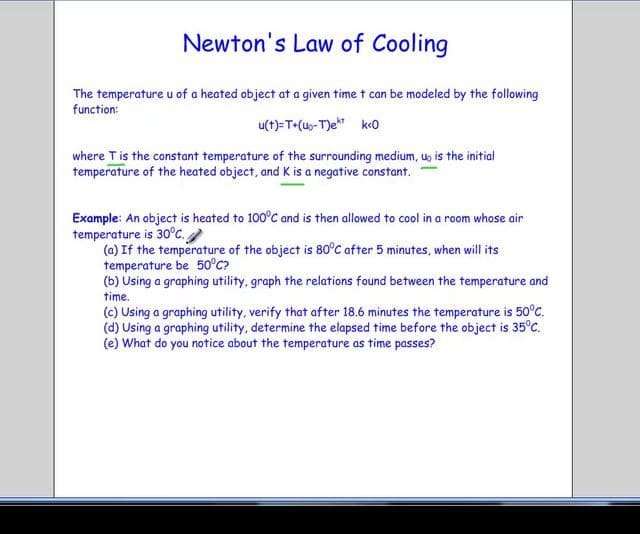
Newton's Law of Cooling on Vimeo View original
Is this image relevant?
31.6 Binding Energy – College Physics View original
Is this image relevant?
Newton's Law of Cooling on Vimeo View original
Is this image relevant?
Newton's Law of Cooling
Law and Mathematical Representation
Newton's Law of Cooling states that the rate of convective heat transfer between a surface and a surrounding fluid is directly proportional to the temperature difference between them. The larger the gap in temperature, the faster heat flows.
The mathematical form is:
where:
- = heat transfer rate (W)
- = convective heat transfer coefficient (W/m²·K)
- = surface area exposed to the fluid (m²)
- = surface temperature (K)
- = ambient fluid temperature (K)
When , is positive, meaning heat flows from the object into the surroundings. This is consistent with the second law of thermodynamics: heat naturally flows from hot to cold.
Two key assumptions are baked into this equation:
- The convective heat transfer coefficient stays constant throughout the cooling process.
- The object's temperature is uniform (no internal temperature gradients).
Both of these are idealizations. Keep them in mind when deciding whether the law applies to a given problem.
Assumptions and Limitations
Constant heat transfer coefficient: The law treats as fixed, but in practice it can change as the object cools. Temperature shifts alter fluid properties like viscosity and density, and flow conditions may evolve over time. This means is really an average value in most applications.
Uniform object temperature: The law assumes the entire object is at a single temperature . This is reasonable for small, highly conductive objects (like a thin copper plate) but breaks down for large objects or poor conductors where the interior stays much hotter than the surface.
Negligible thermal radiation: Newton's Law only accounts for convective heat transfer. It ignores radiation, which becomes significant at high temperatures or for surfaces with high emissivity. For example, a glowing piece of steel at 1000 K loses a substantial fraction of its heat through radiation, and this law alone won't capture that.
Factors Affecting Convective Heat Transfer
Fluid Properties
The properties of the surrounding fluid have a direct impact on how effectively heat is carried away from a surface.
- Thermal conductivity controls how well the fluid conducts heat near the surface. Fluids with higher thermal conductivity (like water at ~0.6 W/m·K) transfer heat much more effectively than those with low conductivity (like air at ~0.026 W/m·K).
- Density affects how much fluid mass is available to carry heat away. Denser fluids like water transport more thermal energy per unit volume than lighter fluids like air.
- Viscosity influences the thickness of the thermal boundary layer. A highly viscous fluid (like engine oil) forms a thicker boundary layer, which acts as insulation and slows heat transfer. A low-viscosity fluid (like water) allows a thinner boundary layer and faster heat transfer.
- Specific heat capacity determines how much energy a fluid can absorb per degree of temperature rise. Water has a high specific heat (~4,180 J/kg·K), so it can absorb a lot of heat without its temperature rising much, making it an excellent coolant.
Flow Conditions
How the fluid moves past the surface matters just as much as the fluid's properties.
- Fluid velocity: Higher velocities sweep heated fluid away from the surface faster and bring cooler fluid in contact, thinning the boundary layer. This is why blowing on hot soup cools it faster.
- Flow regime (laminar vs. turbulent): Turbulent flow produces much higher heat transfer coefficients than laminar flow because the chaotic mixing disrupts the thermal boundary layer. Think of smoke rising smoothly from a candle (laminar) versus billowing from a chimney (turbulent).
- Surface geometry: The shape and orientation of the object affect how the boundary layer develops. Flow over a flat plate behaves differently from flow around a cylinder or through a tube, and each has its own correlations for .
- Surface roughness: Rough surfaces can trip the boundary layer into turbulence sooner, which can increase the heat transfer coefficient. Surface coatings or fins are sometimes added deliberately for this purpose.
Temperature Difference
The driving force for convective heat transfer is the temperature difference . A larger difference means a steeper thermal gradient near the surface, which pushes heat across the boundary layer faster. As the object cools and approaches , the heat transfer rate drops, which is why cooling slows down over time.

Applying Newton's Law of Cooling
Calculating Heat Transfer Rate
To find the instantaneous rate of heat loss from a surface:
- Identify the convective heat transfer coefficient (from tables, correlations, or experimental data).
- Measure or calculate the exposed surface area .
- Determine the surface temperature and the ambient fluid temperature .
- Plug into the equation:
Example: Cooling a hot metal plate in air
- Given: , , ,
- Calculate:
The plate is losing 500 W of heat to the surrounding air at this instant.
Calculating Temperature Change
When you know the heat transfer rate, you can find how quickly the object's temperature is changing by linking Newton's Law to the energy balance:
where is the object's mass (kg), is its specific heat capacity (J/kg·K), and is the rate of temperature change (K/s).
Rearranging:
Example: Cooling a hot steel ball in water
- Given: (negative because the ball is losing heat), ,
- Calculate:
The ball's temperature is dropping at 0.4 K every second.
Lumped Capacitance Method
This method simplifies transient cooling problems by assuming the object has a uniform temperature at every instant. It's valid when the Biot number is small:
where is the characteristic length (typically volume/surface area), and is the thermal conductivity of the object.
The rule: if , you can use the lumped capacitance method. This condition means internal conduction is so fast relative to surface convection that the object's temperature stays nearly uniform.
Under this assumption, the governing equation becomes:
This is a first-order ODE with the exponential solution:
where is the initial temperature. The term is the time constant of the system and tells you how quickly the object approaches the ambient temperature.
Convective Heat Transfer Coefficient
Definition and Units
The convective heat transfer coefficient quantifies how effectively heat moves between a surface and a fluid. Its units are W/m²·K. Physically, it represents the heat transfer rate per unit area per unit temperature difference. A higher means the fluid is more effective at pulling heat from (or delivering heat to) the surface.
Dependence on Fluid Properties and Flow Conditions
The value of is not a material property; it depends on the entire situation:
- Thermal conductivity of the fluid: Higher conductivity means heat conducts through the boundary layer more readily, raising . Water ( W/m·K) gives much higher values than air ( W/m·K).
- Density, viscosity, and specific heat: These collectively determine how the fluid transports and stores thermal energy. They appear in dimensionless groups (Reynolds, Prandtl numbers) used to correlate .
- Fluid velocity: Faster flow thins the boundary layer and increases . Forced convection (a fan blowing air) produces higher than natural convection (still air rising due to buoyancy).
- Flow regime: Turbulent flow disrupts the boundary layer and dramatically increases compared to laminar flow. For flow in a pipe, the transition typically occurs around .
Empirical Correlations
Because depends on so many variables, engineers rely on empirical correlations that relate the Nusselt number () to the Reynolds and Prandtl numbers.
Dittus-Boelter equation (turbulent flow inside circular pipes, ):
- for heating the fluid
- for cooling the fluid
Churchill-Bernstein equation (external flow over a cylinder):
These correlations let you estimate once you know the fluid properties, flow velocity, and geometry. From there, you plug back into Newton's Law of Cooling to find the heat transfer rate.
See Fiveable more often in Google
Mark Fiveable as a preferred source and Google is more likely to show you our guides in Top Stories, with a "preferred" badge in AI Mode and AI Overviews.