2.2 Thermal Conductivity and Thermal Resistance

❤️🔥Heat and Mass Transfer Unit 2 Review
2.2 Thermal Conductivity and Thermal Resistance
❤️🔥 Heat and Mass Transfer
Thermal conductivity and material properties

Top images from around the web for Fundamentals of thermal conductivity
I-1 Genesis of Fourier Analysis - Utopie View original
Is this image relevant?
14.5 Conduction – College Physics: OpenStax View original
Is this image relevant?
I-1 Genesis of Fourier Analysis - Utopie View original
Is this image relevant?
14.5 Conduction – College Physics: OpenStax View original
Is this image relevant?
Fundamentals of thermal conductivity
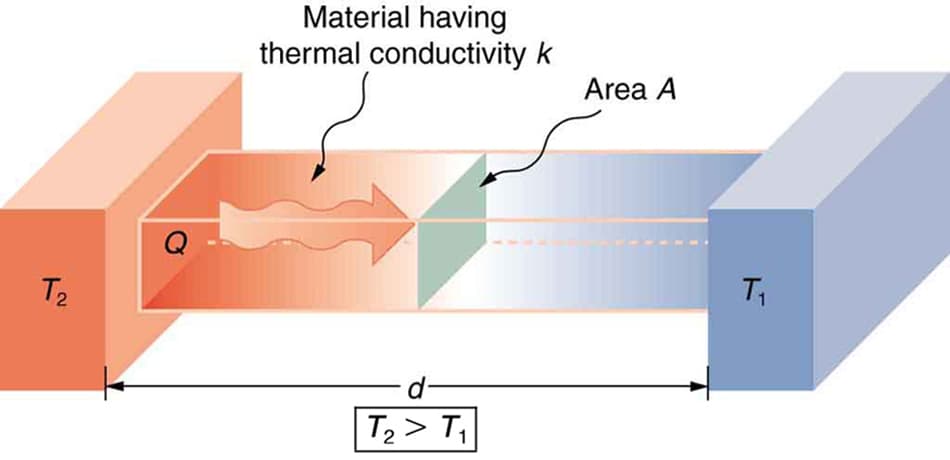
Thermal conductivity () quantifies how well a material conducts heat. Its units are W/(m·K) or Btu/(h·ft·°F). A higher means heat passes through the material more easily.
The governing relationship is Fourier's law of heat conduction:
where is the heat flux (W/m²), is thermal conductivity (W/(m·K)), and is the temperature gradient (K/m).
Two things to notice in this equation:
- Heat flux is directly proportional to both and the temperature gradient. Double either one and you double the heat flow per unit area.
- The negative sign tells you heat flows from high temperature toward low temperature, opposite the direction of increasing temperature.
Factors influencing thermal conductivity
Thermal conductivity spans several orders of magnitude depending on the type of material:
| Material class | Examples | Typical range (W/(m·K)) |
|---|---|---|
| Metals | Copper, aluminum | 20–400 |
| Non-metals | Polymers, ceramics | 0.1–50 |
| Gases | Air, helium | 0.01–0.2 |
Why such a big spread? In metals, free electrons carry most of the thermal energy, which makes them excellent conductors. In non-metals, heat travels mainly through lattice vibrations (phonons), which is less efficient. In gases, molecules are far apart, so energy transfer between them is slow.
Temperature dependence is worth remembering:
- Pure metals: generally decreases with rising temperature because increased lattice vibrations scatter electrons more.
- Gases: increases with rising temperature because faster-moving molecules transfer energy more effectively during collisions.
Other structural factors also matter:
- Density — Denser materials tend to conduct better because atoms are packed closer, improving phonon and electron transport.
- Porosity — Pores trap air (very low ), so porous materials like foams are good insulators.
- Crystalline structure — Single crystals conduct better than polycrystalline materials because grain boundaries scatter phonons.
Thermal resistance in series and parallel systems
Thermal resistance and its calculation
Thermal resistance () measures how strongly a material opposes heat flow. For a flat slab of thickness and thermal conductivity :
Units are (m²·K)/W. A thicker slab or a lower means higher resistance.
The electrical analogy makes this intuitive. Just as Ohm's law relates voltage, current, and resistance, the thermal version relates temperature difference, heat flow rate, and thermal resistance:
Analogy mapping:
- Temperature difference → Voltage
- Heat flow rate → Current
- Thermal resistance → Electrical resistance
This analogy is not just a learning trick. Engineers routinely draw thermal resistance circuits to solve conduction problems, especially in composite walls and electronic packaging.
Series and parallel configurations
Series (layers stacked along the heat flow direction):
The total thermal resistance is the sum of each layer's resistance:
Think of a building wall with brick, insulation, and drywall. Heat must pass through every layer in sequence, so each layer adds resistance.
Parallel (multiple heat flow paths side by side):
The total resistance follows the reciprocal rule:
An example is a set of heat fins attached to a surface. Each fin provides a separate path for heat to escape, so adding more fins lowers the overall resistance.
A quick way to remember: series resistances add (making it harder for heat to flow), while parallel paths reduce total resistance (giving heat more ways to escape).

Thermal contact resistance in composite systems
Causes and effects of thermal contact resistance
Even when two solid surfaces are pressed together, they don't make perfect contact. At a microscopic level, surface roughness means the surfaces only touch at scattered peaks (called asperities). The gaps between those peaks trap air, which has very low thermal conductivity.
This imperfect contact creates thermal contact resistance at the interface. The result is a temperature jump across the interface that wouldn't exist if the surfaces were perfectly bonded. In systems where efficient heat transfer is critical, like CPU heat sinks or power electronics packaging, contact resistance can be a significant bottleneck.
The magnitude of contact resistance depends on:
- Surface roughness — rougher surfaces have more and larger air gaps
- Contact pressure — higher pressure deforms the peaks and increases real contact area
- Material hardness — softer materials conform more easily
- Interstitial materials — filling gaps with a conductive substance reduces resistance
Mitigation strategies for thermal contact resistance
There are three main approaches to reduce contact resistance:
- Increase contact pressure. This plastically deforms surface asperities, increasing the true contact area between the two surfaces.
- Reduce surface roughness. Polishing or lapping the mating surfaces minimizes the size of air gaps.
- Apply a thermal interface material (TIM). TIMs fill the microscopic air gaps with a substance that conducts heat far better than air. Common TIMs include:
- Thermal greases (silicone-based pastes loaded with conductive particles)
- Phase change materials (solid at room temperature, soften at operating temperature to conform to surfaces)
- Thermal pads (compliant, pre-formed sheets for easy assembly)
When analyzing a composite system with multiple interfaces, your total thermal resistance must include both the bulk resistance of each material layer and the contact resistance at every interface between them. Neglecting contact resistance is a common mistake that leads to underestimating the total resistance.
Material selection for thermal applications
Criteria for material selection
Choosing the right material for a thermal design involves balancing several properties:
- Thermal conductivity — how fast heat moves through the material
- Density and specific heat capacity — relevant for transient (time-varying) heat transfer and weight-sensitive designs
- Thermal expansion coefficient — mismatched expansion between bonded materials can cause mechanical stress or delamination
- Cost, weight, and manufacturability — practical constraints that often drive the final choice
Trade-offs are unavoidable. Copper has excellent conductivity ( 400 W/(m·K)) but is heavy and expensive. Aluminum ( 200 W/(m·K)) is lighter and cheaper, which is why it dominates in automotive and aerospace heat exchangers despite its lower .
Materials for specific thermal applications
High-conductivity applications (heat dissipation):
When you need to move heat away from a source quickly, pick materials with high . Copper and aluminum are the standard choices for heat sinks and heat spreaders in electronics. For extreme performance, diamond ( 2000 W/(m·K)) and hexagonal boron nitride are used in specialized applications, though at much higher cost.
Low-conductivity applications (insulation):
To block heat flow, you want low . Polymer foams, fiberglass batts, and aerogels all work by trapping pockets of still air or gas within their structure. Building insulation, refrigerator walls, and industrial pipe lagging all rely on this principle.
Tuning resistance through geometry:
Since , you can adjust thermal resistance by changing thickness even with the same material. Thicker insulation raises for better thermal protection. Thinner layers of a high- material lower for more efficient heat spreading in tight spaces.
Composite materials offer the ability to tailor multiple properties at once. Metal-matrix composites (e.g., aluminum with silicon carbide particles) can combine good thermal conductivity with a controlled expansion coefficient, which is valuable in electronic substrates where thermal cycling would otherwise crack solder joints.
See Fiveable more often in Google
Mark Fiveable as a preferred source and Google is more likely to show you our guides in Top Stories, with a "preferred" badge in AI Mode and AI Overviews.