5.2 Log Mean Temperature Difference (LMTD) Method

❤️🔥Heat and Mass Transfer Unit 5 Review
5.2 Log Mean Temperature Difference (LMTD) Method
❤️🔥 Heat and Mass Transfer
LMTD Equation for Heat Exchangers
The Log Mean Temperature Difference (LMTD) method lets you calculate the heat transfer rate in a heat exchanger by finding a single, representative temperature difference between the hot and cold fluids. A simple arithmetic average of the endpoint temperature differences would overestimate performance because the temperature profile along the exchanger isn't linear. The LMTD corrects for this by accounting for the logarithmic way temperature changes along the exchanger's length.

Top images from around the web for Derivation of the LMTD Equation
Applications of Thermodynamics: Heat Pumps and Refrigerators | Physics View original
Is this image relevant?
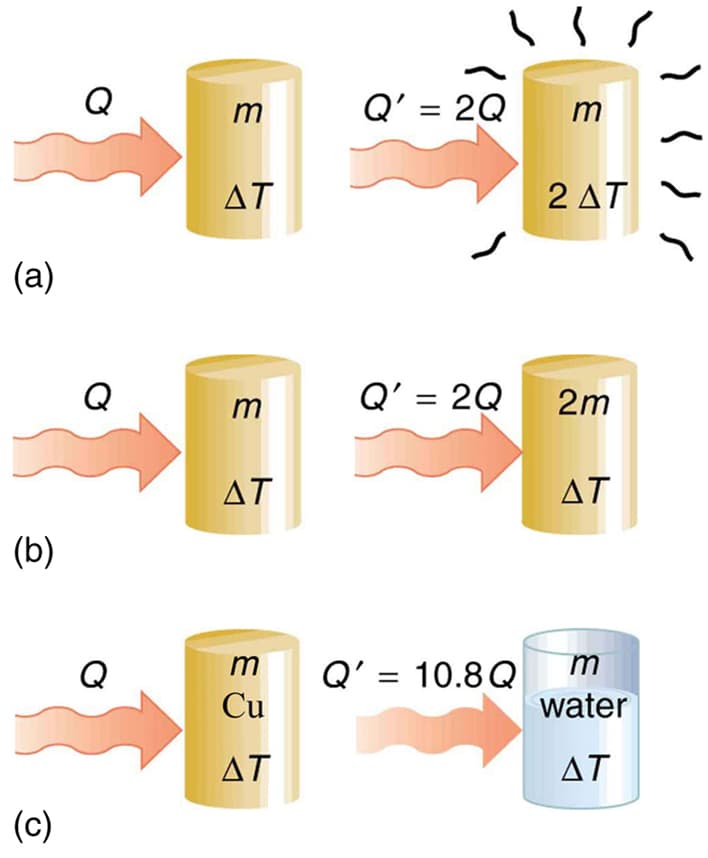
Temperature Change and Heat Capacity | Physics View original
Is this image relevant?
design and Analysis of a Heat Exchanger Network – Material Science Research India View original
Is this image relevant?
Applications of Thermodynamics: Heat Pumps and Refrigerators | Physics View original
Is this image relevant?
Temperature Change and Heat Capacity | Physics View original
Is this image relevant?
Derivation of the LMTD Equation
The starting point is the basic heat exchanger design equation:
where:
- = heat transfer rate (W)
- = overall heat transfer coefficient (W/m²·K)
- = heat transfer surface area (m²)
- = temperature difference between the hot and cold fluids
The problem is that varies along the length of the exchanger. To handle this, you integrate the local heat transfer over the entire length. The result of that integration gives the LMTD:
- = temperature difference between the hot and cold fluids at one end of the exchanger
- = temperature difference at the other end
With the LMTD in hand, the design equation becomes:
Why not just use the arithmetic mean ? The arithmetic mean always overestimates the true average driving force. The LMTD is smaller and more accurate because it properly weights the exponential decay of the temperature difference. The two values converge only when .
Quick check: If , the LMTD formula gives 0/0. In that special case, LMTD simply equals (apply L'Hôpital's rule to confirm).
Assumptions and Limitations of the LMTD Equation
The LMTD derivation relies on several idealizations. Keep these in mind when deciding whether the method applies to a given problem:
- Constant : The overall heat transfer coefficient doesn't change along the exchanger. In reality, can vary if fluid properties change significantly with temperature.
- Constant specific heats: The values of both fluids remain fixed. This is reasonable for moderate temperature ranges but breaks down for large swings.
- No phase change: Both fluids remain single-phase (no boiling or condensation). Phase-change problems require separate treatment because the temperature of the changing fluid stays nearly constant.
- Steady-state operation: Flow rates, inlet temperatures, and don't change with time.
- Negligible axial conduction and heat losses: Heat travels only radially (fluid-to-fluid), not along the wall, and nothing is lost to the surroundings.
LMTD Method for Heat Transfer Analysis

Determining Heat Transfer Rate and Outlet Temperatures
The core idea is to combine the LMTD with energy balance equations for each fluid. You have three key relationships:
Design equation:
Energy balances:
- Hot fluid:
- Cold fluid:
where is the mass flow rate (kg/s) and is the specific heat capacity (J/kg·K).
These three equations share the same , so you can solve for unknowns by combining them. Typically you know the inlet temperatures, flow rates, fluid properties, , and , and you need to find the outlet temperatures and .
Applicability to Different Flow Arrangements
How you define and depends on the flow arrangement. Getting this wrong is one of the most common mistakes.
Parallel-flow (both fluids enter at the same end):
Both differences are taken at the same physical end of the exchanger.
Counter-flow (fluids enter at opposite ends):
Each difference pairs the hot and cold temperatures at the same physical location, but because the fluids flow in opposite directions, the hot inlet faces the cold outlet.
Counter-flow exchangers always produce a higher LMTD than parallel-flow for the same inlet/outlet temperatures. That's why counter-flow is more thermally efficient and is preferred in practice.
Correction Factors for Heat Exchangers

Purpose and Definition of Correction Factors
The LMTD formula as derived above applies directly only to pure parallel-flow and pure counter-flow arrangements. Real heat exchangers often have more complex geometries: multi-pass shell-and-tube, cross-flow with mixed or unmixed fluids, etc. In these cases, the true mean temperature difference is lower than the counter-flow LMTD.
To handle this, you multiply the counter-flow LMTD by a correction factor :
so the design equation becomes:
The correction factor satisfies . A value of means the exchanger behaves like pure counter-flow. Values below about 0.75 typically signal that the chosen configuration is thermally inefficient and a different design should be considered.
Temperature Effectiveness and Heat Capacity Rate Ratio
The correction factor is read from charts (or calculated from correlations) using two dimensionless parameters:
Temperature effectiveness :
This is the ratio of the actual temperature rise of the tube-side fluid to the maximum possible temperature difference. It ranges from 0 to 1.
Heat capacity rate ratio :
Here subscripts and refer to the shell-side and tube-side fluids. is the ratio of the tube-side to shell-side heat capacity rates.
Different exchanger configurations (1-shell/2-tube-pass, 2-shell/4-tube-pass, cross-flow unmixed, etc.) each have their own -chart or correlation. Your textbook or reference tables will specify which chart to use for a given geometry.
LMTD Method for Flow Arrangements
Solving Heat Exchanger Problems
The LMTD method applies to:
- Parallel-flow heat exchangers
- Counter-flow heat exchangers
- Multi-pass shell-and-tube heat exchangers
- Cross-flow heat exchangers (one or both fluids mixed or unmixed)
Typical given information:
- Inlet temperatures and
- Mass flow rates and
- Specific heat capacities and
- Overall heat transfer coefficient
- Heat transfer surface area
Step-by-step approach:
- Write energy balances for both fluids to relate to the unknown outlet temperatures.
- Calculate and using the correct definitions for your flow arrangement (parallel or counter-flow).
- Compute the LMTD from .
- Determine the correction factor if the exchanger is multi-pass or cross-flow. Calculate and , then read from the appropriate chart.
- Apply the design equation: (use for pure parallel or counter-flow).
- Solve for unknowns. If outlet temperatures aren't known upfront, you'll need to iterate: assume an outlet temperature, compute LMTD, find , check against the energy balance, and repeat until values converge.
Common pitfall: The LMTD method is straightforward when all four temperatures are known (a "rating" problem). When you need to find outlet temperatures (a "design" problem), it becomes iterative because the LMTD itself depends on the unknowns. For design problems, the effectiveness-NTU method (covered separately) is often more direct.
Examples of Heat Exchanger Problems
Example 1 (Counter-flow): Oil enters a counter-flow heat exchanger at 150°C and must be cooled using water entering at 20°C. You're given the mass flow rates, specific heats, , and . To solve: write energy balances for both fluids, express and , compute LMTD, and use together with the energy balances to find the outlet temperatures. Since two outlet temperatures are unknown, you'll iterate or solve the system simultaneously.
Example 2 (Multi-pass shell-and-tube): Water is heated by steam in a 1-shell/2-tube-pass exchanger. Steam enters the shell side at 120°C; water enters the tubes at 25°C. After computing the counter-flow LMTD, calculate and for the tube-side fluid, look up from the 1-shell/2-tube-pass correction factor chart, and apply to find the heat transfer rate and water outlet temperature.
See Fiveable more often in Google
Mark Fiveable as a preferred source and Google is more likely to show you our guides in Top Stories, with a "preferred" badge in AI Mode and AI Overviews.