7.4 Atmospheric perspective

✏️Drawing I Unit 7 Review
7.4 Atmospheric perspective
✏️ Drawing I
Definition of atmospheric perspective
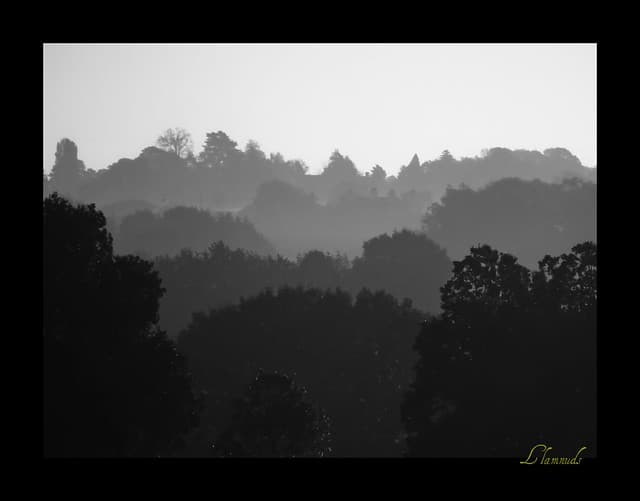
Atmospheric perspective (also called aerial perspective) is a technique for creating the illusion of depth and distance in a drawing. It's based on a simple real-world observation: as objects get farther away, the atmosphere between you and those objects changes how they look. Light gets scattered and absorbed by particles in the air (dust, moisture, pollution), which alters the color, value, and clarity of everything in the distance.

Top images from around the web for Reduced color saturation
Color and Color Vision | Physics View original
Is this image relevant?
Atmospheric Perspective | Flickr - Photo Sharing! View original
Is this image relevant?
Wikipedia:Featured picture candidates/Aerial perspective - Wikipedia View original
Is this image relevant?
Color and Color Vision | Physics View original
Is this image relevant?
Atmospheric Perspective | Flickr - Photo Sharing! View original
Is this image relevant?
Effects on distant objects
Understanding what actually changes as things recede into the distance is the foundation of this technique. There are four main effects to watch for.
Reduced color saturation
Colors become less intense and more muted the farther away an object is. This happens because light scatters as it passes through the atmosphere, and some of that color information never reaches your eye. A row of vivid green trees in the foreground, for example, might appear bluish-gray a mile away. The shift is gradual, not sudden.
Shift toward cooler color temperature
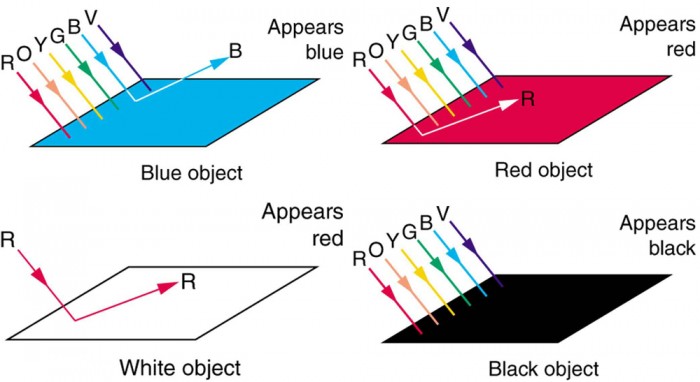
Distant objects tend to take on a cooler, bluish hue. Shorter wavelengths of light (blues and violets) scatter more easily in the atmosphere, while warmer wavelengths (reds, oranges, yellows) get absorbed over distance. The result: foreground objects keep their warm colors, while the background leans cool. That warm-to-cool contrast across your composition is one of the strongest depth cues you can use.
Reduced contrast
The difference between the lightest lights and the darkest darks shrinks as objects recede. Light scattering fills in the shadows and dulls the highlights, so distant objects appear to have a much narrower value range than nearby ones. A mountain in the distance looks almost flat in tone compared to a rock at your feet.
Blurred edges and details
Fine details and sharp edges become softer and less distinct with distance. The atmosphere acts like a diffusing filter, smoothing out textures and forms. You can use this to your advantage: keep foreground objects sharp and well-defined, then progressively soften everything behind them.
Techniques for creating depth
Here's how to translate those real-world observations into your drawings.
Layering of tones
Organize your composition into distinct tonal layers:
- Foreground uses the darkest values
- Middle ground uses mid-range values
- Background uses the lightest values
This dark-to-light progression from front to back establishes clear spatial zones in your drawing.
Gradation of values
Gradually lighten the values of objects as they recede. You can do this with smooth, continuous blending or by building up multiple layered tones. The key is consistency: if values jump around randomly, the depth illusion breaks down.

Simplification of distant shapes
Reduce the complexity of objects as they move into the background. Distant trees don't need individual leaves. Distant buildings don't need window frames. Simplify far-off forms into basic geometric shapes, and save your detailed rendering for the foreground. That contrast in detail level reinforces the sense of distance.
Atmospheric perspective vs. linear perspective
These two types of perspective solve the same problem (creating depth on a flat surface) in different ways:
- Linear perspective uses converging lines and vanishing points to show how objects appear smaller and closer together with distance.
- Atmospheric perspective uses changes in color, value, and detail to show how the atmosphere affects the appearance of distant objects.
They work best together. Linear perspective gives your scene accurate spatial structure, while atmospheric perspective makes it feel like there's real air and space between objects.
Role in landscape drawing
Suggesting expansive space
Atmospheric perspective is especially useful in landscapes, where you're often trying to convey vast, open space. Gradual shifts in value, color temperature, and detail across the composition make the scene appear to stretch far toward the horizon, even on a small sheet of paper.
Enhancing sense of scale
By establishing a clear foreground, middle ground, and background with atmospheric effects, you give the viewer reference points for judging size and distance. A detailed, dark-valued figure in the foreground next to pale, simplified mountains in the background immediately communicates how far away those mountains are.
Factors influencing atmospheric perspective
The strength of atmospheric effects changes depending on real-world conditions. Paying attention to these factors will make your drawings more convincing.
Weather conditions
- Humidity, fog, and haze amplify atmospheric perspective by increasing the amount of scattering and absorption in the air. On a foggy day, objects just a short distance away can lose almost all detail and contrast.
- Clear, dry conditions produce less pronounced effects, so distant objects retain more of their color and sharpness.
Time of day
- At sunrise and sunset, sunlight travels through a thicker slice of atmosphere, which strengthens the color shifts and value reduction in the distance.
- At midday, the more direct light path means atmospheric effects are less dramatic.
Altitude and air quality
- At higher altitudes, thinner air with fewer particles means weaker atmospheric perspective. Mountain scenes at elevation can look surprisingly crisp.
- In areas with heavy air pollution or dust, the extra particles in the air can exaggerate the effect considerably.
Combining with other perspective techniques
Atmospheric perspective is most effective when paired with linear perspective. Converging lines pull the viewer's eye into the scene, while the gradation of value, color, and detail reinforces the feeling of real depth. Using both together creates a more convincing spatial illusion than either technique alone.
Examples in art history
Renaissance masters
Leonardo da Vinci was one of the first artists to systematically study and apply atmospheric perspective. Look at the background of the Mona Lisa: the landscape behind her becomes progressively lighter, bluer, and less detailed as it recedes. Other Renaissance painters like Raphael and Titian also used the technique to push backgrounds convincingly into the distance.
19th-century landscape painters
Atmospheric perspective became central to the work of the Hudson River School painters, including Thomas Cole and Albert Bierstadt. These artists used dramatic value gradations and color temperature shifts to convey the scale and grandeur of the American wilderness. Their paintings are excellent references for studying how atmospheric effects work across large distances.
Exercises for practicing atmospheric perspective
Monochromatic value studies
- Choose a single medium (graphite or charcoal works well).
- Sketch a simple landscape with a clear foreground, middle ground, and background.
- Apply your darkest values to the foreground and progressively lighten each zone as it moves into the distance.
- Focus on making the transitions feel gradual and natural.
Color temperature gradients
- Set up a landscape composition in color (colored pencil, pastel, or paint).
- Use warm colors (yellows, oranges, warm greens) in the foreground.
- Shift toward cooler colors (blues, blue-grays, cool purples) as objects recede.
- Aim for a smooth transition between temperature zones rather than abrupt changes.
Simplifying distant details
- Draw a landscape scene with objects at varying distances.
- Render foreground objects with full detail: textures, sharp edges, individual forms.
- In the middle ground, reduce detail noticeably.
- In the background, simplify shapes to their most basic forms with minimal texture.
- Compare the three zones to check that the level of detail clearly decreases from front to back.
See Fiveable more often in Google
Mark Fiveable as a preferred source and Google is more likely to show you our guides in Top Stories, with a "preferred" badge in AI Mode and AI Overviews.