3.4 Pastels

✏️Drawing I Unit 3 Review
3.4 Pastels
✏️ Drawing I
Types of Pastels
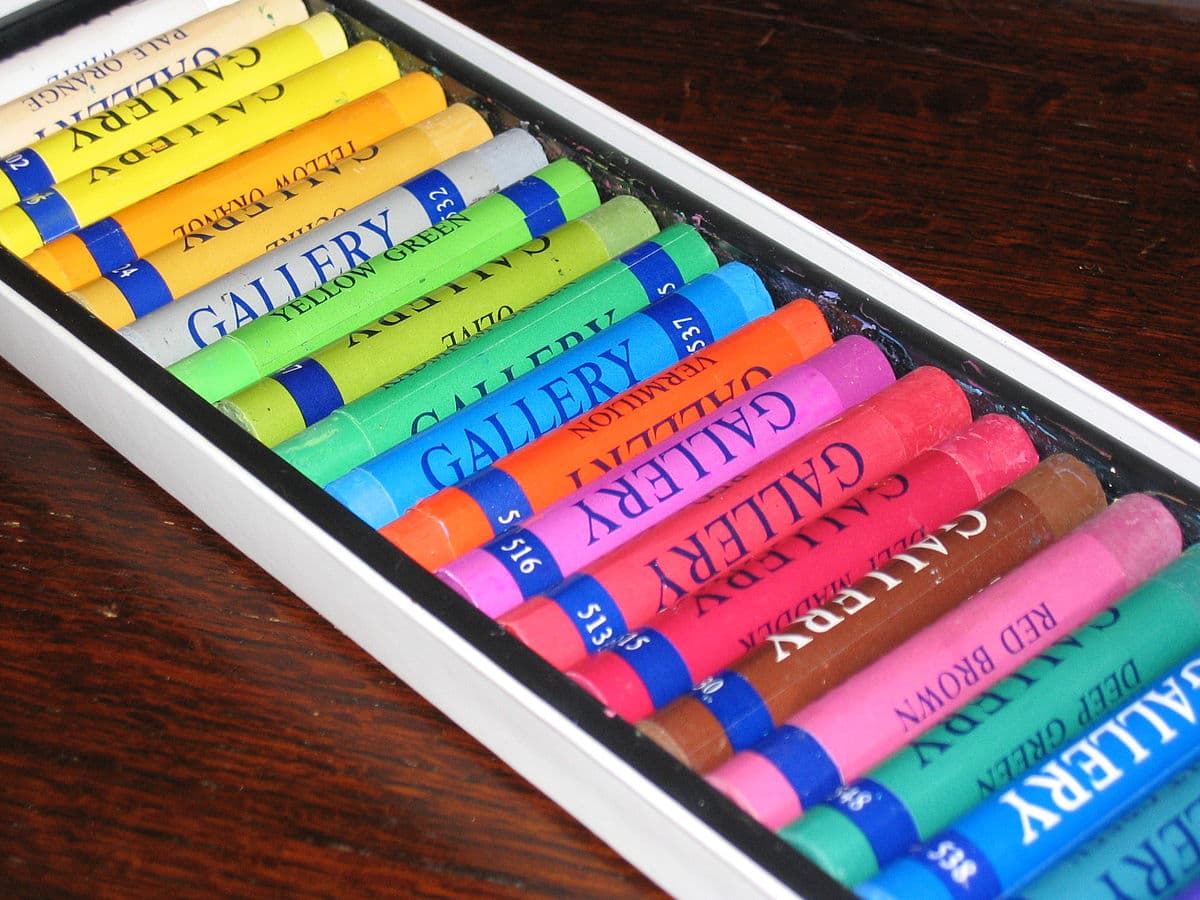
Pastels come in several forms, and each behaves differently on paper. The differences come down to what holds the pigment together (the binder) and how much of it is used. The three main types are soft pastels, hard pastels, and oil pastels, with pan pastels as a newer option.

Top images from around the web for Soft vs hard pastels
soft pastel landscape by blackblacksea on DeviantArt View original
Is this image relevant?
Pastel (color) - Wikipedia View original
Is this image relevant?
soft pastel landscape by blackblacksea on DeviantArt View original
Is this image relevant?
Pastel (color) - Wikipedia View original
Is this image relevant?
Soft vs Hard Pastels
The key difference is the pigment-to-binder ratio.
- Soft pastels use more pigment and less binder, which gives them a velvety, crumbly texture. They blend easily and lay down rich, saturated color. This makes them great for broad strokes, atmospheric effects, and smooth gradients.
- Hard pastels use more binder and less pigment, so they hold a firmer edge. They're better for detailed work, sharp lines, and underdrawings. The color is less intense than soft pastels, but you get much more control.
Many artists use both in the same piece: hard pastels for the initial sketch and fine details, soft pastels for building up color and blending.
Oil Pastels
Oil pastels use a non-drying oil and wax binder instead of the chalky gum binder found in soft and hard pastels. This gives them a creamy, buttery consistency and a slightly glossy finish.
- They're water-resistant, so they can be used on paper, canvas, or wood.
- They blend differently than soft pastels. You can thin and blend them with solvents like mineral spirits, or layer them thickly for an almost painterly effect.
- Because they never fully dry, oil pastels stay workable longer but also remain vulnerable to smudging.
Oil pastels and soft pastels are not interchangeable in the same artwork. Their binders are chemically different, so they don't layer well together.
Pan Pastels
Pan pastels are a newer format that comes in shallow pans, similar to makeup compacts. You apply them with specialized foam sponge applicators rather than sticks.
- They produce smooth, even layers and are excellent for covering large areas or building soft gradients.
- They generate very little dust compared to stick pastels.
- Pan pastels can be used alongside soft pastels in the same piece, which makes them useful for laying down base tones before adding detail with sticks.
Pastel Surfaces
The surface you work on has a huge impact on how your pastels behave. Pastel pigment needs something to grip onto, which is called the tooth of the surface. More tooth means more layers; less tooth means smoother blending but fewer layers before the surface fills up.
Textured vs Smooth Paper
- Textured papers (like cold-pressed watercolor paper or dedicated pastel paper such as Canson Mi-Teintes) have a pronounced tooth that grabs pastel particles. This allows you to build up multiple layers and achieve intense, saturated color.
- Smooth papers (like hot-pressed watercolor paper or bristol board) have minimal tooth. You'll get softer edges and smoother application, but the surface fills up quickly, limiting how many layers you can add.
For most pastel work in a Drawing I course, textured paper is the more forgiving choice.
Pastel Board
Pastel boards are rigid surfaces with a textured, pH-neutral coating applied to them. They're sturdy enough that they don't buckle or warp, and their rigidity means you can display them without necessarily framing under glass (though framing is still recommended for long-term preservation).
Boards come in various colors and grit levels, letting you choose a surface that complements your subject or technique.
Sanded Pastel Paper
Sanded pastel paper has a fine grit bonded to its surface, almost like very fine sandpaper. This grit creates aggressive tooth that holds many more layers of pastel than standard paper.
- It comes in different grit levels, from fine to coarse. Finer grits feel smoother and suit detailed work; coarser grits hold more pigment for heavy layering.
- Popular brands include UART and Pastelmat (which uses a fiber-based tooth rather than traditional grit).
- Sanded papers are especially useful when you want to build up thick, rich color without the surface becoming slick or saturated.
Pastel Techniques
Blending Methods
Blending smooths and merges colors to create seamless transitions. You have several tools to choose from, and each gives a different result:
- Fingers provide direct control and warmth (body heat slightly softens the pastel), but they can muddy colors if overused.
- Tortillons and blending stumps are rolled paper tools that give more precision than fingers, useful for smaller areas.
- Foam applicators and soft brushes work well for broad, even blending.
You can also vary your blending motion. Circular motions create soft, even gradients. Linear strokes maintain a sense of direction. Stippling (dabbing) produces a textured, pointillist-like effect.
Layering Colors
Layering builds up color, depth, and complexity by applying one color over another.
- Start with lighter values and broader shapes.
- Gradually add mid-tones and darker shades on top.
- Finish with your darkest darks and brightest highlights last.
Where two layered colors overlap, they optically mix on the surface. This is how you create complex color mixtures without physically blending them together, a technique that keeps colors vibrant rather than muddy.
Lifting and Erasing
Lifting removes or lightens pastel from the surface. It's useful for correcting mistakes, creating highlights, or adding texture.
- A kneaded eraser can be shaped to a point and pressed onto the surface to lift pigment gently without damaging the tooth.
- A plastic or vinyl eraser removes more aggressively and can create sharp, clean highlights.
- For very precise lifting, you can use the edge of a firm eraser or even a piece of tape pressed and peeled from the surface.
Fixative Usage
Fixatives are aerosol sprays that stabilize pastel pigment on the surface. There are two types:
- Workable fixative is applied between layers. It locks down the current layer so you can add more pastel on top without disturbing what's underneath. This is especially helpful on surfaces with limited tooth.
- Final fixative is applied once the artwork is complete to protect against smudging and dusting.
A few important cautions:
- Apply fixative in light, even coats from about 12 inches away. Heavy application can darken colors, shift values, or create an unwanted sheen.
- Always spray in a well-ventilated area.
- Some pastel artists avoid final fixative entirely because it can dull the vibrancy of soft pastels. Test on a scrap piece first.
Color Theory in Pastels
Because you can't pre-mix pastels on a palette the way you mix paint, understanding color relationships is especially important. You're choosing and layering individual sticks, so knowing which colors work together saves time and prevents muddy results.
Color Wheel Basics
The color wheel maps the relationships between hues:
- Primary colors (red, blue, yellow) can't be made by mixing other colors.
- Secondary colors (green, orange, purple) result from mixing two primaries in equal proportion.
- Tertiary colors are made by mixing a primary with an adjacent secondary (red-orange, yellow-green, blue-violet, etc.).
When working with pastels, you won't literally mix primaries to get secondaries. Instead, you'll select sticks that match the hue you need and use layering to fine-tune the color on the surface.
Warm vs Cool Colors
- Warm colors (reds, oranges, yellows) tend to advance visually, meaning they appear closer to the viewer. They convey energy and light.
- Cool colors (blues, greens, purples) tend to recede, appearing farther away. They suggest calm, shadow, and distance.
This warm/cool relationship is one of the most practical tools for creating depth in a pastel drawing. Placing warm colors in the foreground and cool colors in the background reinforces the illusion of space.
Complementary Color Schemes
Complementary colors sit directly opposite each other on the color wheel: red and green, blue and orange, yellow and purple.
Placed side by side, complements make each other appear more vivid. This high contrast is useful for drawing the viewer's eye to a focal point or adding energy to a composition. Used in shadows, a touch of a color's complement can create richer, more natural darks than simply using black.
Analogous Color Schemes
Analogous colors are three to five colors that sit next to each other on the wheel (for example, blue, blue-green, and green).
Because they share an underlying hue, analogous schemes feel harmonious and unified. They work well for natural scenes like forests, ocean views, or sunsets. The trade-off is lower contrast, so you may need to rely more on value changes (light vs dark) to create visual interest.

Pastel Still Life
Still life subjects give you a controlled setup where you can carefully study how light, color, and texture interact. You choose the objects, arrange the composition, and control the lighting, making it an ideal exercise for building pastel skills.
Composition and Arrangement
Composition is how you arrange elements within the picture plane. A few guiding principles:
- The rule of thirds divides your surface into a 3×3 grid. Placing key objects along these lines or at their intersections tends to create more dynamic compositions than centering everything.
- Overlapping objects creates depth and connects elements visually.
- Vary the size, shape, and height of objects to keep the arrangement interesting. An odd number of objects (3 or 5) often feels more natural than an even number.
Lighting and Shadows
Lighting defines the form of your objects and sets the mood of the piece.
- A single light source from one side creates strong, clear shadows that make forms easy to read. This is the simplest setup and a good starting point.
- Shadows have two parts: the form shadow (the dark side of the object itself) and the cast shadow (the shadow the object throws onto nearby surfaces). Cast shadows are typically darker and sharper near the object, then lighter and softer as they move away.
- Use blending and layering to capture the gradual transition from light to shadow on curved surfaces.
Texture and Detail
Different objects have different surface qualities, and pastels are well-suited to depicting them:
- Vary your pressure: light pressure for soft, diffused textures; firm pressure for dense, saturated areas.
- Vary your stroke direction: short, choppy marks for rough surfaces; long, smooth strokes for polished ones.
- Details like reflections on glass or patterns on fabric are best saved for the final stages, after you've established the overall values and colors.
Pastel Landscapes
Landscapes let you work with broad color fields, atmospheric effects, and natural light. Pastels are a natural fit for this genre because of how quickly you can cover large areas and blend soft transitions.
Atmospheric Perspective
Atmospheric perspective (also called aerial perspective) is the way the atmosphere changes how distant objects look. As things get farther away:
- Colors shift cooler and bluer.
- Values get lighter (darks become less dark).
- Details become less defined and edges soften.
You can use this in your pastel landscapes by keeping your foreground warm, saturated, and detailed while making your background cooler, lighter, and softer. This single principle does more to create convincing depth than almost any other technique.
Skies and Clouds
The sky often occupies a large portion of a landscape and sets the overall mood.
- Clear skies typically grade from a deeper blue at the top (zenith) to a lighter, warmer tone near the horizon.
- Clouds can be built by layering light values over the sky color. Cumulus clouds (the puffy ones) have distinct light and shadow sides. Stratus clouds (flat, layered) are more about subtle value shifts.
- Blending with a soft touch keeps clouds from looking too hard-edged.
Trees and Foliage
Trees provide structure and texture in a landscape. A few techniques to try:
- Stippling (tapping the pastel tip) creates the impression of individual leaves without drawing each one.
- Scumbling (lightly dragging a pastel on its side) suggests masses of foliage.
- Use darker values in the interior of the tree canopy and lighter, warmer values where light hits the outer edges.
- Seasonal color shifts (bright greens in spring, warm reds and oranges in autumn) can be captured by selecting the right pastel sticks and layering them.
Water and Reflections
Water adds movement and reflective qualities to a landscape.
- Reflections generally mirror the colors and shapes above them, but they appear slightly darker and less distinct than the actual objects.
- Horizontal strokes help convey the flat plane of water.
- Leaving small gaps of lighter color between strokes can suggest the sparkle of light on the surface.
- Still water produces clearer reflections; moving water breaks reflections into fragmented, rippling shapes.
Pastel Portraits
Portraits are among the most challenging subjects because viewers are highly attuned to faces. Even small inaccuracies in proportion or color are noticeable. Pastels are a strong medium for portraiture because they allow you to blend skin tones smoothly and build up subtle color variations.
Facial Proportions
A few standard proportional guidelines to keep in mind:
- The eyes sit roughly at the vertical midpoint of the head (a common beginner mistake is placing them too high).
- The distance between the eyes is approximately one eye-width.
- The bottom of the nose falls about halfway between the eyes and the chin.
- The mouth sits roughly one-third of the way between the nose and chin.
These are averages. Every face is different, so use comparative measurement (holding your pencil or pastel stick at arm's length to compare distances) to check proportions against your actual subject.
Skin Tones
Skin is never one flat color. Building convincing skin tones requires layering multiple hues:
- Start with a mid-tone base that matches the overall skin color.
- Add warmth (reds, oranges, yellows) in areas where blood is close to the surface: cheeks, nose, ears, fingertips.
- Add cool tones (blues, greens, purples) in shadow areas and around the jaw, temples, and under the eyes.
- Blend gently to create the translucent quality of skin, but avoid over-blending, which can make skin look flat and waxy.
Hair and Fabric Textures
Hair and clothing contribute to the character and mood of a portrait.
- For hair, work in the direction of growth. Use the side of the pastel for broad masses of color, then add individual strands and highlights with the edge or a harder pastel.
- Fabric texture depends on the material. Silk has sharp, high-contrast highlights. Velvet absorbs light and has soft, dark tones. Cotton falls somewhere in between with gentle folds.
- Hatching and cross-hatching can suggest the weave of fabric, while scumbling works well for softer, fuzzier textures like wool.
Pastel Storage and Care
Pastel pigment sits on the surface rather than soaking in, which makes finished artwork vulnerable to smudging, dust, and environmental damage. Proper handling and storage protect your work over time.
Proper Storage Methods
- Store pastel artworks flat whenever possible. If you must store them vertically, make sure they have rigid backing support.
- Place glassine paper (a smooth, translucent protective sheet) or acid-free tissue over the surface of each piece to prevent pigment transfer between stacked works.
- Keep artworks in a cool, dry environment away from direct sunlight and humidity. Heat and moisture can cause mold growth and paper warping.
- Use acid-free boxes, folders, or portfolios for long-term storage. Acidic materials will yellow and degrade the paper over time.
Transporting Pastel Artwork
- Place glassine or acid-free tissue over the pastel surface.
- Sandwich the artwork between rigid boards (foam core or cardboard) so nothing can press against the surface.
- Secure the package so the artwork can't shift during transit.
- Avoid touching the pastel surface directly. If you need to handle the piece, wear clean cotton gloves.
Framing and Preservation
Proper framing is the best long-term protection for a pastel piece.
- Always frame under glass or acrylic glazing to shield the surface from dust, moisture, and physical contact.
- Use a spacer or mat between the glass and the artwork so the pastel surface doesn't touch the glazing. Without a spacer, pigment can transfer to the glass.
- Choose acid-free matboard and backing to prevent discoloration and deterioration.
- Mount the artwork with hinges or corners, not adhesive. This allows the piece to be removed for conservation later if needed.
- Display framed pastels away from direct sunlight and heat sources to prevent fading.
See Fiveable more often in Google
Mark Fiveable as a preferred source and Google is more likely to show you our guides in Top Stories, with a "preferred" badge in AI Mode and AI Overviews.