10.5 Facial features

✏️Drawing I Unit 10 Review
10.5 Facial features
✏️ Drawing I
Facial features are the building blocks of portrait drawing. Each element of the face contributes to a person's unique appearance, and understanding proportions, structure, and variations will help you capture individuality and expression in your work. This topic covers techniques for drawing eyes, noses, mouths, and ears, plus how to handle facial hair, expressions, and lighting.
Facial proportions
Facial proportions refer to the relative sizes and distances between features on the face. Getting these right is what makes a portrait look "correct" before you even start refining details. The ideal ratios give you a reliable starting framework, but real faces always deviate from them, and those deviations are what make each face unique.

Top images from around the web for Ideal ratios
Assessment of facial analysis measurements by golden proportion | Brazilian Journal of ... View original
Is this image relevant?
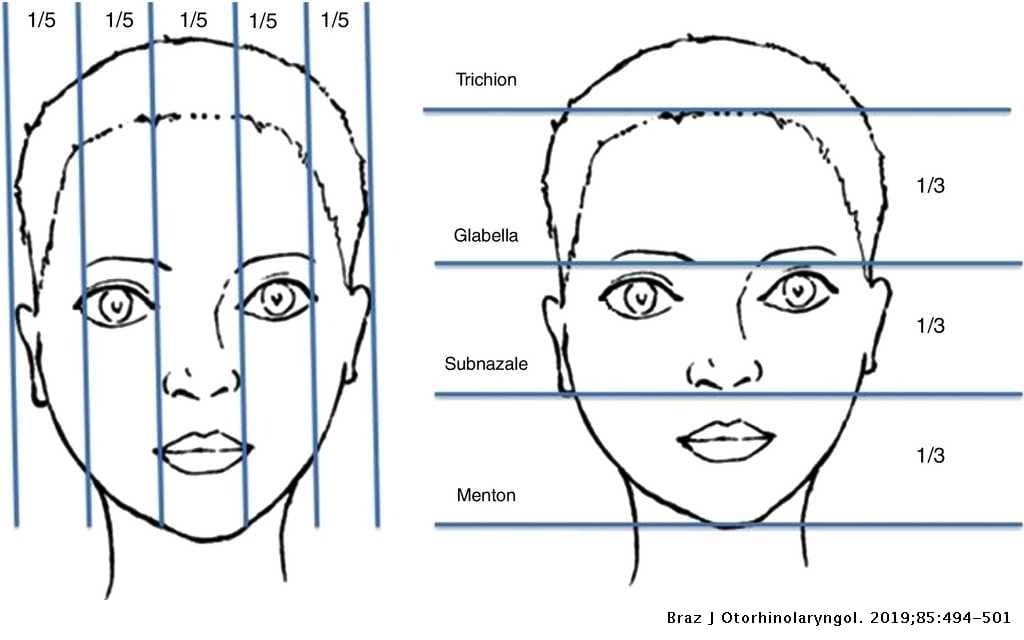
Assessment of facial analysis measurements by golden proportion | Brazilian Journal of ... View original
Is this image relevant?
Assessment of facial analysis measurements by golden proportion | Brazilian Journal of ... View original
Is this image relevant?
Assessment of facial analysis measurements by golden proportion | Brazilian Journal of ... View original
Is this image relevant?
Assessment of facial analysis measurements by golden proportion | Brazilian Journal of ... View original
Is this image relevant?
Ideal ratios
- The face divides vertically into thirds: hairline to brow, brow to base of nose, base of nose to chin. These thirds should be roughly equal in a standard adult face.
- Horizontally, the face is about five eye-widths wide. The eyes sit one eye-width apart, with one eye-width of space between each eye and the edge of the face.
- The mouth typically sits about one-third of the way down from the base of the nose to the chin.
- The ears generally align with the eyebrows at the top and the base of the nose at the bottom.
Sketch these guidelines lightly before placing any features. They'll keep everything in proportion even if you adjust later.
Variations by age
- Infants have much larger craniums relative to their faces. The eyes, nose, and mouth are clustered in the lower half of the head, and the forehead takes up a large portion.
- Children's faces are rounder and softer, with smaller noses and mouths compared to adults. Features are spaced closer together.
- Older adults tend to have longer-looking faces as skin loses elasticity. Features become more pronounced, and wrinkles and sagging skin alter the surface contours.
Variations by gender
- Male faces tend to be larger and more angular, with prominent brow ridges, stronger jawlines, and wider chins.
- Female faces are generally rounder and more delicate, with higher cheekbones and fuller lips.
- These differences become more apparent after puberty, but individual variation is significant. Don't rely on generalizations alone.
Facial structure
The underlying structure of the face, including the skull, muscles, and fat distribution, determines the overall shape and contours you see on the surface. Even if you never draw a skull directly, knowing what's underneath helps you place features convincingly and render expressions that look three-dimensional.
Skull anatomy
The skull provides the basic framework for the face. The eye sockets define where the eyes sit and create the shadow patterns around them. The nasal cavity shapes the bridge and width of the nose. The jaw consists of the maxilla (upper jaw, fixed) and the mandible (lower jaw, the only movable bone in the skull).
Other key landmarks to know:
- Zygomatic arch (cheekbone): determines the width of the mid-face and catches light prominently
- Brow ridge: the bony ledge above the eye sockets, more pronounced in male skulls
- Mental protuberance: the bony point of the chin
Muscle groups
Facial muscles sit just beneath the skin and are responsible for every expression. Unlike most body muscles that connect bone to bone, many facial muscles connect bone to skin, which is why they can create such fine movements.
Key muscle groups to know for drawing:
- Orbicularis oculi: rings around the eyes; responsible for squinting and blinking
- Zygomaticus major: runs from the cheekbone to the corner of the mouth; pulls the mouth up and back when smiling
- Corrugator supercilii: sits above the brow; pulls the eyebrows together when frowning
- Orbicularis oris: rings around the mouth; controls lip pursing and puckering
You don't need to memorize every muscle, but understanding where these major groups pull helps you draw expressions that feel structurally believable.
Fat distribution
Facial fat sits in specific pads, particularly in the cheeks, around the eyes, and under the chin. The amount and location of fat significantly affect how a face looks. Youthful faces tend to have fuller, more evenly distributed fat pads. With age, fat migrates downward and thins in some areas (like around the eyes) while accumulating in others (like the jowls). Weight changes and genetics also play a role.
Eyes
The eyes tend to be the first place a viewer looks, and they carry the most emotional weight in a portrait. Getting the eyes right often determines whether a portrait "works" or not.
Eye shapes
Eyes come in several common shapes: round, almond, hooded, monolid, downturned, and upturned. The shape is determined by the bone structure of the eye socket and the way the eyelids drape over the eyeball. Pay close attention to how much of the iris is visible and where the eyelid cuts across it, as this varies significantly between individuals and strongly affects the character of the face.
Eyelids and creases
The upper and lower eyelids wrap around the spherical form of the eyeball. The upper eyelid usually has a visible crease where it folds, and this crease varies in depth and position. Some people have a deep crease with a lot of visible lid space; others have a hooded lid where the crease is mostly hidden.
The lower eyelid is generally smoother but still has thickness. Don't draw it as a single hard line. Instead, suggest it with shadow and a subtle edge. Rendering the lids accurately creates the sense that the eye is a sphere sitting inside a socket, not a flat shape pasted onto the face.
Iris and pupil
The iris is the colored ring, and the pupil is the dark opening at its center. A few things to remember:
- The iris is partially covered by the upper eyelid in a relaxed gaze. If you draw the full circle of the iris visible, the face will look startled.
- The pupil dilates in low light and constricts in bright light.
- Highlights are critical. A small, bright reflection on the iris/pupil is what makes the eye look alive. Place it consistently with your light source, and leave it as the lightest value in the eye.
- The iris has radial patterns and subtle color shifts that you can suggest with light, directional strokes.
Nose
The nose sits at the center of the face and is one of the trickiest features to draw because it has very few hard edges. Most of its form is communicated through value changes rather than outlines.
Nose shapes
Noses vary widely: straight, concave (upturned), convex (Roman/aquiline), bulbous, narrow, wide. The shape comes from the combination of the nasal bone (the hard upper bridge) and the cartilage (the flexible lower portion including the tip). When drawing, pay attention to where the bony bridge transitions to softer cartilage, as this is often where the nose changes direction.
Nostril variations
Nostrils can be round, oval, or more triangular. They can flare wide or stay narrow, and they're rarely perfectly symmetrical. The alar wings (the fleshy sides of the nostrils) vary in thickness and shape. Avoid drawing nostrils as simple dark holes. Instead, observe their actual shape and render the surrounding forms that define them.
Nose in profile
The profile view reveals the nose's full silhouette and is where its unique character is most visible. Break the profile into three parts:
- The bridge: the slope from the brow to the tip, which can be straight, curved, or bumped
- The tip: the rounded end, which can point up, down, or straight out
- The columella: the fleshy strip between the nostrils, visible from the side as the area connecting the tip to the upper lip
Sketch the overall angle of the nose first, then refine the curves and transitions.
Mouth and lips
The mouth is the second most expressive feature after the eyes. It changes shape dramatically with every expression, so understanding its structure at rest gives you a foundation for drawing it in any position.
Lip shapes
Lips vary in fullness, width, and contour. Common descriptions include full, thin, bow-shaped, and heart-shaped. The upper lip typically has a defined cupid's bow (the M-shaped curve at the center) and is often slightly darker in value because it faces downward and catches less light. The lower lip is usually fuller and lighter because it faces upward toward the light source.
The line where the lips meet (the lip line) is actually the darkest, most defined edge of the mouth. Many beginners outline the entire lip shape with a hard line, but a more effective approach is to define the lip line clearly and let the outer edges of the lips blend softly into the surrounding skin.
Mouth expressions
The mouth can produce an enormous range of expressions. A few key observations:
- A genuine smile pulls the corners of the mouth up and back, and also engages the muscles around the eyes (the orbicularis oculi). A smile that only moves the mouth looks forced.
- Sadness and displeasure pull the corners of the mouth downward.
- Surprise drops the jaw and parts the lips, often revealing teeth.
When drawing expressions, focus on the overall shape the mouth makes rather than trying to render every detail of the lips first.
Teeth and tongue
When the mouth is open or smiling, teeth and sometimes the tongue become visible. A few practical tips:
- Don't outline every individual tooth. Instead, suggest the row of teeth as a shape, then lightly indicate the separations between a few key teeth.
- Teeth are not pure white. They have subtle value variations and are usually slightly darker than the brightest highlights on the face.
- The tongue has a soft, rounded form. When visible, it typically appears behind the lower teeth and has a slightly darker value than the surrounding skin.
Ears
Ears are often partially hidden by hair, but when visible, they need to be drawn with the same care as any other feature. Their complex, folded shape can seem intimidating, but it becomes manageable once you understand the basic parts.
Ear anatomy
The ear has several distinct parts:
- Helix: the outer rim that curves around the top and back of the ear
- Antihelix: the Y-shaped inner ridge
- Concha: the bowl-shaped depression leading to the ear canal
- Tragus: the small flap that partially covers the ear canal opening
- Lobe: the soft, fleshy bottom portion
When drawing, start with the overall shape (roughly an oval tilted slightly backward), then carve out the internal forms. The concha is the deepest area and will be the darkest value.
Ear placement
The ears sit on the sides of the head, roughly aligned with the eyebrows at the top and the base of the nose at the bottom. They're not flat against the head; they angle outward slightly. The degree of this angle varies between individuals.
When the head tilts or turns, the ears move with it. In a three-quarter view, the far ear will appear smaller and more compressed due to perspective. Getting ear placement right helps maintain the overall balance of the head.
Ear variations
Ears vary considerably. Some lobes are attached directly to the head; others hang free. Some helixes are thick and rounded; others are thin and angular. Some ears protrude noticeably while others sit close to the skull. These variations are worth observing carefully because they contribute to a subject's likeness more than most students expect.
Facial hair
Facial hair can significantly change the perceived shape and character of a face. It obscures some of the underlying structure while adding its own texture and form.
Types of facial hair
Common types include full beards, goatees, mustaches, stubble, and sideburns. Each type covers different areas of the face and creates different visual effects. A full beard, for example, can make a narrow jaw appear wider, while a goatee can elongate the chin.
Rendering techniques
Drawing facial hair convincingly requires attention to its direction of growth, texture, and density. Here are some effective approaches:
- Layering: Build up hair gradually from light to dark, working in the direction of growth.
- Cross-hatching: Use overlapping strokes at slight angles to suggest thickness and volume.
- Stippling: Use dots to suggest very short stubble or sparse growth.
Always follow the contour of the face beneath the hair. Facial hair wraps around the jaw and chin, and it should feel like it's sitting on a three-dimensional form, not pasted flat onto the surface.
Facial hair and age
Younger men often have sparser, finer facial hair, while older men may have thicker, coarser growth. Over time, facial hair can thin, gray, or change in texture. Stubble on a young face looks different from stubble on an older face because the underlying skin texture is different. Paying attention to these age-related qualities helps you create convincing, age-appropriate portraits.
Facial expressions
Expressions are what bring a portrait to life. They're created by the coordinated movement of facial muscles, and even small changes can shift the entire mood of a face.
Universal emotions
Psychologist Paul Ekman identified six universally recognized expressions: happiness, sadness, anger, fear, surprise, and disgust. Each involves specific, predictable muscle movements:
- Happiness: corners of the mouth rise, cheeks push up, crow's feet appear around the eyes
- Sadness: inner eyebrows rise, corners of the mouth drop, lower lip may push up
- Anger: eyebrows lower and pull together, lips press tight or bare teeth, nostrils may flare
- Fear: eyebrows rise and pull together, eyes widen, mouth opens slightly
- Surprise: eyebrows rise high, eyes open wide, jaw drops
- Disgust: nose wrinkles, upper lip rises, cheeks push up
These are your starting points. Real expressions are usually blends and variations of these basics.
Subtle expressions
Most of the expressions you'll actually draw are subtler than the six universals. A slight narrowing of the eyes, a barely raised eyebrow, or a faint tightening at the corner of the mouth can communicate complex emotions like skepticism, amusement, or discomfort. These subtle shifts often happen in just one or two features while the rest of the face stays relatively neutral. Train yourself to notice them by studying faces closely, both in life and in photographs.
Asymmetry in expressions
Faces are never perfectly symmetrical, and expressions amplify this. One side of the mouth might curl up more in a smirk. One eyebrow might rise higher than the other in a questioning look. Incorporating this natural asymmetry makes your portraits feel alive and authentic. If you draw both sides of the face as mirror images, the expression will look stiff and artificial.
Lighting on faces
Lighting determines how you see every form on the face. The same face under different lighting can look dramatically different, so understanding light is just as important as understanding anatomy.
Light and shadow
The direction, intensity, and quality of your light source create the pattern of lights and shadows across the face. A few common setups:
- Front lighting: flattens the face, minimizes shadows, shows detail evenly
- Side lighting (Rembrandt lighting): light from about 45 degrees to one side creates a triangle of light on the shadow-side cheek; great for showing form and drama
- Underlighting: light from below creates an eerie, unnatural look because it reverses the shadow patterns we're used to seeing
- Backlighting (rim lighting): creates a bright edge around the head with the face mostly in shadow
Identify your light source direction first, then map out the major shadow shapes before rendering details.
Planes of the face
The face isn't a smooth, continuous surface. It's made up of distinct planes, flat or gently curved surfaces that change direction at edges. The major planes include the front of the forehead, the side of the forehead, the front of the cheek, the side of the cheek, the front plane of the nose, and the side planes of the nose.
Where two planes meet, you get a value change. A plane facing the light will be lighter; a plane angled away will be darker. Practicing "planar head" studies (drawing the head as a series of flat, simplified planes) is one of the best ways to understand how light falls across the face.
Reflections and highlights
Beyond shadows, light also creates highlights and reflected light on the face. Highlights appear where the surface faces the light source most directly, typically on the forehead, bridge of the nose, cheekbones, and lower lip. Reflected light is the softer, secondary illumination that bounces into shadow areas from nearby surfaces.
The eyes deserve special attention here. The cornea is a wet, curved surface that produces sharp, bright reflections. These small highlights are what make drawn eyes look alive, so place them carefully and keep them consistent with your light source.
Facial features and identity
What makes a face recognizable isn't any single feature but the unique combination of proportions, shapes, and subtle details that distinguish one person from another. Capturing a likeness means identifying and accurately rendering these distinguishing qualities.
Distinguishing characteristics
Every face has features that stand out: the specific curve of someone's nose, the spacing of their eyes, the shape of their jawline, or the way their mouth sits at rest. When starting a portrait, spend time observing what makes this face different from an average face. Those differences are what you need to get right for the portrait to read as that specific person.
A useful exercise: before you start drawing, mentally list three to five things that are most distinctive about your subject's face. Then make sure those qualities come through clearly in your drawing.
Exaggeration vs realism
Portrait artists constantly navigate the spectrum between strict realism and selective exaggeration. Even in a "realistic" portrait, slightly emphasizing a subject's most distinctive features can actually make the portrait more recognizable than a perfectly measured copy would. This is because our brains identify people partly through their most distinctive traits.
The key is intentionality. Exaggerate with purpose, not by accident. If you push a feature too far without meaning to, it reads as an error. If you push it deliberately, it reads as interpretation.
Caricature techniques
Caricature takes exaggeration to its logical extreme, amplifying the most prominent or unusual features of a face while simplifying or minimizing everything else. To create an effective caricature:
- Identify the features that deviate most from "average" (a large nose, close-set eyes, a wide smile).
- Exaggerate those features further in the same direction they already deviate.
- Simplify or reduce the less distinctive features to keep the focus on what matters.
- Maintain enough of the overall proportional relationships that the subject is still recognizable.
Good caricature requires a strong understanding of realistic facial anatomy. You need to know the rules well before you can break them effectively.
See Fiveable more often in Google
Mark Fiveable as a preferred source and Google is more likely to show you our guides in Top Stories, with a "preferred" badge in AI Mode and AI Overviews.