10.2 Proportions of the human body

✏️Drawing I Unit 10 Review
10.2 Proportions of the human body
✏️ Drawing I
Proportions of the human body
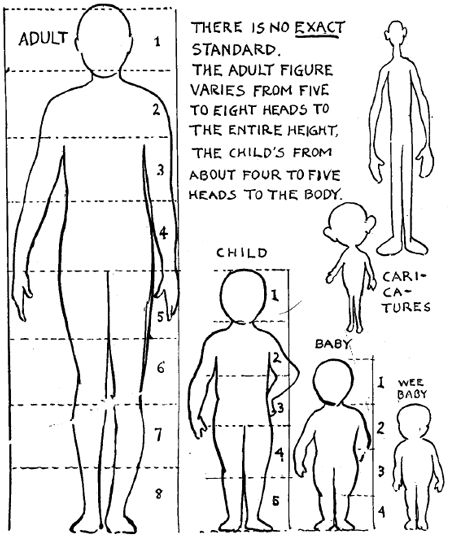
Understanding proportions is what separates a figure that looks "right" from one that feels slightly off. Artists use head lengths as a standard unit of measurement to map out the human body, with an average adult standing about 7.5 to 8 heads tall. Once you internalize this system, you can quickly block in figures and check whether body parts are sized and placed correctly relative to each other.
Proportions also shift depending on gender, age, and body type. This unit covers the key ratios you need to know, how they vary across different figures, and how to apply them when drawing.

Top images from around the web for Ideal proportions vs individual variations
Body proportions - Wikipedia View original
Is this image relevant?
Year8FrenchTerm3 - Lesson 06, The body View original
Is this image relevant?
Thomas Carpentier’s “L’homme, mesures de toutes choses” – SOCKS View original
Is this image relevant?
Body proportions - Wikipedia View original
Is this image relevant?
Year8FrenchTerm3 - Lesson 06, The body View original
Is this image relevant?
Ideal proportions vs. individual variations
Ideal proportions are the standardized ratios artists use as a starting framework for drawing balanced figures. Think of them as a baseline, not a rule. The classic 8-head-tall figure, for instance, is slightly idealized; most real people are closer to 7.5 heads tall.
Individual variation is everywhere. Genetics, age, nutrition, and body type all affect a person's height, limb length, torso-to-leg ratio, and facial structure. Your job as an artist is to use ideal proportions as a guide for construction, then observe your actual subject and adjust. Drawing every figure to the same template produces stiff, generic results. Capturing what makes a specific person's proportions unique is what makes a figure drawing feel alive.
Measuring the body in head lengths
The head length (measured from the crown of the skull to the chin) is the basic unit for mapping the whole figure. Here's how the standard 7.5–8 head system breaks down:
- Head 1: Crown to chin
- Heads 1–2: Chin to roughly the nipple line / mid-chest
- Heads 2–3.5: Mid-chest to the navel and just below the hip crests (the torso is about 2.5 head lengths total)
- Heads 3.5–4: Navel area to the crotch / base of the pelvis
- Heads 4–6: Crotch to just below the knees (the knee falls roughly at head 6)
- Heads 6–7.5/8: Below the knees to the soles of the feet
To use this in practice:
- Draw or estimate one head length at the top of your figure.
- Mark that same length repeatedly down the page to establish total height.
- Use the landmarks above to place the chest, waist, hips, knees, and feet.
- Adjust from there based on the specific person you're drawing.
The legs account for roughly half the total body height, which is a quick check you can use anytime a figure looks too top-heavy or bottom-heavy.
Proportional differences between genders
Male and female figures share the same skeletal framework, but several proportional tendencies differ:
- Shoulders: Male figures typically have shoulders about 2 head lengths wide. Female figures trend narrower, closer to 1.5–1.75 head lengths.
- Hips: Female figures tend to have wider hips relative to the shoulders, sometimes nearly matching shoulder width. Male hips are noticeably narrower than the shoulders.
- Waist placement: The natural waist on female figures often sits slightly higher and is more defined relative to the ribcage and hips.
- Overall silhouette: Male figures tend toward more angular, tapered shapes (wide shoulders to narrow hips). Female figures tend toward more curved transitions between ribcage, waist, and hips.
- Facial features: Male faces often have more angular jawlines, a more prominent brow ridge, and slightly larger overall proportions. Female faces tend toward softer angles and rounder contours.
These are general tendencies, not absolutes. Real people fall along a wide spectrum, so always prioritize observation over assumptions.

Proportions of the head and face
The head and face have their own set of reliable proportional guidelines:
- Eye line: The eyes sit roughly halfway between the top of the skull and the chin. This surprises most beginners, who tend to place the eyes too high.
- Thirds of the face: The face divides into three roughly equal vertical sections: hairline to brow ridge, brow ridge to base of the nose, and base of the nose to the chin.
- Mouth placement: The mouth sits about one-third of the way down from the base of the nose to the chin, not halfway.
- Face width: The face is approximately five eye-widths across. One eye-width separates the two eyes, and one eye-width spans from each outer eye corner to the edge of the face.
- Ears: The tops of the ears generally align with the brow, and the bottoms align with the base of the nose.
A helpful exercise: draw a simple oval, divide it with a horizontal halfway line (for the eyes) and three equal horizontal zones (for the face), then place features using the ratios above. You'll see how quickly a believable face emerges from just a few guidelines.
Proportions of the torso and limbs
Torso:
- The ribcage spans roughly 1 head length from the collarbones to its base.
- The pelvis is about half a head length tall.
- The distance from the base of the ribcage to the top of the pelvis (the waist/abdominal area) is roughly half a head length, though this varies with body type.
Arms:
- When relaxed at the sides, the fingertips reach roughly to mid-thigh.
- The elbows align approximately with the navel (or the natural waist).
- The wrists align approximately with the base of the pelvis (the greater trochanter area).
- The upper arm and forearm are each roughly 1.5 head lengths, though the forearm (including the hand) can appear slightly longer.
Legs:
- The legs make up about half the total body height.
- The knees fall approximately halfway between the hip joint and the soles of the feet.
- A common mistake is making the thigh and lower leg equal in length. The thigh (hip to knee) is typically slightly longer than the lower leg (knee to ankle).
Proportions of hands and feet
Hands and feet are notoriously tricky, partly because students tend to draw them too small.
Hands:
- The hand, from wrist to fingertip, is roughly the same length as the face (chin to hairline). Hold your hand up to your face to verify this on yourself.
- The palm width is approximately equal to the width of the face at the cheekbones.
- The middle finger is roughly half the total hand length.
Feet:
- The foot is about 1 head length long. This is another measurement that surprises people; feet are bigger than you'd expect.
- Foot width is roughly one-third of its length.
- When drawing shoes or bare feet, keeping this 1-head-length guideline in mind prevents the common error of undersizing them.

Changes in proportions with age
Proportions shift dramatically from infancy through old age, and getting these right is essential for drawing figures of different ages convincingly.
- Infants (0–1 year): The head is about one-quarter of total body height (a 4-head-tall figure). Limbs are short and chubby, and the torso is relatively long.
- Young children (2–5 years): Roughly 5–6 heads tall. The head is still proportionally large, the forehead is prominent, and the limbs are short relative to the torso.
- Older children (6–12 years): About 6–6.5 heads tall. Limbs begin to lengthen, and the body starts approaching adult proportions.
- Adolescents: Proportions approach adult ratios (7–7.5 heads), though growth spurts can temporarily make limbs look long relative to the torso.
- Older adults: The spine may compress slightly, reducing overall height. Posture often shifts forward, and the relationship between the ribcage and pelvis can change.
The key takeaway: the younger the figure, the larger the head relative to the body and the shorter the limbs.
Proportions in different body types
Body types vary widely, and recognizing common patterns helps you draw diverse figures. Three broad categories (originally from the somatotype system) are useful as drawing shorthand:
- Ectomorph: Lean build, long limbs relative to the torso, narrow shoulders and hips. Think of a long-distance runner's frame.
- Mesomorph: Athletic build, broad shoulders, narrow waist, well-defined musculature. Think of a gymnast or swimmer.
- Endomorph: Rounder build, wider hips and midsection, softer contours, shorter-appearing limbs due to more tissue mass.
Most real people are a mix of these types. The point isn't to label your subject but to notice how weight distribution, limb length, and shoulder-to-hip ratio differ from the "ideal" baseline, and then adjust your proportional framework accordingly.
Artistic interpretations of proportions
Proportional accuracy matters for realism, but plenty of powerful art deliberately breaks these rules.
- Elongation: Artists like El Greco and Modigliani stretched their figures to create a sense of elegance or spiritual intensity. Modigliani's portraits often feature necks and faces elongated well beyond natural proportions.
- Exaggeration for emphasis: Caricature artists enlarge distinctive features (a big nose, a wide smile) while shrinking others, using proportional distortion to capture personality.
- Stylized proportions: Anime and manga characters often have eyes that take up a third of the face and legs that are far longer than realistic. Comic book superheroes are frequently drawn at 8.5–9 heads tall to look more imposing.
The underlying principle: you need to understand standard proportions before you can break them effectively. Distortion reads as intentional and expressive only when the rest of the figure's construction is solid.
Proportions in foreshortening and perspective
Foreshortening occurs when a body part points toward or away from the viewer, causing it to appear compressed along its length. A classic example: an arm reaching directly toward you looks much shorter than it actually is, with the hand appearing disproportionately large.
To handle foreshortened figures:
- Identify which body parts are angled toward or away from the viewer.
- Recognize that those parts will appear shorter in length but may appear wider or larger at the nearest end.
- Use overlapping forms (the forearm overlapping the upper arm, for example) to communicate depth.
- Trust what you see over what you "know." Your brain wants to draw the arm at its full length, but your eyes are telling you it's compressed. Follow your eyes.
Linear perspective also affects figure proportions in a scene. Figures farther from the viewer appear smaller, and their proportions must shrink consistently. If you have multiple figures at different depths in a composition, establish a horizon line and use it to keep their relative sizes consistent. A figure in the background drawn too large will look like a giant, not a distant person.
See Fiveable more often in Google
Mark Fiveable as a preferred source and Google is more likely to show you our guides in Top Stories, with a "preferred" badge in AI Mode and AI Overviews.