7.4 Part Writing of Secondary Leading Tone Chords

🎶AP Music Theory Unit 7 Review
7.4 Part Writing of Secondary Leading Tone Chords
🎶 AP Music Theory
When you part write secondary leading tone chords, treat them like normal leading tone chords, just aimed at a temporary tonic instead of the real one. Raise the temporary leading tone, resolve any chordal seventh down by step, avoid doubling tendency tones, and watch for parallel fifths and octaves.
Why This Matters for the AP Music Theory Exam
Secondary function chords show up across both sections of the AP Music Theory exam. You may see multiple-choice questions that ask you to identify a chromatic chord or explain a key relationship, and harmonic dictation and part-writing tasks can include secondary leading tone chords too. This topic specifically trains the voice-leading half of that skill: not just spotting vii°7/V, but knowing how every voice should move when you write or check it.
Because secondary leading tone chords follow the same rules as regular leading tone chords, getting comfortable here also reinforces your core voice-leading habits. If you can analyze a score, catch errors, write the chord correctly, and hear it in context, you are practicing all four ways this skill is tested.
Key Takeaways
- A secondary leading tone chord is a diminished triad or diminished seventh chord whose root is the leading tone of the chord being tonicized (for example vii°7/V is built on the raised fourth scale degree and resolves to V).
- Keep every doubling and voice-leading rule you use for normal leading tone chords, including resolving the chordal seventh down by step.
- Always raise the temporary leading tone; the whole purpose is to create tendency tones that pull toward the temporary tonic.
- Fully diminished sevenths (vii°7) can tonicize major or minor triads; half-diminished sevenths (viiø7) only tonicize major triads, so they do not appear in minor-key tonicizations.
- Avoid root-position diminished seventh chords when possible, just as you would with normal leading tone sevenths.
- Watch for parallel fifths and octaves and do not double the chromatic leading tone.
Reviewing Secondary Leading Tone Chords
A vii° chord has a dominant function much like the V chord: both pull toward the tonic and create a sense of resolution. Because of that shared function, you can use a secondary leading tone chord to tonicize a non-tonic triad, just as you can use a secondary dominant.
These chords most often appear as seventh chords: vii°7 (fully diminished) and viiø7 (half-diminished). In a major key you can use both vii°7 and viiø7 to tonicize. In a minor key you should only use vii°7, because the half-diminished version does not fit. Fully diminished sevenths are the more common choice overall.
To spell one, find the root of the chord you want to tonicize, treat it as a temporary tonic, and build a diminished chord on that temporary tonic's leading tone.
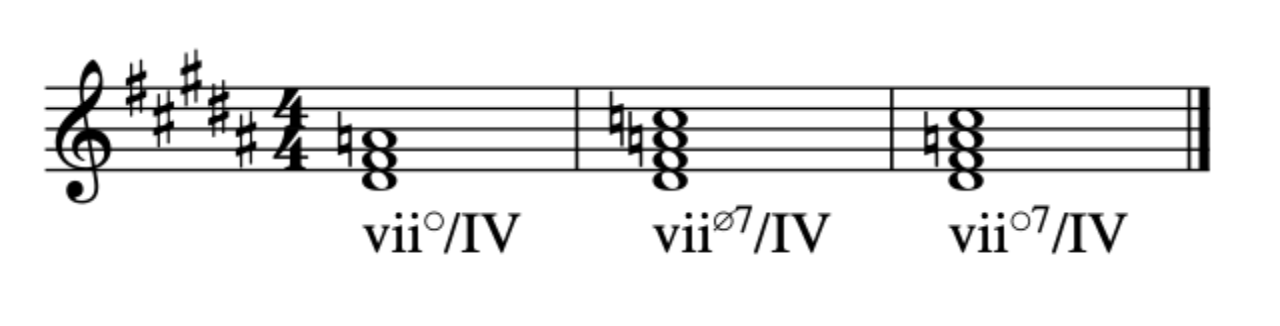
Example: spell vii°/IV, vii°7/IV, and viiø7/IV in B major.
In B major, the root of IV is E, so E is the temporary tonic. The temporary leading tone is D♯. That gives you:
- vii°/IV = D♯-F♯-A♮
- vii°7/IV = D♯-F♯-A♮-C♮
- viiø7/IV = D♯-F♯-A♮-C♯
Identifying Secondary Leading Tone Chords

Spotting these works a lot like spotting secondary dominants. Start by scanning for accidentals. Accidentals that do not belong to the key signature are your first clue that a chord might be tonicizing something.
Next, check the chord quality. A V chord is almost always major, so if you find a diminished or half-diminished chord with accidentals, you are likely looking at a secondary leading tone chord. From there, figure out which triad its root is the leading tone of, and label it (for example, F♯ as a leading tone points to G, which is V in C major, so the chord is vii°7/V).
Context matters too. A real tonicization should resolve to the chord it is pointing at. If a candidate chord does not resolve that way, it probably is not functioning as a secondary leading tone chord, even if it looks diminished on paper.
Part Writing Secondary Leading Tone Chords
When you write these chords, follow all the voice-leading rules you already use for normal leading tone chords. The only twist is that you are working in a temporary key, so the leading tone, chordal seventh, and tonic are all defined by that temporary tonic, not the real one. If you are in C major and writing vii°7/V, the chordal seventh is not F; it is the fourth scale degree of the temporary key (G), so the seventh is C.
Keep these specific points in mind:
- Resolve the chordal seventh down by step, just as in any leading tone seventh chord.
- Always raise the temporary leading tone. The whole point is to build tendency tones that resolve to the temporary tonic, so a chord without that raised leading tone would not function as a secondary leading tone chord.
- Avoid root-position diminished seventh chords when you can, the same way you avoid root-position vii°7 in regular 18th-century voice leading.
- Do not double the chromatic leading tone, and check carefully for parallel fifths and octaves.
A few quality reminders help when adding accidentals. In a major key, a leading tone seventh built diatonically is half-diminished, because the interval between its fifth and seventh is a major third (for example F to A in C major). In a minor key, that same chord is fully diminished, because the fifth-to-seventh interval is a minor third (for example F to A♭ in C minor). That is why minor-key tonicizations use vii°7, not viiø7.
For practice, write a vii°/V-V chord progression in any key you choose. Then add a cadential ⁶₄ by writing vii°/V-V⁶₄-⁵₃, and finally practice with seventh chords by writing vii°7/V-V⁸₆₄-⁷₅₃.
How to Use This on the AP Music Theory Exam
Score Analysis
When you analyze a score, look for accidentals first, then chord quality, then resolution. If you find a diminished or half-diminished seventh with non-key accidentals that resolves like a leading tone, label it as a secondary leading tone chord and name the chord it tonicizes (for example vii°7/V resolving to V).
Error Detection
Check the high-frequency voice-leading rules: does the chordal seventh resolve down by step, is the temporary leading tone raised and resolving correctly, and are there hidden parallel fifths or octaves? Also confirm the quality is right for the mode (vii°7 in minor, either quality in major).
Writing Exercises
When you add voices, decide your temporary tonic, raise its leading tone, and place the chordal seventh so it can fall by step. Prefer inversions over root position for diminished sevenths, and avoid doubling the chromatic leading tone.
Contextual Listening
A secondary leading tone chord often sounds like a sudden chromatic lean toward a new chord, followed by a satisfying resolution. Train your ear to hear that brief pull and the tendency-tone release that follows.
Common Misconceptions
- Misconception: A diminished chord with accidentals is always vii°7/V.Actually: It tonicizes whatever triad its root is the leading tone of. Check which chord it actually resolves to before labeling it.
- Misconception: You can use viiø7 in any key.Actually: Half-diminished leading tone sevenths only tonicize major triads, so you will not use viiø7 in a minor-key tonicization.
- Misconception: The chordal seventh in C major is always F.Actually: In a tonicization, the seventh belongs to the temporary key. For vii°7/V in C major, the temporary tonic is G, so the chordal seventh is C, not F.
- Misconception: Secondary leading tone chords get their own special rules.Actually: They follow the same doubling and voice-leading rules as ordinary leading tone chords; only the key of reference changes.
- Misconception: Root-position diminished sevenths are fine here.Actually: As with normal vii°7, avoid root position when possible and prefer an inversion.
- Misconception: Any chromatic chord is a tonicization.Actually: If the chord does not resolve to the triad it would tonicize, it probably is not functioning as a secondary leading tone chord.
Related AP Music Theory Guides
Practice Questions for 7.4
1 of 4
In what way does the treatment of the chordal seventh in a secondary leading tone chord differ from its treatment in a primary key vii° chord?
A.
The chordal seventh in a secondary leading tone chord always resolves by leap
B.
The chordal seventh in a secondary leading tone chord is typically omitted
C.
The chordal seventh in a secondary leading tone chord often resolves upward by step
D.
The chordal seventh in a secondary leading tone chord is doubled for emphasis
Vocabulary
The following words are mentioned explicitly in the AP® course framework for this topic.Term | Definition |
|---|---|
chordal sevenths | The seventh note of a chord that typically resolves downward by step in proper voice leading. |
doubling | The practice of having two or more voices or instruments play the same pitch or pitch class in different octaves. |
leading-tone chords | Chords built on the seventh scale degree that typically resolve upward by half step to the tonic, creating strong harmonic motion. |
part-writing | The process of composing individual melodic lines for each voice in a multi-voice musical texture. |
secondary leading-tone chords | Chords built on scale degrees other than the tonic that function as leading-tone chords, creating chromatic voice leading to their resolution chords. |
voice leading | The technique of moving individual melodic lines (voices) in a musical composition, including considerations for smooth transitions and proper resolution of chords. |
Frequently Asked Questions
What are secondary leading tone chords in AP Music Theory?
Secondary leading tone chords are diminished or diminished-seventh chords that tonicize a chord other than the tonic by using that chord's temporary leading tone.
How do you spell vii°7/V?
To spell vii°7/V, treat V as a temporary tonic, build a fully diminished seventh chord on its leading tone, and resolve it to V.
What is the difference between vii°7 and viiø7 secondary leading tone chords?
vii°7 is fully diminished and can tonicize major or minor triads. viiø7 is half-diminished and tonicizes major triads only.
How should the chordal seventh resolve in secondary leading tone chords?
The chordal seventh resolves down by step, just as it does in ordinary leading-tone seventh chords.
What should you avoid doubling in a secondary leading tone chord?
Avoid doubling the chromatic temporary leading tone because it is a tendency tone that needs to resolve correctly.
How are secondary leading tone chords tested on AP Music Theory?
You may identify them in score analysis or listening, check voice-leading errors, or write them in part-writing exercises using normal 18th-century voice-leading rules.
See Fiveable more often in Google
Mark Fiveable as a preferred source and Google is more likely to show you our guides in Top Stories, with a "preferred" badge in AI Mode and AI Overviews.