5.6 Cadential 6/4 Chords

🎶AP Music Theory Unit 5 Review
5.6 Cadential 6/4 Chords
🎶 AP Music Theory
A cadential 6/4 chord is a second inversion tonic triad that sits right before the dominant at or near a cadence. It looks like a I chord, but it does not function as tonic.
Why This Matters for the AP Music Theory Exam
Second-inversion triads are a known weak spot for students, and the cadential 6/4 is the one you will run into most. Knowing it well pays off in several exam tasks: spotting and labeling chords during harmonic analysis, hearing the resolution in contextual listening, catching mistakes in error detection, and writing it correctly in part-writing exercises. When you realize a figured bass or complete a four-voice progression, a clean cadential 6/4 shows you understand both harmonic function and 18th-century voice leading.
Key Takeaways
- A cadential 6/4 contains the notes of the tonic triad but functions as an embellishment of the dominant, not as tonic.
- It sits in a metrically stronger position than the dominant chord that follows, so place it on a strong beat.
- The sixth and fourth above the bass always resolve down by step to the dominant.
- It can be notated as V⁶₄-⁵₃, which reminds you that 6 moves to 5 and 4 moves to 3.
- Double the bass (scale degree 5), not the root, to reinforce the dominant function.
- Approach it with a predominant chord like IV or ii⁶ so the dominant area is set up clearly.
How 6/4 Chords Function
You already know that some chords can shift roles depending on context. A IV chord can act as a predominant or as an extension of tonic, for example. Second-inversion triads work in a similar but stricter way: they do not behave like ordinary triads, and they only appear in a few specific situations.
Try this at a keyboard. Play a I chord in C major in root position, then invert it to second inversion (a I⁶₄ chord with G in the bass). The tonic quality gets much weaker. The same thing happens with other 6/4 chords: a V⁶₄ does not really sound like a dominant, and a IV⁶₄ does not really sound like a subdominant.
That does not mean 6/4 chords are off-limits. They appear in four specific contexts:
- Cadential 6/4: embellishes the dominant before a cadence. The upper voices of the I⁶₄ move down by step into a root-position V. For example, in C major a I⁶₄ spelled G-C-E resolves so the upper voices step down to a G-B-D root-position V.
- Neighboring or pedal 6/4: embellishes the upper lines while the bass stays put. In a I-IV⁶₄-I motion in C major, the bass C holds while upper voices move to their upper neighbors and back. This usually falls on a weak beat.
- Passing 6/4: fills in a stepwise bass line. In a I-V⁶₄-I⁶ progression in C major, the bass walks C-D-E and the 6/4 harmonizes the passing tone D. This usually falls on a weak beat.
- Arpeggiated 6/4: results from the bass arpeggiating a single triad, as in I-I⁶-I⁶₄. Here the chord keeps the same harmonic function as the other inversions.
The big idea: in each of these cases, the 6/4 chord is embellishing harmony that is already there. It is not adding a new harmony.
Cadential 6/4 Chords in Detail
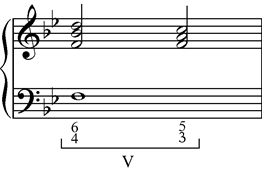
The cadential 6/4 is a I⁶₄ chord that precedes a root-position dominant, usually at a cadence. Even though it contains the notes of the tonic triad, it does not act as tonic. It serves as a brief expansion of the dominant area, which is why we say it has dominant function. Instead of writing I⁶₄-V, you usually notate it as V⁶₄-⁵₃ to show that the 6/4 is "part of" the dominant.

The cadential 6/4 sits in a metrically stronger position than the dominant chord that follows it, and the upper voices move down by step to reach the dominant. For example, a cadential 6/4 in A major has the notes E-A-C. The A and C in the upper voices step down to G and B, spelling the root-position dominant E-G-B. From there you use normal voice-leading rules to resolve V to I, usually with the I on a strong beat.
When you write a cadential 6/4, double the bass of the chord (scale degree 5), not the root. This puts scale degree 5 in two voices and emphasizes the dominant function.
Here is another acceptable way to notate the cadential 6/4, even though V⁶₄-⁵₃ is the more common label.
Resolving to the Dominant Seventh
You can absolutely use a cadential 6/4 before a V⁷-I cadence. When a cadential 6/4 moves to a dominant triad, you usually keep the doubled dominant note as a common tone. In a Bb major example, a 6/4 chord spelled F-F-B-D moves to F-F-A-C. The bass F is a common tone, so both Fs stay while A and C step down.
To reach a V⁷ instead, move one of those upper-voice Fs down by step to E, spelling F-E-A-C, a root-position V⁷. You would notate this as V⁸-⁷ over ⁶-⁵ over ⁴-³, showing that the octave above the bass moves to the seventh, the sixth moves to the fifth, and the fourth moves to the third. Just like with regular figured bass, the actual voicing order does not change the figures.

How to Use This on the AP Music Theory Exam
Part Writing
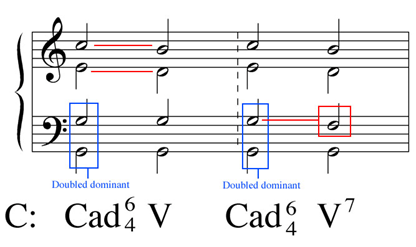
- Always double the bass (scale degree 5) of the cadential 6/4. If you double the root instead, the chord reads as a second-inversion tonic and will be marked wrong.
- Resolve the sixth and fourth above the bass down by step into the dominant. Keep the bass as a common tone when moving to V or V⁷.
- Place the cadential 6/4 on a strong beat and the dominant on a weaker beat after it.
- Approach with a predominant such as IV or ii⁶ so the harmonic flow is tonic, predominant, then the cadential 6/4 embellishing the dominant.
Common Trap
- After writing the chord, check for parallel fifths and octaves. Since all upper voices step down together, parallel motion is a real risk if your voicing is off. Correct voice leading usually avoids the problem, but always double-check.
Score Analysis and Listening
- When you see a second-inversion tonic on a strong beat right before V, label it as a cadential 6/4 (V⁶₄-⁵₃), not as a real I chord.
- In contextual listening, listen for that "lean into the cadence" feeling: the 6/4 sounds suspended over the dominant bass, then the upper voices settle down by step.
Common Misconceptions
- Misconception: The cadential 6/4 is a tonic chord.Actually: It has the notes of the tonic triad, but it functions as an embellishment of the dominant, not as tonic.
- Misconception: You double the root like a normal triad.Actually: No. Double the bass (scale degree 5) to reinforce dominant function.
- Misconception: The 6 and 4 can resolve any direction.Actually: They always resolve down by step to the tones of the dominant.
- Misconception: It can go on a weak beat like the other 6/4 types.Actually: The cadential 6/4 belongs on a metrically stronger beat than the dominant that follows. Passing and neighboring 6/4 chords are the ones that fall on weak beats.
- Misconception: It is fine to put it right after tonic.Actually: Approaching it straight from the tonic area weakens its effect, since it shares tonic notes. Set it up with a predominant chord so the dominant area is clear.
Related AP Music Theory Guides
Practice Questions for 5.6
1 of 10
A student compares a score to a recording of a phrase in F Major. The score notates a cadential chord resolving to a dominant triad. The alto voice is notated with the pitch F resolving down to E. The recording performs the alto pitch F resolving up to G. Which statement correctly identifies this discrepancy?
A.
The performance incorrectly resolves the fourth of the chord upward.
B.
The performance incorrectly resolves the seventh of the chord upward.
C.
The performance incorrectly resolves the leading tone upward.
D.
The performance incorrectly resolves the sixth of the chord upward.
Vocabulary
The following words are mentioned explicitly in the AP® course framework for this topic.Term | Definition |
|---|---|
⁶₄ chord | A second-inversion triad where the fifth of the chord appears in the bass, notated with the figured bass symbols 6 and 4. |
arpeggiated ⁶₄ | A ⁶₄ chord that results from triad arpeggiation in the bass, where the bass arpeggiates a complete triad or oscillates between the root and fifth while upper voices remain static. |
bass | The lowest voice part in SATB four-voice texture, typically the lowest musical line. |
cadence | A harmonic progression that marks the end of a phrase and provides punctuation in musical flow. |
cadential ⁶₄ | A sixth-four chord that occurs on a strong beat, typically preceding a V-I cadence in 18th-century harmonic practice. |
cadential ⁶₄ chord | A second-inversion chord that typically appears before a V-I cadence, functioning as an acceptable harmonic pattern in voice leading. |
dominant | The fifth scale degree and its associated chord (V), which creates tension and typically resolves to the tonic. |
figured bass | A notational system using Arabic numerals below a bass note to indicate the intervals and pitches of the chord to be played above that bass note. |
neighboring ⁶₄ | A ⁶₄ chord that occurs when the third and fifth of a root-position triad are embellished by their upper neighbor tones while the bass remains stationary, typically appearing on a weak beat. |
passing ⁶₄ | A ⁶₄ chord that harmonizes a passing tone in the bass, typically occurring on a weak beat as part of a three-note ascending or descending scale fragment. |
pedal ⁶₄ | A ⁶₄ chord in which the bass note remains stationary while upper voices move, often used interchangeably with neighboring ⁶₄ when describing embellished triads. |
resolution | The movement of a chord tone, typically by step, to another chord tone, often from a dissonant interval to a consonant one. |
second-inversion triad | A triad with the fifth of the chord in the bass position, creating a ⁶₄ figured bass notation. |
tonic triad | A chord built on the first scale degree, serving as the primary harmonic center and point of rest in a key. |
voice leading | The technique of moving individual melodic lines (voices) in a musical composition, including considerations for smooth transitions and proper resolution of chords. |
Frequently Asked Questions
What is a cadential 6/4 chord in AP Music Theory?
A cadential 6/4 is a second-inversion tonic triad that appears right before the dominant at or near a cadence. It contains tonic-triad notes, but it functions as an embellishment of the dominant.
Why is a cadential 6/4 not really a tonic chord?
Even though it looks like I6/4, the bass is scale degree 5 and the chord resolves into V. Because it supports dominant function, AP Music Theory often labels it V6/4-5/3 rather than I6/4-V.
How does a cadential 6/4 resolve?
The sixth and fourth above the bass resolve down by step to the fifth and third above the bass. In figured-bass terms, the 6/4 resolves to 5/3.
What should you double in a cadential 6/4?
Double the bass, which is scale degree 5. Doubling the bass reinforces the dominant function and supports the expected 6/4 to 5/3 resolution.
What are the four allowed types of 6/4 chords?
The four common second-inversion contexts are cadential 6/4, neighboring or pedal 6/4, passing 6/4, and arpeggiated 6/4. Each one depends on context and voice leading.
How is AP Music Theory 5.6 tested?
AP Music Theory 5.6 can appear in score analysis, part writing, error detection, and contextual listening. Be ready to identify the cadential 6/4, label its function, and resolve the upper voices correctly.
See Fiveable more often in Google
Mark Fiveable as a preferred source and Google is more likely to show you our guides in Top Stories, with a "preferred" badge in AI Mode and AI Overviews.