2.4 Other Scales: Chromatic, Whole-Tone, and Pentatonic

🎶AP Music Theory Unit 2 Review
2.4 Other Scales: Chromatic, Whole-Tone, and Pentatonic
🎶 AP Music Theory
2.1
Minor Scales: Natural, Harmonic, and Melodic
2.2
Relative Keys: Determining Relative Minor Key and Notating Key Signatures
2.3
Key Relationships: Parallel, Closely Related, and Distantly Related Keys
2.4
Other Scales: Chromatic, Whole-Tone, and Pentatonic
2.5
Interval Size and Quality
2.6
Interval Inversion and Compound Intervals
2.7
Transposing Instruments
2.8
Timbre
2.9
Melodic Features
2.10
Melodic Transposition
2.11
Texture and Texture Types
2.12
Texture Devices
2.13
Rhythmic Devices
TLDR
Beyond major and minor, AP Music Theory asks you to recognize three more scales: the chromatic scale (12 pitches a half step apart), the whole-tone scale (6 pitches a whole step apart), and pentatonic scales (5 pitches drawn from a major or minor scale). Your job is to identify these scales both by ear and in notation, using their pitch-count, interval pattern, and overall sound.
Why This Matters for the AP Music Theory Exam
This topic builds your ability to spot non-diatonic scales in both performed music and a score. On the listening side, you train your ear to tell these scales apart from ordinary major and minor melodies by their distinctive sound. On the notation side, you learn to count notes and check interval patterns to label a scale correctly. Both skills feed into melodic dictation, score analysis, and any question that asks you to describe the scale behind a melodic passage. Recognizing the sound, the scale-degree pattern, and the musical context is the main task here.
Key Takeaways
- The chromatic scale has 12 pitches, each a half step apart, and includes every pitch in Western music within an octave.
- The whole-tone scale has 6 pitches, each a whole step apart, and sounds unresolved because it has no half steps and no leading tone.
- Pentatonic scales have 5 pitches taken from a major or minor scale.
- Major pentatonic uses scale degrees 1, 2, 3, 5, and 6 of the major scale; minor pentatonic uses scale degrees 1, 3, 4, 5, and 7 of the natural minor scale.
- Count the pitches first: 5 means pentatonic, 6 means whole-tone, 12 means chromatic.
- Recognizing each scale's sound, scale-degree pattern, and context is what the exam expects.
Chromatic Scales


The chromatic scale is a scale with 12 pitches, each a semitone (half step) apart. Starting on C, it runs:
C C♯ D D♯ E F F♯ G G♯ A A♯ B
The chromatic scale includes every pitch used in Western music within an octave. A common notation habit: when writing an ascending chromatic scale, use sharps for the accidentals, and when writing a descending chromatic scale, use flats.
Chromatic motion often adds tension and color to a melody. You will frequently see short chromatic stretches inside an otherwise diatonic melody, such as chromatic passing tones connecting two diatonic pitches. On the exam, the giveaway is a run of consecutive half steps.
Whole-Tone Scale

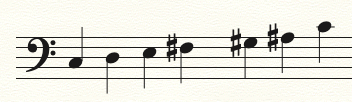
The whole-tone scale has 6 pitches, with each note a whole step (two semitones) from its neighbors. Because every interval is the same size, the scale is symmetrical. Here is one whole-tone scale spelled from C:
C D E F♯ G♯ A♯
The defining sound of the whole-tone scale is that it feels unresolved and floating. That happens because it has no half steps anywhere, which means there is no leading tone pulling up to a tonic. Without that half-step pull, the scale lacks a clear "home" pitch, so it sounds open and ambiguous.
You can spot a whole-tone scale by eye because it uses only 6 different pitches, compared to 7 in a major or minor scale. If you write the scale out to its octave repeat, a major or minor scale spans 8 notes, while a whole-tone scale spans 7.
As optional background, composers in the Impressionist style, such as Debussy and Ravel, used the whole-tone scale to create that hazy, unanchored color. This is context, not required AP content.
Pentatonic Scales
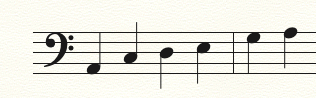

Pentatonic scales have 5 pitches per octave, drawn from the 7 pitches of a major or minor scale. They appear in folk and popular music from many traditions around the world, including East Asian, African, and American music.
There are two types: major pentatonic and minor pentatonic.
Major pentatonic uses scale degrees 1, 2, 3, 5, and 6 of the major scale. The C major pentatonic scale is:
C D E G A
Minor pentatonic uses scale degrees 1, 3, 4, 5, and 7 of the natural minor scale. The A minor pentatonic scale is:
A C D E G
Notice that pentatonic scales skip the pitches that would create half steps in a regular scale, which gives them their smooth, open sound. On the exam, the main task is recognizing the pentatonic sound, knowing the scale-degree pattern, and judging the context. Telling major and minor pentatonic apart comes down to which scale degrees are present and where the tonic sits.
As one piece of optional background: the minor pentatonic scale is closely related to the blues scale, which adds an extra "blue note." You do not need to construct the blues scale for this topic.
How to Use This on the AP Music Theory Exam
Aural Recognition
- Listen for consecutive half steps inching upward or downward: that is the chromatic sound.
- If a melody feels like it never settles or resolves, suspect the whole-tone scale. The missing leading tone is why it sounds unfinished.
- If a melody sounds open and gapped, with no half-step "leaning" tones, think pentatonic.
Notated Identification
- Count the different pitches first. 5 different pitches points to pentatonic, 6 points to whole-tone, 12 points to chromatic.
- For whole-tone, check that every adjacent interval is a whole step.
- For chromatic, check that every adjacent interval is a half step.
- For pentatonic, compare the pitches to a major or minor scale and match them to scale degrees 1-2-3-5-6 (major) or 1-3-4-5-7 (minor).
Common Trap
- Do not assume "lots of accidentals" automatically means chromatic. A whole-tone scale also uses accidentals but moves entirely in whole steps.
Common Misconceptions
- Misconception: The whole-tone scale has 7 different pitches.Actually: The whole-tone scale does not have 7 different pitches. It has 6, and the octave note that repeats the tonic is the same pitch class, not a new one.
- Misconception: "Pentatonic" means a random 5-note collection.Actually: "Pentatonic" does not mean a random 5-note collection. The pitches come from a major or natural minor scale using fixed scale degrees.
- Misconception: The whole-tone scale's unresolved sound is caused by accidentals.Actually: The whole-tone scale's unresolved sound is not caused by accidentals. It comes from the absence of any half steps, which removes the leading-tone pull toward a tonic.
- Misconception: A chromatic passage in a melody means the whole piece is in some "chromatic key."Actually: A chromatic passage in a melody does not mean the whole piece is in some "chromatic key." Chromatic pitches are often just coloring tones moving by half step between diatonic notes.
- Misconception: Pentatonic scales are only "Asian music."Actually: Pentatonic scales are not only "Asian music." They appear across many cultures and styles, including folk, blues, and popular music.
Related AP Music Theory Guides
Practice Questions for 2.4
1 of 10
A score displays a descending scale with the notes C-Bb-Ab-Gb-E-D-C. The recording plays C-B-A-G-F-E-D-C. What is the primary discrepancy?
A.
The score notates a chromatic scale, but the performance uses a whole-tone scale.
B.
The score notates a chromatic scale, but the performance uses a diatonic major scale.
C.
The score notates a whole-tone scale, but the performance uses a diatonic major scale.
D.
The score notates a whole-tone scale, but the performance uses a chromatic scale.
Vocabulary
The following words are mentioned explicitly in the AP® course framework for this topic.Term | Definition |
|---|---|
chromatic scale | A scale consisting of twelve pitches, each separated by a half-step. |
half-step | The smallest interval in Western music, representing the distance between adjacent pitches on the chromatic scale. |
pentatonic scale | A scale consisting of five pitches derived from the seven pitches of a major or minor scale. |
scale degree | The position of a pitch within a scale, identified by name or number relative to the tonic. |
whole step | An interval equal to two half steps, representing the distance between pitches separated by one chromatic pitch. |
whole-tone scale | A scale consisting of six notes, each separated by a whole step. |
Frequently Asked Questions
What is the difference between chromatic, whole-tone, and pentatonic scales?
A chromatic scale has 12 pitches a half step apart, a whole-tone scale has 6 pitches a whole step apart, and a pentatonic scale has 5 pitches from a major or minor scale.
What is a pentatonic scale?
A pentatonic scale is a 5-note scale. Major pentatonic uses scale degrees 1, 2, 3, 5, and 6; minor pentatonic uses 1, 3, 4, 5, and 7 of natural minor.
What is a chromatic scale?
A chromatic scale includes all 12 pitches in an octave, moving by half step between each adjacent pitch.
What is a whole-tone scale?
A whole-tone scale has 6 pitches, each separated by a whole step. Because it has no half steps, it often sounds floating or unresolved.
How do you identify these scales on the AP Music Theory exam?
Count distinct pitches first: 5 suggests pentatonic, 6 suggests whole-tone, and 12 suggests chromatic. Then confirm the interval pattern by ear or notation.
Why does the whole-tone scale sound unresolved?
The whole-tone scale has no half steps and no leading tone, so it lacks the usual pull toward a clear tonic.
See Fiveable more often in Google
Mark Fiveable as a preferred source and Google is more likely to show you our guides in Top Stories, with a "preferred" badge in AI Mode and AI Overviews.