1.1 Pitch and Pitch Notation

🎶AP Music Theory Unit 1 Review
1.1 Pitch and Pitch Notation
🎶 AP Music Theory
TLDR
Pitch is how high or low a sound is, and in AP Music Theory you show pitch by placing notes on a staff that a clef gives letter names. Get fluent at reading treble, bass, alto, and tenor clefs, spotting accidentals (♯, ♭, ♮), and recognizing octaves and enharmonic equivalents like C♯ and D♭. These reading skills are the base for every notation, listening, and sight-singing task you will see later.
Why This Matters for the AP Music Theory Exam
Reading and notating pitch shows up across the whole course because almost everything else builds on it. When you can name any note in any clef and handle accidentals correctly, you can move faster on score-analysis multiple-choice questions and notate melodies cleanly during dictation.
This topic supports several kinds of exam thinking:
- Identifying pitches on the staff in treble, bass, alto, and tenor clefs, both in written scores and in performed music.
- Catching pitch discrepancies between what a score shows and what is actually performed, in one or two voices.
- Sight-singing a melody notated in treble or bass clef, since you can only sing what you can read.
One important rule for the aural portions: you are expected to use relative pitch, not perfect pitch. You will always get one or more starting pitches as a reference, so your job is hearing how the other pitches relate to that anchor.
Key Takeaways
- A staff has 5 lines and 4 spaces, and a clef assigns letter names (A through G) to each line and space.
- Treble and bass clefs are read differently, so the same line position means different pitches depending on the clef.
- Accidentals (♯ raises a half step, ♭ lowers a half step, ♮ cancels) go to the left of the notehead and last through the end of the measure.
- Enharmonic equivalents are the same sounding pitch spelled two ways, like C♯ and D♭, chosen based on musical context.
- An octave is the distance from a pitch up or down to the next pitch with the same letter name.
- Aural questions test relative pitch, and you always get a reference pitch to start from.
Reading Musical Notes
The Staff and Grand Staff

A single staff has 5 lines and 4 spaces, and every line and space stands for a specific pitch. The grand staff stacks two staves together: the treble clef on top for higher pitches and the bass clef on the bottom for lower pitches. The higher a note sits on a staff, the higher its frequency.
All pitches use the letter names A through G. Once you reach G, the letters start over at A. You read treble clef and bass clef differently, so the middle line of the treble clef is a different pitch than the middle line of the bass clef.
Reading in Treble Clef


The lines of the treble clef, from bottom to top, are E-G-B-D-F. Common ways to remember them:
- "Every Good Boy Does Fine"
- "Every Good Boy Deserves Fudge"
- "Every Green Bird Does Flips"
The spaces of the treble clef, from bottom to top, spell FACE.
So if you read a treble-clef line and then the space above it and so on, you walk up the musical alphabet: E, F, G, A, B, C, and so on.
Reading in Bass Clef


The lines of the bass clef, from bottom to top, are G-B-D-F-A. Ways to remember them:
- "Good Boys Do Fine Always"
- "Good Birds Don't Fly Away"
- "Go Buy Donuts For Al"
The spaces of the bass clef, from bottom to top, are A-C-E-G. Ways to remember them:
- "All Cows Eat Grass"
- "Anyone Can Enjoy Golf"
Ledger Lines


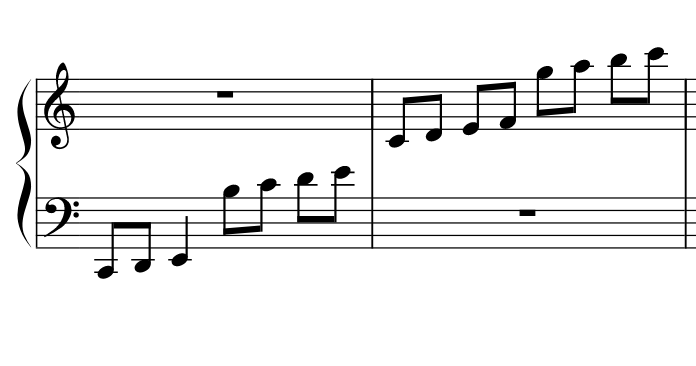
Pitches that go above or below a staff are written using ledger lines, the short lines added outside the staff. You keep counting lines and spaces through the alphabet just like you do on the staff itself. Ledger lines let one clef reach into the range of another, which is why a note written high in the bass clef can actually sound higher than a note written low in the treble clef.
Alto and Tenor Clefs (the C Clefs)

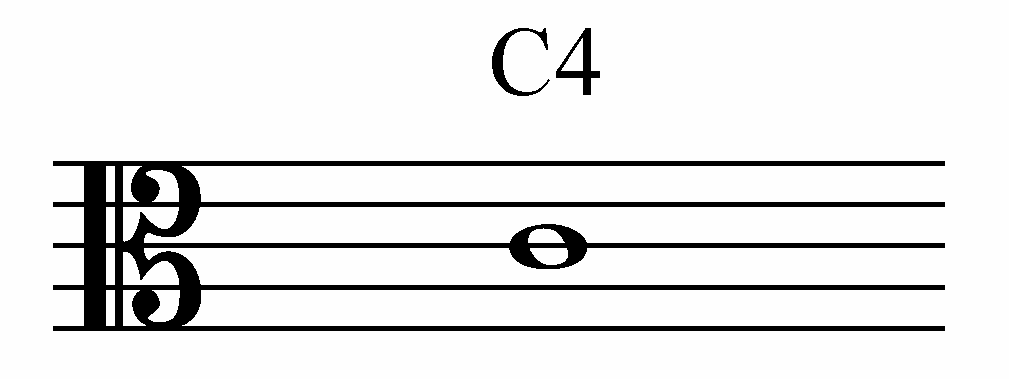
Most instruments read treble or bass clef, but a few use the alto and tenor clefs, also called the C clefs. You will do most of your own writing on the grand staff, but you may see these clefs in multiple-choice questions, so know how to read them.
The handy trick for both C clefs is that the clef symbol points to middle C:
- Alto clef: middle C sits on the middle (third) line. The viola reads alto clef.
- Tenor clef: middle C sits on the fourth line, so it covers slightly lower registers. Cello and bassoon often use tenor clef.
If you remember where middle C lands, you can count up and down from it to name any other note, even if you mix up which clef is which.
Octaves and Enharmonic Equivalents

An octave is the distance from one pitch up or down to the next pitch with the same letter name, like one E to the next E. The two pitches share a name and sound like the "same" note, just higher or lower in frequency.
Accidentals change a pitch:
- ♯ (sharp) raises a pitch by a half step.
- ♭ (flat) lowers a pitch by a half step.
- ♮ (natural) cancels a previous sharp or flat.
Accidentals always go to the left of the notehead. Once you write an accidental, it stays in effect for that pitch through the end of the measure, even if the note returns. The bar line at the end of the measure cancels it.
Because of accidentals, the same sounding pitch can be spelled more than one way. These are enharmonic equivalents: A♯ and B♭ sound identical but are named differently depending on the musical context, and so are C♯ and D♭.
Measures

Notes are grouped into measures, also called bars. The vertical bar line marks where one measure ends and the next begins. On the grand staff, a bar line can run between the treble and bass staves to line up both clefs.
Relative Pitch, Intervals, and Melody Preview
An interval is the distance between two pitches. A melody is a series of pitches with rhythm, and what makes a melody recognizable is often the intervals between the notes rather than the exact starting pitch. Think of "Happy Birthday": it can start on different pitches and you still recognize it because the relationships between the pitches stay the same. That is relative pitch.
Relative pitch matters for the exam. On aural tasks you are given a starting pitch and asked to hear how the other pitches relate to it, and on sight-singing you read a melody in treble or bass clef and produce it using those same relationships. Even when a melody is transposed to another key, the intervals between its pitches stay the same, so the tune keeps its character. Identifying specific interval qualities (like a minor 3rd or major 6th) comes later, but training your ear early pays off because relative pitch is not something you can cram.
How to Use This on the AP Music Theory Exam
MCQ
- Practice naming notes quickly in treble, bass, alto, and tenor clefs so clef-reading questions do not slow you down.
- For C clefs, find middle C first, then count to the note in question.
- Watch accidentals carefully: an accidental affects that pitch for the rest of the measure, so a note may be altered even without a symbol right next to it.
Listening and Discrepancy Questions
- When comparing a score to a performance, listen for whether a performed pitch matches the notated one in one or two voices. A performed pitch should not deviate from the score unless the style allows improvisation or ornamentation.
- Use your given reference pitch as an anchor and track how each new pitch moves relative to it.
Sight-Singing
- You read sight-singing melodies in treble or bass clef, so be fast and accurate at naming those pitches.
- Keep the tonic in your ear; holding onto the tonic and the correct contour helps even if a pitch slips.
- Sustain notes for their full value, especially at cadences, where it is tempting to cut the last note short.
Common Trap
- Forgetting that an accidental carries through the whole measure. Recheck repeated notes after any sharp, flat, or natural.
Common Misconceptions
- Misconception: You need perfect pitch.Actually: You do not. The aural sections test relative pitch and always give you a reference pitch to work from.
- Misconception: An accidental only changes the one note it touches.Actually: It applies to that pitch for the rest of the measure, then the bar line cancels it.
- Misconception: Enharmonic equivalents are different sounds.Actually: C♯ and D♭ sound the same; only the spelling changes based on context.
- Misconception: The higher-written note is always the higher pitch.Actually: With ledger lines, a note written high in the bass clef can sound higher than a low note in the treble clef, so check the actual pitch, not just where it sits on the page.
- Misconception: Accidentals go on either side of the notehead.Actually: They always go to the left of the notehead.
- Misconception: Reading treble and bass the same way works.Actually: The same line or space means different pitches in different clefs, so read each clef on its own terms.
Related AP Music Theory Guides
Practice Questions for 1.1
1 of 10
A score in C minor contains a B-natural accidental on the downbeat of a measure. The recording, however, sounds a B-flat at that location. Which statement best describes this pitch error?
A.
The musician performed the dominant pitch instead of the notated submediant
B.
The musician performed the leading tone pitch instead of the notated subtonic
C.
The musician performed the submediant pitch instead of the notated dominant
D.
The musician performed the subtonic pitch instead of the notated leading tone
Vocabulary
The following words are mentioned explicitly in the AP® course framework for this topic.Term | Definition |
|---|---|
accidental | A symbol that modifies the pitch of a note, such as a sharp, flat, or natural. |
alto clef | A type of C clef with C positioned on the middle line of the staff, commonly used for viola. |
bass clef | A musical clef symbol used to notate pitches in the lower register, commonly used for bass voices and lower-pitched instruments. |
C clef | A clef symbol that assigns letter names to the lines and spaces of the staff, with C positioned on a specific line or space. |
cadential note | The final notes of a phrase or melody that mark a point of rest or conclusion. |
clef | A symbol placed at the beginning of the staff that assigns specific letter names to the lines and spaces. |
contour | The shape or outline of a melody created by the pattern of ascending and descending pitches. |
enharmonic equivalents | Tones of the same pitch spelled differently according to their musical contexts, such as C# and Db. |
flat | An accidental that lowers a pitch by one semitone. |
improvisation | The creation and performance of music in real-time without prior written notation, allowed in certain musical styles. |
melodic interval | The distance in pitch between two consecutive notes in a melody. |
melody | A succession of pitches through time, produced by pitch and rhythm together, that expresses a musical statement. |
musical score | A written representation of music that specifies the pitches and other musical elements to be performed. |
natural | An accidental that cancels a previous sharp or flat, restoring a pitch to its original letter name. |
notehead | The oval-shaped part of a note symbol on which accidentals are placed to the left. |
octave | The interval spanning eight letter names, representing a doubling or halving of frequency. |
ornamentation | Decorative notes or embellishments added to a melody, allowed in certain musical styles as deviations from the written score. |
pitch | The highness or lowness of a sound, determined by its frequency. |
pitch discrepancies | Differences between the pitches as written in a musical score and the pitches as actually performed. |
sharp | An accidental that raises a pitch by one semitone. |
sight-sing | To perform a notated melody at first sight without prior rehearsal or familiarity, reading and singing the music as it is presented. |
staff | A set of five lines and four spaces on which musical notes are written to indicate their pitch. |
tenor clef | A type of C clef with C positioned on the second line from the top of the staff, commonly used for cello and trombone. |
tonic pitch | The first scale degree and the central pitch of a key, serving as the tonal center of a melody. |
transposed | Shifted to a different key or pitch level while maintaining the same intervallic relationships and contour. |
treble clef | A musical clef symbol used to notate pitches in the higher register, commonly used for soprano, alto, and tenor voices and many instruments. |
Frequently Asked Questions
How do you read pitch notation in AP Music Theory?
Read pitch by using the clef to assign letter names to the staff lines and spaces, then account for ledger lines, accidentals, and octave placement. The same note position can mean different pitches in different clefs.
What clefs do I need to know for AP Music Theory?
You need to read treble, bass, alto, and tenor clefs. Treble and bass appear constantly, while alto and tenor clefs can appear in score-reading and multiple-choice contexts.
What do accidentals do in music notation?
Accidentals change pitch: a sharp raises a pitch by a half step, a flat lowers it by a half step, and a natural cancels a previous alteration. Accidentals are written to the left of the notehead.
How long does an accidental last?
In standard notation, an accidental applies to that pitch for the rest of the measure. The bar line cancels it unless the pitch is altered again in the next measure.
What are enharmonic equivalents?
Enharmonic equivalents are the same sounding pitch spelled different ways, such as C-sharp and D-flat. The spelling depends on key, harmonic function, and musical context.
Do you need perfect pitch for AP Music Theory?
No. The aural portions test relative pitch, not absolute pitch. You are given one or more reference pitches and use them to identify or notate the pitches that follow.
See Fiveable more often in Google
Mark Fiveable as a preferred source and Google is more likely to show you our guides in Top Stories, with a "preferred" badge in AI Mode and AI Overviews.