3.1 Triad and Chord Qualities (M, m, d, A)

🎶AP Music Theory Unit 3 Review
3.1 Triad and Chord Qualities (M, m, d, A)
🎶 AP Music Theory
A triad is a three note chord built by stacking two thirds, giving you a root, third, and fifth. The four triad qualities are major (M), minor (m), diminished (d or °), and augmented (A or +), and each one has a unique sound that comes from the size of its third and fifth.
What Are the Four Triad Qualities?
The four triad qualities are major, minor, diminished, and augmented. Each quality is defined by the interval from the root to the third and from the root to the fifth, so you identify quality by stacking the chord in thirds and checking those intervals.
Triad quality is the base for labeling diatonic chords with Roman numerals, reading figured bass, and following progressions later in the course. Harmonic dictation, where you hear a progression and name its chords, is a known challenge on the exam, so accurate triad recognition now pays off there.
Triad Qualities Come From the Third and Fifth
- A triad has three distinct pitches stacked in thirds: root, third, and fifth.
- The four triad qualities are major (M), minor (m), diminished (° or d), and augmented (+ or A).
- Quality comes from the intervals above the root: the type of third and the type of fifth.
- A chord can be sounded all at once or outlined one note at a time as an arpeggio.
- A triad is in root position when the root is the lowest note.
- You need to identify triad quality both from a score and by ear.
Building a Triad

A chord is three or more pitches sounding together. It can also be implied when pitches are played one after another in a group, such as an arpeggio. In Western music, the two basic kinds of chord are triads (three distinct pitches) and seventh chords (four distinct pitches). Both are built by stacking thirds.
When the pitches are stacked in thirds, each note gets a name:
- The bottom note is the root.
- The note a third above is the third.
- The note a fifth above is the fifth.
This stacked-thirds shape is the chord's basic structure. The specific intervals between these notes decide the chord's quality.
The Four Triad Qualities

Triad quality depends on two things: the third above the root and the fifth above the root. Remember that a major third is 4 half steps, a minor third is 3 half steps, a perfect fifth is 7 half steps, a diminished fifth is 6 half steps, and an augmented fifth is 8 half steps.
| Quality | Symbol | Third above root | Fifth above root |
|---|---|---|---|
| Major | M | major third | perfect fifth |
| Minor | m | minor third | perfect fifth |
| Diminished | ° or d | minor third | diminished fifth |
| Augmented | + or A | major third | augmented fifth |
Built on C, that gives you C major (C-E-G), C minor (C-E♭-G), C diminished (C-E♭-G♭), and C augmented (C-E-G♯). Notice how only one or two notes change between them, but the sound shifts a lot.
Each quality has a recognizable character:
- Major: bright and stable.
- Minor: darker and more mellow.
- Diminished: tense and unstable, because of the diminished fifth.
- Augmented: strange and unsettled, because of the augmented fifth.
Root Position and a Note on Inversions
A triad is in root position when the root is the lowest sounding note. In the C triads above, C is at the bottom, so each is in root position.
You can also rearrange the notes so the third or the fifth is in the bass, which creates inversions. Inversion does not change a chord's quality, only which member is on the bottom. You will dig into how to label inversions with figured bass in later topics, so for now just focus on identifying quality and recognizing root position.
Naming Triad Quality From a Score or by Ear
Notated Music:

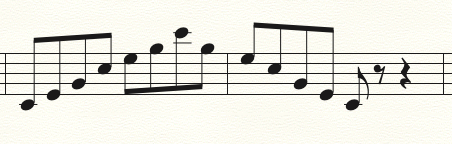
To name a triad's quality from a score:
- Stack the notes in thirds so you can see the root, third, and fifth clearly.
- Find the interval from the root to the third. Is it major (4 half steps) or minor (3 half steps)?
- Find the interval from the root to the fifth. Perfect, diminished, or augmented?
- Match those two intervals to a quality using the table above.
Spell carefully and use the correct letter names. For example, a B♭ major triad is B♭-D-F, not A♯-D-F, even though A♯ and B♭ sound the same. Correct spelling matters for naming quality.
Aural Recognition: When you hear a triad or a progression and need to identify quality:
- Listen for the overall character first. Major sounds bright, minor sounds darker, diminished sounds tense, augmented sounds unsettled.
- The third is the note that flips between major and minor, so train your ear to hear whether the third sounds high (major) or low (minor).
- The fifth tells diminished and augmented apart from the rest. A shrinking fifth signals diminished; a stretched fifth signals augmented.
- Listen to chords inside a real progression, not just in isolation. The exam tests chords as they function together, so practice hearing how one quality leads to the next.
Common Trap: Inverted chords can fool you into mislabeling quality, because the bass note is not the root. Identify the actual root by stacking the pitches in thirds before you decide the quality.
Common Misconceptions
- Misconception: A triad always has exactly three notes you can see.Actually: The essence is three distinct pitches, but in real textures notes get doubled, so a chord on the page can show four or more noteheads while still being a triad.
- Misconception: Quality is set by the third alone.Actually: The third separates major from minor, but you also need the fifth to spot diminished and augmented triads.
- Misconception: Inversion changes the quality.Actually: Putting the third or fifth in the bass creates an inversion, not a new quality. A C major triad is still major no matter which member is on the bottom.
- Misconception: Enharmonic spellings are interchangeable when naming chords.Actually: C-E-G♯ spelled that way is augmented, but respelling notes can change how the chord should be labeled. Use correct letter names for each chord member.
- Misconception: You only need to recognize chords by ear.Actually: The exam asks you to describe quality in both performed and notated music, so you have to read triads in a score too. To check yourself: how would you spell a B♭ major triad, and what three notes make up a C diminished triad?
Related AP Music Theory Guides
Practice Questions for 3.1
1 of 10
A motive consists of the pitches B-flat, D, and F-sharp. What is the quality of the triad formed by these pitches?
A.
Diminished triad
B.
Augmented triad
C.
Minor triad
D.
Major triad
Vocabulary
The following words are mentioned explicitly in the AP® course framework for this topic.Term | Definition |
|---|---|
arpeggiation | The use of arpeggios, where successive pitches of a chord are played individually rather than simultaneously. |
augmented triad | A three-note chord indicated by an uppercase Roman numeral with a plus sign (+), consisting of a root, major third, and augmented fifth. |
chord | Three or more pitches sounding simultaneously, or successive pitches that form a perceived grouping, often through arpeggiation. |
chord quality | The classification of a chord based on the specific intervals between its pitches, such as major, minor, diminished, or augmented. |
diminished triad | A three-note chord built on a root with a minor third and a diminished fifth. |
fifth | The interval of a fifth above the root of a chord, or the note that is a fifth above the root. |
major triad | A three-note chord built on a root with a major third and a perfect fifth. |
minor triad | A three-note chord built on a root with a minor third and a perfect fifth. |
root | The fundamental note of a chord upon which the chord is built. |
seventh | The fourth pitch of a seventh chord when stacked in thirds above the root. |
seventh chord | A chord containing four notes built in thirds, consisting of a triad plus an additional note a seventh above the root. |
third | The interval of a third above the root of a chord, or the note that is a third above the root. |
triad | A chord whose essence consists of three distinct pitches stacked on adjacent lines or spaces in thirds. |
See Fiveable more often in Google
Mark Fiveable as a preferred source and Google is more likely to show you our guides in Top Stories, with a "preferred" badge in AI Mode and AI Overviews.