1.2 Rhythmic Values

🎶AP Music Theory Unit 1 Review
1.2 Rhythmic Values
🎶 AP Music Theory
TLDR
Rhythmic values are the symbols that tell you how long to play a note or hold a rest. You will work with whole, half, quarter, eighth, and sixteenth notes (plus their matching rests), and you can stretch any of these durations using ties and augmentation dots. Being able to recognize and notate these values by sight and by ear is the foundation for every rhythm task in AP Music Theory.
Why This Matters for the AP Music Theory Exam
Rhythmic values show up in both the aural and written parts of the AP Music Theory exam. In the multiple-choice section, you may hear performed music and need to recognize the rhythmic values, or compare a score to a performance to spot rhythmic discrepancies. In the free-response section, you notate rhythms during melodic dictation and perform them during sight-singing. If you cannot quickly tell a quarter note from an eighth note, or read a dotted rhythm correctly, those later tasks become much harder. Getting fluent with note and rest durations now pays off across the whole course.
Key Takeaways
- Every note and rest has a duration. The common values from longest to shortest are whole, half, quarter, eighth, and sixteenth, each dividing in half to make the next.
- Each note value has a matching rest of the same duration.
- A single augmentation dot adds half the value of the note or rest it follows. A double dot adds half, then half of that addition.
- A tie connects two notes of the same pitch to create one longer sound. Ties can cross a barline.
- You need to identify rhythmic values both in performed music (by ear) and in notated music (in a score).
- Clear beaming and beat placement matter when you notate rhythm, so the beat structure stays visible.
Note and Rest Durations


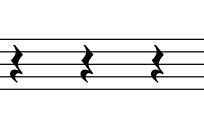
A rhythm is built by stringing together notes and rests, each with a set time value. The beat is the basic unit of pulse you feel when you tap your foot. How many beats a note takes depends partly on the time signature, but for learning the relationships it helps to assume a quarter note equals one beat.
Here is the basic family, from longer to shorter:
| Note | Beats (when quarter = 1 beat) | Matching rest |
|---|---|---|
| Whole note (semibreve) | 4 | Whole rest |
| Half note (minim) | 2 | Half rest |
| Quarter note (crotchet) | 1 | Quarter rest |
| Eighth note (quaver) | 1/2 | Eighth rest |
| Sixteenth note (semiquaver) | 1/4 | Sixteenth rest |
Each value divides the one above it in half. Two eighth notes equal one quarter note. Four sixteenth notes equal one quarter note. Two sixteenth notes equal one eighth note.
Smaller Subdivisions

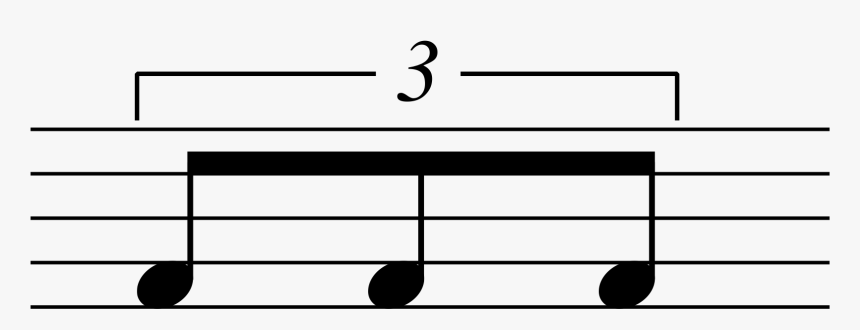

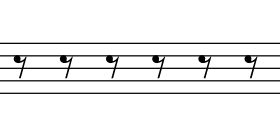
The pattern keeps going past sixteenth notes. Cut a sixteenth note in half and you get a thirty-second note, then a sixty-fourth note, and so on. You are unlikely to see the smallest values on the exam, but knowing the halving pattern helps you read anything that does appear.
Whole Rest vs. Half Rest
A common mix-up is the whole rest versus the half rest, since both are small rectangles near the staff line. One trick: a whole rest is like a "hole," so it hangs below the line, while a half rest sits on top of the line. In real music you can also tell them apart from context.
Stretching Durations: Dots and Ties
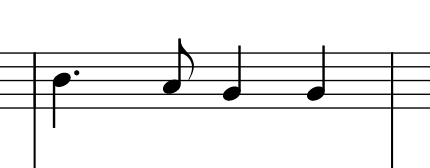

You can extend a note or rest without dividing the beat further.
Augmentation Dots
A dot placed to the right of a notehead (not above it) adds half the value of that note. A dotted quarter note equals a quarter plus an eighth, so it lasts one and a half beats. A dotted eighth note equals an eighth plus a sixteenth, which is three-quarters of a beat.
A double dot adds half the note's value, then half of that added amount. So a double-dotted half note equals a half note plus a quarter note plus an eighth note.
Ties

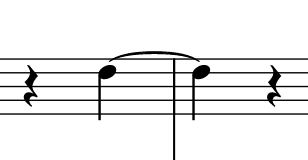
A tie is a curved line that connects two notes of the same pitch to make one longer sound. A quarter note tied to an eighth note sounds exactly like a dotted quarter note; it is just a different way to write the same duration. Because a tie joins identical pitches, it cannot connect two different notes.
Ties also let you carry a long note across a barline. When a note would not fit in the remaining beats of a measure, you can tie it to a note in the next measure instead of overfilling the bar.
Be careful: a tie looks like a slur, since both are curved lines above or below notes. A slur connects different pitches and is a type of articulation, not a duration symbol.
Notation Conventions Worth Knowing
When you notate rhythm, the goal is to keep the beat structure easy to read.
- Beam eighth and sixteenth notes into groups that make beats clear. Notes, rests, ties, or beams that hide where the beats fall are considered incorrect.
- Keep the location of beats visible. In quadruple meter, for example, the half-measure point (between beats 2 and 3) should stay clear, so avoid beaming or sustaining a single value straight through it.
- For dotted notes, place the dot in the space if the note sits on a space, and just above the line if the note sits on a line.
These habits help a performer read your rhythm correctly and matter when you notate during dictation.
How to Use This on the AP Music Theory Exam
MCQ
Expect to hear performed excerpts and identify the rhythmic values, and to compare a score against a performance to find rhythmic discrepancies. Train your ear so you can tell, for example, a steady stream of eighth notes from a dotted-eighth-and-sixteenth pattern.
Free Response
In melodic dictation you write down the rhythms you hear, so accurate note and rest values are essential. In sight-singing you perform notated rhythms at sight, which means reading dotted rhythms and ties quickly. Sustain notes for their full duration, especially at the ends of phrases where it is tempting to cut a note short.
Common Trap
When you write a tied or dotted rhythm, double-check that the beat structure of the measure stays visible. A correct duration can still be marked wrong if your beaming or note grouping hides the beats.
Common Misconceptions
- Misconception: A tie changes pitch or creates a new attack.Actually: A tie does not change pitch or create a new attack. It joins two notes of the same pitch into one sustained sound.
- Misconception: A tie and a slur are the same.Actually: A tie and a slur are not the same. A slur connects different pitches and is about articulation, not duration.
- Misconception: A dot always adds one beat.Actually: A dot does not always add one beat. It adds half the value of the note it follows, so the amount depends on the note.
- Misconception: A whole rest and a half rest have the same duration.Actually: A whole rest and a half rest are different durations even though they look similar. Remember the whole rest hangs below the line.
- Misconception: Writing a duration "correctly" is enough on its own.Actually: Writing a duration "correctly" is not enough on its own. If your beaming or grouping hides the beats, the notation is still counted as wrong.
Quick Self-Check
Try this rhythm drill: clap a steady quarter-note pulse and keep it going. Switch to clapping steady eighth notes at the same tempo, then to sixteenth notes. Being able to move between subdivisions cleanly builds the fluency you need for dictation and sight-singing.
Related AP Music Theory Guides
Practice Questions for 1.2
1 of 10
A score notates a quarter note on beat 4 tied to a quarter note on beat 1 of the next measure. The recording articulates a sound on beat 4 and a distinct, separate sound on beat 1. What is the rhythmic discrepancy?
A.
The tied value is performed as one half note value
B.
The tied value is performed as one dotted quarter
C.
The tied value is performed as two distinct notes
D.
The tied value is performed as triplet quarter notes
Vocabulary
The following words are mentioned explicitly in the AP® course framework for this topic.Term | Definition |
|---|---|
augmentation dots | Dots placed after a note or rest that extend its duration by half of its original value. |
double dots | Two dots placed after a note or rest, where the second dot adds half the value of the first dot, further extending the duration. |
duration | The length of time that a note or rest is held or sustained in music. |
note | Symbols in musical notation that represent the pitch and duration of sounds to be performed. |
rest | Symbols in musical notation that represent periods of silence with specific durations. |
rhythmic value | The relative duration of a note or rest, such as whole note, half note, quarter note, or eighth note. |
tie | Curved lines connecting two notes of the same pitch, indicating that the duration should be combined into one continuous sound. |
Frequently Asked Questions
What are rhythmic values in music?
Rhythmic values are note and rest symbols that show duration. Whole, half, quarter, eighth, and sixteenth notes each last for different lengths, and matching rests show silence for the same durations.
How do you read note values?
Start with the beat. If a quarter note gets one beat, a half note gets two beats, an eighth note gets half a beat, and a sixteenth note gets one quarter of a beat. Other meters can change which note value gets the beat.
What does a dot do to a note value?
An augmentation dot adds half the value of the note or rest it follows. A dotted quarter note equals a quarter note plus an eighth note, so it lasts one and a half quarter-note beats.
What is a tie in music notation?
A tie is a curved line connecting two notes of the same pitch so they sound as one sustained note. Ties extend duration and can carry a note across a barline.
What is the difference between a tie and a slur?
A tie connects notes of the same pitch and changes duration. A slur connects different pitches and shows articulation or phrasing, not a longer single note.
How do rhythmic values show up on the AP Music Theory exam?
You identify rhythmic values by ear and in notation, compare scores to performances, notate rhythms in melodic dictation, and perform rhythms in sight-singing. Accurate grouping and beaming matter too.
See Fiveable more often in Google
Mark Fiveable as a preferred source and Google is more likely to show you our guides in Top Stories, with a "preferred" badge in AI Mode and AI Overviews.