1.6 Simple and Compound Beat Division

🎶AP Music Theory Unit 1 Review
1.6 Simple and Compound Beat Division
🎶 AP Music Theory
Beat division tells you whether a meter is simple or compound. In a simple meter the beat splits into two equal parts; in a compound meter the beat splits into three.
Why This Matters for the AP Music Theory Exam
Describing beat division and meter type shows up in the listening and score-reading parts of AP Music Theory. When you hear an excerpt, you need to feel whether each beat splits into two or three to decide if it is simple or compound. When you read a score, you use the time signature and beaming to reach the same answer. This skill also supports rhythmic dictation and sight-singing later in the unit, where feeling a steady beat and its division keeps your rhythm accurate.
Meter has three connected layers: the measure, the beat, and the beat division. Hearing all three is what lets you separate the main pulse from its smaller subdivisions instead of mislabeling fast divisions as beats.
Key Takeaways
- Simple meter means the beat divides into two equal parts; compound meter means the beat divides into three.
- Meter is built from three layers that work together: measure, beat, and beat division.
- Simple meters usually have top numbers 2, 3, or 4; compound meters usually have top numbers 6, 9, or 12.
- For a time signature with 8 on the bottom, the top number and how the notes group decide simple vs compound, not the bottom number alone.
- In a compound meter, find the number of beats per measure by dividing the top number by 3 (6/8 has 2 beats, 9/8 has 3 beats, 12/8 has 4 beats).
- A few triplets or other groupings inside a simple-meter piece do not change the overall meter; go with the division you feel for most of the music.
Simple vs Compound Meter
Meter is the layered structure of pulses that organizes rhythm. Three pulse speeds work together: the measure (the largest grouping), the beat (the main pulse you tap your foot to), and the beat division (the smaller pulses inside each beat).
The difference between simple and compound comes down to one question: when the beat divides, does it split into two or three?
- Simple meter: each beat divides into two equal parts. Think of clapping "1-and, 2-and." A 4/4 measure has four quarter-note beats, and each one splits into two eighth notes.
- Compound meter: each beat divides into three equal parts. In 6/8 you might count six fast eighth notes, but you usually feel two larger beats, each made of three eighths.
Reading the Time Signature
The top number is your first clue:
- Top numbers 2, 3, or 4 usually mean simple meter.
- Top numbers 6, 9, or 12 usually mean compound meter.
The bottom number alone does not decide the meter type. A common shortcut says "bottom number 4 means simple, bottom number 8 means compound," but that is only a rough guide, not a rule.
For meters with 8 on the bottom, look at the top number and how the notes are grouped into beats:
- 6/8, 9/8, and 12/8 are compound. The eighth note is the division, and groups of three eighths form one dotted-quarter beat.
- 3/8 is simple. If you treated 3/8 as compound, the measure and the beat would be the same thing, which leaves no real beat-division layer. So 3/8 has three eighth-note beats and counts as simple.
Counting Beats in Compound Meter
In a compound meter, divide the top number by 3 to find the number of beats per measure:
- 6/8 has 2 beats per measure
- 9/8 has 3 beats per measure
- 12/8 has 4 beats per measure
Each smaller pulse you hear inside a beat is a beat division. You feel six divisions in 6/8, but only two beats.
How to Use This on the AP Music Theory Exam
Listening
- Find the steady main pulse first, then notice how it splits. Two even parts point to simple meter; three even parts point to compound.
- Use tempo as a clue. If the pulse you are tapping feels extremely fast, you may be tapping divisions instead of beats. Step back to the larger grouping.
- Listen for the layers: the strong downbeat marks the measure, the foot-tap marks the beat, and the quick even notes inside each beat are the division.
Score Reading
- Check the top number to predict simple (2, 3, 4) or compound (6, 9, 12).
- For an 8 on the bottom, confirm by how the notes beam into beat groups. Threes grouped together signal compound; groupings into twos signal simple.
- Remember the beat note differs by type. In simple meter the beat is usually a plain note value; in compound meter the beat is usually a dotted note (such as a dotted quarter in 6/8).
Common Trap
A piece in simple meter can still contain triplets. A triplet squeezes three notes into the space normally filled by two, but a handful of triplets does not turn a simple meter into a compound one. Label the meter by the division you feel for most of the piece, not by an occasional grouping.
Triplets and Other Groupings

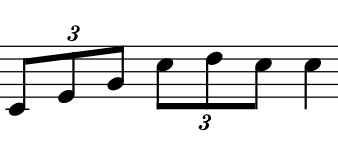
Even in a simple meter, a single beat can be split into three, five, or seven notes. A triplet is three notes played in the time normally taken by two notes of the same value, usually marked with a "3" above or below the group. Less common groupings include quintuplets (five in the space of four) and septuplets (seven in the space of four).
These groupings let composers add complexity without changing the underlying meter. The meter still describes the big picture: if most beats split into two, you are in simple meter even when a triplet shows up here and there.
Common Misconceptions
- Misconception: The bottom number of the time signature decides simple vs compound.Actually: Not by itself. The top number and the way beats group are what tell you the meter type, especially when the bottom number is 8.
- Misconception: Any 6/8 piece has six beats.Actually: It has six eighth-note divisions but usually two beats, each a dotted quarter. Divide the top number by 3 to get the real beat count.
- Misconception: 3/8 is compound because the bottom number is 8.Actually: It is simple. Treating it as compound would erase the separate beat-division layer.
- Misconception: One triplet makes the whole passage compound.Actually: No. Compound meter means the beat regularly divides into three. An occasional triplet inside a simple meter is just a temporary subdivision.
- Misconception: Compound meter is always harder or more syncopated than simple meter.Actually: Meter type only describes how the beat divides. Either type can feel smooth, driving, or complex depending on the music.
Related AP Music Theory Guides
Practice Questions for 1.6
1 of 10
In a performed march section, the listener perceives a strong pulse of two beats per measure. The percussion accompaniment consistently divides each of these beats into three equal parts. Which term best describes the meter of this section?
A.
Simple triple meter
B.
Compound triple meter
C.
Simple duple meter
D.
Compound duple meter
Vocabulary
The following words are mentioned explicitly in the AP® course framework for this topic.Term | Definition |
|---|---|
beat | The primary pulse in music that serves as the foundation for meter and rhythm. |
beat division | The subdivision of the beat into smaller rhythmic units; in simple meter the beat divides into two parts, and in compound meter into three parts. |
compound meter | A meter in which the upper number of the time signature is 6, 9, or 12, and each beat divides into three equal parts. |
measure | A unit of meter containing a specific number of beats, marked by bar lines in musical notation. |
meter | A layered structure of interrelated pulses that governs rhythm in music, based on beat, beat division, and measure. |
meter type | The classification of meter as either simple (beat divided into two) or compound (beat divided into three). |
simple meter | A meter in which the upper number of the time signature is 2, 3, or 4, and each beat divides into two equal parts. |
Frequently Asked Questions
What is beat division?
Beat division is how each beat splits into smaller equal parts. In simple meter the beat divides into two; in compound meter the beat divides into three.
What is the difference between simple and compound meter?
Simple meter has beats that divide into two equal parts, like 1-and. Compound meter has beats that divide into three equal parts, like 1-la-li. The difference is about subdivision, not difficulty.
Is 6/8 simple or compound?
6/8 is usually compound duple. It has six eighth-note divisions grouped into two dotted-quarter beats, so you feel two main beats per measure, each divided into three.
Why is 3/8 simple instead of compound?
3/8 is usually simple because it has three eighth-note beats in the measure. If you treated the whole measure as one compound beat, there would be no separate measure, beat, and beat-division layers.
How do you find beats in compound meter?
Divide the top number by 3. In 6/8 there are 2 beats, in 9/8 there are 3 beats, and in 12/8 there are 4 beats. Each beat is usually a dotted quarter.
Do triplets make a simple meter compound?
No. A triplet temporarily divides a simple-meter beat into three notes, but the meter is still simple if most beats divide into two. Meter depends on the regular beat division across the passage.
See Fiveable more often in Google
Mark Fiveable as a preferred source and Google is more likely to show you our guides in Top Stories, with a "preferred" badge in AI Mode and AI Overviews.