5.2 Young's Double-Slit Experiment

🌀Principles of Physics III Unit 5 Review
5.2 Young's Double-Slit Experiment
Young's Double-Slit Experiment
Young's double-slit experiment demonstrates that light behaves as a wave. By shining light through two narrow slits and observing the pattern on a distant screen, you get alternating bright and dark bands called fringes. These fringes arise from interference, something that only waves can do. This experiment was historically decisive in overthrowing the particle ("corpuscular") theory of light, and it remains one of the cleanest ways to measure wavelength and understand wave behavior.
Experimental Setup and Significance
The setup has three main components: a coherent light source (like a laser, or a lamp behind a single slit to create spatial coherence), a barrier with two narrow parallel slits separated by a distance , and a detection screen placed a distance away.
When light passes through both slits, it diffracts and the two emerging wavefronts overlap on the screen. Instead of two bright patches (which particle theory would predict), you see a series of evenly spaced bright and dark fringes. This pattern is direct evidence that light is a wave.
- The alternating fringes are impossible to explain if light consists only of particles
- Thomas Young first performed this experiment in 1801, providing strong evidence against Newton's corpuscular theory
- The same experiment has since been repeated with electrons, neutrons, and even large molecules, all of which produce interference patterns, demonstrating wave-particle duality across quantum mechanics
Interference and Fringe Formation
How Interference Works
Interference is the superposition of two or more waves to produce a combined wave. Two key cases matter here:
- Constructive interference: waves arrive in phase (crest meets crest). Their amplitudes add together, producing a bright fringe.
- Destructive interference: waves arrive out of phase (crest meets trough). Their amplitudes cancel, producing a dark fringe.
In the double-slit setup, the light from each slit travels a slightly different distance to reach any given point on the screen. That difference in path length, called the path difference, determines whether the waves arrive in phase or out of phase at that point.
How the Pattern Forms
- Light diffracts through both slits, spreading out as roughly spherical wavefronts.
- These two wavefronts overlap as they travel toward the screen.
- At the center of the screen (directly between the two slits), both waves travel the same distance. Path difference is zero, so you get perfect constructive interference. This is the central bright fringe (order ).
- Moving away from center, the path difference gradually increases. At positions where the path difference equals a whole number of wavelengths, you get another bright fringe. Where it equals a half-integer number of wavelengths, you get a dark fringe.
- The result is a symmetric pattern of bright and dark bands on either side of the central maximum.
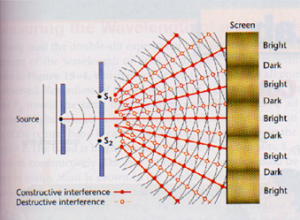
Calculating Fringe Positions
Core Equations
The path difference between light from the two slits arriving at angle from the center is . From this, two conditions follow:
- Bright fringes (constructive interference): where
- Dark fringes (destructive interference): where
Here is the slit separation, is the angle from the central axis, is the order number, and is the wavelength.
Small-Angle Approximation
When the screen is far away (), the angles are small and you can approximate , where is the distance from the central maximum to the fringe on the screen. This gives much more practical formulas:
- Position of the mth bright fringe:
- Position of the mth dark fringe:
- Fringe spacing (distance between adjacent bright fringes):
These equations assume and that the screen is far enough away for the small-angle approximation to hold.
Example Calculation
Suppose you have green laser light (), slit separation , and screen distance . To find the fringe spacing:
So bright fringes appear about 4.3 mm apart on the screen.

Practical Uses of These Equations
- Finding wavelength: Measure , , and , then solve for . This is one of the most common lab applications.
- Finding slit separation: If you know the wavelength, measure the fringe spacing and solve for .
- Extending to diffraction gratings: A grating with slits uses the same bright-fringe condition (), but the maxima become much sharper and brighter as increases.
Factors Affecting Interference Patterns
Wavelength and Geometry
The fringe spacing formula tells you everything about how the pattern responds to changes:
- Wavelength (): Longer wavelengths produce wider fringe spacing. Red light () gives wider fringes than blue light ().
- Slit separation (): Smaller slit separation produces wider fringes. This is an inverse relationship.
- Screen distance (): Moving the screen farther away stretches the pattern, increasing fringe spacing proportionally.
- Slit width: Doesn't change fringe positions, but it does affect the intensity envelope. Narrower slits spread light more evenly across the pattern; wider slits create a single-slit diffraction envelope that modulates the double-slit fringes, dimming the higher-order maxima.
Light Source and Environmental Factors
- Coherence: The light source must be coherent (waves maintaining a constant phase relationship) for clear fringes. Lasers work well. Incoherent sources like white-light bulbs produce fringes only if you first pass the light through a single narrow slit to improve spatial coherence.
- Intensity: Brighter sources make the whole pattern brighter but don't shift fringe positions.
- Polarization: If the two beams have perpendicular polarizations, they cannot interfere. Both beams must share a polarization component for fringes to appear.
- Environmental disturbances: Vibrations, air currents, and temperature gradients introduce random path-length changes that blur the pattern. Stable mounts and controlled environments improve fringe visibility.
- Medium: If the space between the slits and screen is filled with a material of refractive index , the effective wavelength becomes , which narrows the fringe spacing.
See Fiveable more often in Google
Mark Fiveable as a preferred source and Google is more likely to show you our guides in Top Stories, with a "preferred" badge in AI Mode and AI Overviews.