11.1 Crystal Structures and Lattices

🌀Principles of Physics III Unit 11 Review
11.1 Crystal Structures and Lattices
🌀 Principles of Physics III
Crystal Structures and Characteristics
Crystal structures describe how atoms are arranged in solid materials. The specific arrangement determines nearly every physical property of a solid, from how it conducts electricity to how it deforms under stress. This topic builds the foundation for understanding semiconductors, metals, and insulators at the atomic level.

Top images from around the web for Types of Crystal Systems and Structures
Cheesegraters and crystals - All this View original
Is this image relevant?
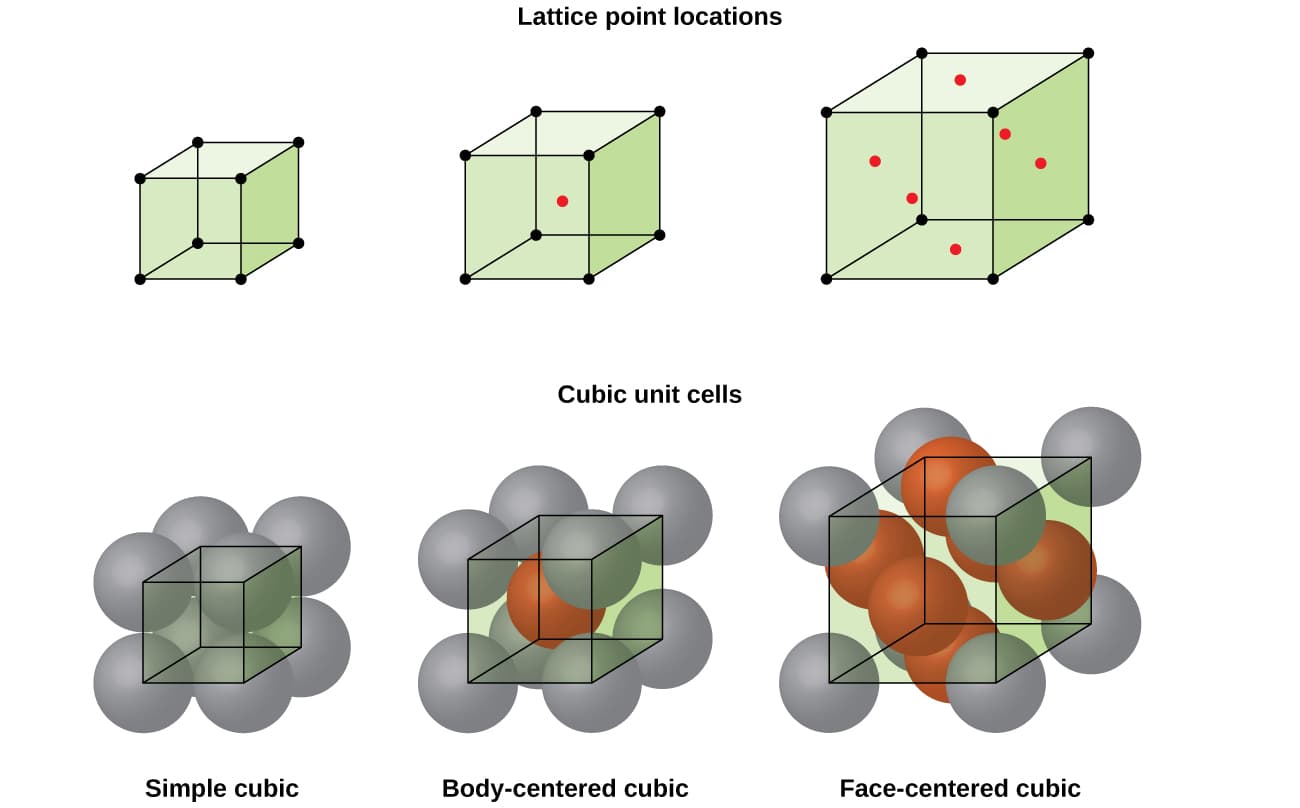
Lattice Structures in Crystalline Solids · Chemistry View original
Is this image relevant?
Cheesegraters and crystals - All this View original
Is this image relevant?
Lattice Structures in Crystalline Solids · Chemistry View original
Is this image relevant?
Types of Crystal Systems and Structures
All crystal structures fall into seven crystal systems, classified by their symmetry and geometry: cubic, tetragonal, orthorhombic, hexagonal, trigonal, monoclinic, and triclinic. These range from the highly symmetric cubic system (all edges equal, all angles 90°) to the triclinic system (no edges equal, no angles constrained to 90°).
For metals, three structures dominate:
- Body-centered cubic (BCC): One atom at each corner of a cube plus one in the center. Iron at room temperature and tungsten adopt this structure.
- Face-centered cubic (FCC): One atom at each corner plus one at the center of each face. Copper, aluminum, and gold are FCC metals.
- Hexagonal close-packed (HCP): Atoms arranged in hexagonal layers stacked in an ABAB pattern. Titanium and zinc are common examples.
The unit cell is the smallest repeating unit that, when tiled in all three dimensions, reproduces the entire crystal. If you know the unit cell, you know the full structure.
Crystal Structure Characteristics and Visualization
The coordination number is the count of nearest neighbors surrounding each atom. It directly affects how tightly atoms are packed and how the material responds to stress:
- BCC: coordination number = 8
- FCC: coordination number = 12
- HCP: coordination number = 12
Polymorphism is the ability of a material to adopt different crystal structures depending on temperature and pressure. Carbon is a classic example: at ambient conditions it forms graphite (layered hexagonal), but under extreme pressure it forms diamond (FCC-like tetrahedral network). Iron transitions from BCC (-Fe) at room temperature to FCC (-Fe) above 912°C.
Several visualization methods help you picture these structures:
- Space-filling models show atoms as touching spheres, emphasizing how much space they actually occupy
- Ball-and-stick models shrink the atoms and add sticks for bonds, making the geometry easier to see
- Polyhedral models draw polyhedra around central atoms to highlight coordination environments
Lattice in Crystalline Materials
Lattice Fundamentals and Bravais Lattices
A lattice is an infinite, periodic array of mathematical points in three dimensions. Each point represents an identical environment in the crystal. The lattice itself doesn't tell you what atoms are present; it tells you the repeating pattern of their arrangement.
To describe a lattice mathematically, you define three primitive vectors (, , ) that are non-coplanar. Any lattice point can be reached by an integer combination of these vectors:
where , , and are integers.
Auguste Bravais showed that there are exactly 14 unique Bravais lattices in three dimensions. These 14 lattices account for every possible way to arrange points periodically in 3D space. They include familiar types like simple cubic, BCC, and FCC, but also less symmetric lattices like base-centered monoclinic.
Lattice Parameters and Symmetry
Lattice parameters are the six numbers that define the size and shape of a unit cell:
- Three edge lengths: , ,
- Three angles between edges: (angle between and ), (angle between and ), (angle between and )
In the cubic system, and , so a single parameter describes the whole cell. Less symmetric systems require more independent parameters.
Symmetry operations are transformations that leave the crystal looking identical:
- Translations shift the crystal by a lattice vector
- Rotations (2-fold, 3-fold, 4-fold, 6-fold) spin the structure around an axis
- Reflections mirror the structure across a plane
These symmetry elements combine into point groups (32 total) and space groups (230 total), which fully classify crystal symmetry.
The reciprocal lattice is a mathematical construction where each point corresponds to a set of parallel planes in the real crystal. It's essential for interpreting X-ray diffraction data: diffraction peaks appear when the scattering vector matches a reciprocal lattice vector, as described by the Laue condition or equivalently by Bragg's law ().
Crystal Structure vs Material Properties

Mechanical and Electrical Properties
Crystal structure controls mechanical behavior because it determines which slip systems are available for dislocation motion:
- FCC metals have 12 slip systems on close-packed {111} planes, giving them high ductility. Copper and aluminum bend easily before breaking.
- HCP metals have fewer easy slip systems (typically 3 on the basal plane), making them more brittle. Zinc crystals cleave readily along basal planes.
- BCC metals have 48 potential slip systems but none on truly close-packed planes, so they tend to be strong but less ductile, especially at low temperatures. This is why steel (BCC iron) can become brittle in cold weather.
Electrical conductivity depends on band structure, which arises from the periodic potential of the crystal lattice:
- Metals like Cu, Ag, and Au (all FCC) have partially filled bands and high conductivity
- Semiconductors like Si and Ge have band gaps of roughly 1.1 eV and 0.67 eV, respectively, allowing controlled conductivity
- Insulators like diamond have a large band gap (~5.5 eV), so almost no electrons reach the conduction band at room temperature
Thermal, Optical, and Magnetic Properties
Thermal properties are governed by lattice vibrations (quantized as phonons):
- Thermal expansion occurs because atomic vibrations become asymmetric at higher energies; different structures expand at different rates
- Heat capacity at low temperatures follows the Debye law, reflecting the phonon spectrum of the lattice
- Thermal conductivity depends on how efficiently phonons propagate; diamond's rigid tetrahedral lattice gives it one of the highest thermal conductivities of any material
Optical properties are tied to crystal symmetry. Anisotropic crystals (those with direction-dependent properties) can exhibit birefringence, where light splits into two rays traveling at different speeds. Calcite is the textbook example: place it over text and you'll see a double image. Quartz exhibits optical activity, rotating the plane of polarized light due to its chiral crystal structure.
Magnetic properties also depend on crystal structure. Ferromagnetic materials like Fe, Ni, and Co have crystal symmetries that allow cooperative alignment of magnetic moments. Magnetocrystalline anisotropy means certain crystallographic directions are easier to magnetize than others. In BCC iron, the easy axis is along [100], while in HCP cobalt it's along [0001].
Crystal Defects and Material Behavior
Real crystals are never perfect. Defects break the ideal periodicity and dramatically alter properties:
- Point defects (vacancies, interstitials, substitutional atoms) affect diffusion rates and electrical behavior. A vacancy concentration in metals roughly follows , increasing exponentially with temperature.
- Line defects (dislocations) are the primary carriers of plastic deformation. Without dislocations, metals would be far stronger but completely brittle.
- Planar defects (grain boundaries, stacking faults, twin boundaries) influence crack propagation, corrosion resistance, and recrystallization behavior.
Engineers exploit these defects to tune material performance:
- Solid solution strengthening introduces atoms of a different size into the lattice, creating local strain fields that impede dislocation motion
- Precipitation hardening forms small coherent precipitates within the crystal that force dislocations to cut through or bow around them
- Radiation damage in nuclear reactor materials creates clusters of point defects (voids, interstitial loops) that harden and embrittle the material over time
Packing Fraction and Atomic Density
Packing Fraction Calculation and Significance
The atomic packing fraction (APF) measures how efficiently atoms fill space in a crystal. It's calculated as:
Here's how to calculate it for a BCC structure, step by step:
- Count atoms per unit cell: 8 corner atoms × (1/8 each) + 1 center atom = 2 atoms
- Find the relationship between atomic radius and lattice parameter : atoms touch along the body diagonal, so
- Calculate atom volume:
- Calculate cell volume:
- Take the ratio: APF
The key packing fractions to know:
| Structure | Atoms per Unit Cell | APF |
|---|---|---|
| Simple cubic | 1 | 0.52 |
| BCC | 2 | 0.68 |
| FCC | 4 | 0.74 |
| HCP | 6 (per hex cell) | 0.74 |
FCC and HCP both achieve 0.74, which is the theoretical maximum for packing identical spheres. This was conjectured by Kepler in 1611 and proven in 2005.
Atomic Density and Structure Comparisons
Atomic density (number of atoms per unit volume) connects crystal structure to measurable material density:
where is the number of atoms per unit cell and is the unit cell volume. To get mass density, multiply by the atomic mass and divide by Avogadro's number:
Comparing structures reveals why properties differ:
- Higher packing fractions generally correlate with higher melting points. FCC copper (melting point 1085°C) is denser-packed than BCC iron (1538°C), though iron's higher melting point reflects stronger bonding rather than packing alone.
- Polymorphs of the same element can have very different densities. Diamond (3.51 g/cm³) is far denser than graphite (2.27 g/cm³) because diamond's tetrahedral bonding packs carbon atoms into a tighter 3D network, even though its APF is lower.
- BCC's more open structure allows faster atomic diffusion, which is why BCC iron (ferrite) carburizes more readily than FCC iron (austenite) despite austenite having higher carbon solubility.
See Fiveable more often in Google
Mark Fiveable as a preferred source and Google is more likely to show you our guides in Top Stories, with a "preferred" badge in AI Mode and AI Overviews.