4.3 Lenses and Mirrors

🌀Principles of Physics III Unit 4 Review
4.3 Lenses and Mirrors
🌀 Principles of Physics III
Converging vs Diverging Lenses and Mirrors

Top images from around the web for Optical Properties and Characteristics
25.7 Image Formation by Mirrors – College Physics View original
Is this image relevant?
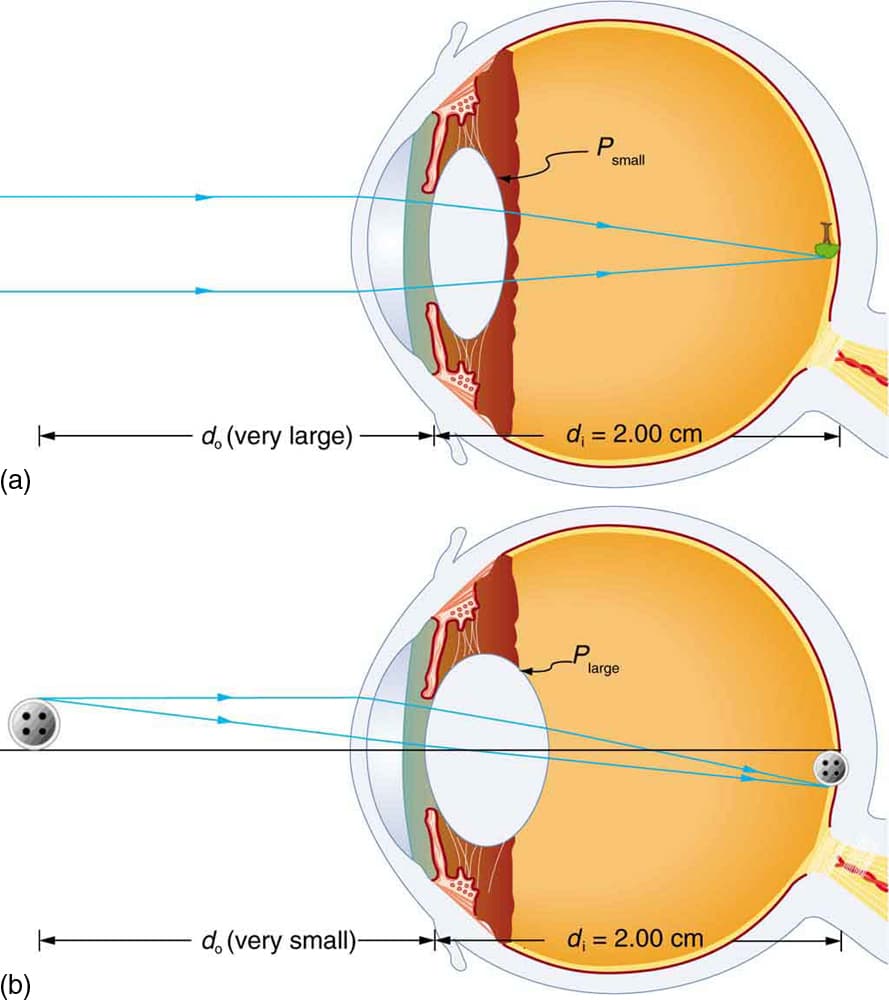
Physics of the Eye | Physics II View original
Is this image relevant?
26.6 Aberrations – College Physics View original
Is this image relevant?
25.7 Image Formation by Mirrors – College Physics View original
Is this image relevant?
Physics of the Eye | Physics II View original
Is this image relevant?
Optical Properties and Characteristics
Converging and diverging optical elements handle light in opposite ways. Converging lenses and mirrors take parallel light rays and focus them to a single point, while diverging lenses and mirrors spread parallel rays outward so they appear to originate from a point behind the element.
You can tell them apart by shape:
- Converging lenses are thicker at the center than at the edges. Converging mirrors have a concave reflective surface.
- Diverging lenses are thinner at the center than at the edges. Diverging mirrors have a convex reflective surface.
The focal point location differs too. For converging elements, the focal point sits in front of the lens or mirror, making it a real focal point. For diverging elements, the focal point is behind the element, making it virtual (light doesn't actually pass through it).
This distinction drives what kinds of images each type can form:
- Real images form where light rays actually intersect. You can project them onto a screen.
- Virtual images form where light rays only appear to intersect. You can see them by looking through or into the optical element, but you can't project them.
Converging lenses and mirrors can produce both real and virtual images. Diverging lenses and mirrors only produce virtual images.
Sign Conventions and Image Formation
Focal length is positive for converging elements and negative for diverging elements.
For converging lenses and mirrors, the image type depends on where the object sits relative to the focal length :
- Object beyond : reduced, real, inverted image
- Object between and : enlarged, real, inverted image
- Object inside : enlarged, virtual, upright image
For diverging lenses and mirrors, the result is always the same: a reduced, virtual, upright image located closer to the optical element than the object is.
Focal Length and Radius of Curvature

Relationships and Calculations
For a spherical mirror, the focal length and the radius of curvature are related by:
This means the focal point sits halfway between the mirror's surface and its center of curvature. A more tightly curved mirror (smaller ) has a shorter focal length and bends light more strongly.
- A mirror with cm has cm.
- A mirror with cm has cm.
Sign conventions apply here too: concave mirrors have positive and , while convex mirrors have negative values for both.
You can find the focal length experimentally by sending parallel light rays at the mirror and measuring where they converge. Alternatively, if you know , you can calculate the radius using .
Paraxial Approximation and Applications
The paraxial approximation simplifies calculations by assuming all light rays travel at small angles close to the optical axis. Under this assumption, you can treat lenses as infinitely thin and mirror surfaces as perfectly focusing. The approximation works well when objects and images stay near the principal axis, and it breaks down for rays hitting far from the center of a curved surface.
Mirrors with large radii of curvature satisfy the paraxial approximation more easily, since their surfaces curve gently.
Focal length also controls practical behavior in optical systems:
- Shorter focal lengths produce greater magnification, which is why microscope objectives use strongly curved elements.
- Longer focal lengths reduce distortion and are preferred in telescopes for viewing distant objects.
Common applications include concave mirrors in reflecting telescopes and convex mirrors as wide-angle security or vehicle mirrors.
Image Location with Ray Diagrams

Principal Rays and Image Formation
Ray diagrams let you predict where an image forms and what it looks like. For spherical mirrors, you trace three principal rays from the top of the object:
- A ray parallel to the principal axis reflects through the focal point (or appears to come from the focal point, for convex mirrors).
- A ray through the center of curvature reflects straight back on itself, since it hits the mirror along a normal line.
- A ray through the focal point reflects parallel to the principal axis.
The image forms where at least two of these reflected rays intersect. If the rays actually cross in front of the mirror, the image is real. If you have to extend the reflected rays backward behind the mirror to find an intersection, the image is virtual.
From the ray diagram, you can determine three things about the image:
- Whether it's real or virtual
- Whether it's upright or inverted
- Whether it's larger, smaller, or the same size as the object
For concave mirrors, objects beyond produce real, inverted images, while objects inside produce virtual, upright images. Convex mirrors always produce virtual, upright, reduced images behind the mirror.
Ray Diagram Accuracy and Applications
Two principal rays are enough to locate an image, but drawing all three serves as a consistency check. If the third ray doesn't pass through the same intersection point, something went wrong in your diagram.
Practice these cases to build intuition:
- Draw a ray diagram for an object placed at exactly from a concave mirror. The image should form at on the other side, same size and inverted.
- Compare ray diagrams for convex and concave mirrors with the same . Notice how the convex mirror always produces a smaller, upright image behind the mirror.
Mirror Equation and Magnification Problems
Mirror Equation and Sign Conventions
The mirror equation relates object distance , image distance , and focal length :
The magnification equation tells you the image size and orientation:
Sign conventions for mirrors (measured from the mirror surface):
- is positive when the object is in front of the mirror (the usual case).
- is positive for real images (in front of the mirror) and negative for virtual images (behind the mirror).
- is positive for concave mirrors and negative for convex mirrors.
- A negative magnification means the image is inverted; positive means upright. means enlarged, means reduced.
Problem-Solving Strategies
Follow these steps for mirror equation problems:
- Draw a sketch and label , , and the mirror type.
- Assign signs to all known quantities using the conventions above.
- Choose your equation. Use the mirror equation to find , then the magnification equation for image size and orientation.
- Solve algebraically before plugging in numbers.
- Check your answer. Does the sign of match what you'd expect? Does the magnification make sense for the mirror type?
Example 1: An object sits 30 cm in front of a concave mirror with cm. Find the image distance.
Positive confirms a real image in front of the mirror. The magnification is , so the image is inverted and twice the size of the object.
Example 2: An object sits 40 cm in front of a convex mirror with cm. Find the image distance and magnification.
Negative confirms a virtual image behind the mirror. The magnification is , so the image is upright and about a quarter the size of the object. This matches what you'd expect from a convex mirror.
See Fiveable more often in Google
Mark Fiveable as a preferred source and Google is more likely to show you our guides in Top Stories, with a "preferred" badge in AI Mode and AI Overviews.