4.2 Snell's Law and Total Internal Reflection

🌀Principles of Physics III Unit 4 Review
4.2 Snell's Law and Total Internal Reflection
🌀 Principles of Physics III
Light changes direction when it crosses the boundary between two materials. Snell's Law describes exactly how much bending occurs, and total internal reflection explains when light can't cross the boundary at all and instead bounces back entirely.
These two ideas are the foundation for technologies like fiber optics and for understanding everyday phenomena like the sparkle of a diamond. This section covers the math behind both concepts and walks through how to solve the most common problem types.
Snell's Law and Refraction

Top images from around the web for Understanding Snell's Law
Snell's law - Wikipedia View original
Is this image relevant?
Snell's law - Wikipedia View original
Is this image relevant?
The Law of Refraction | Physics View original
Is this image relevant?
Snell's law - Wikipedia View original
Is this image relevant?
Snell's law - Wikipedia View original
Is this image relevant?
Understanding Snell's Law
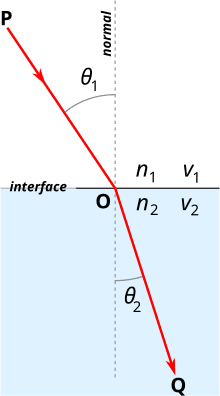
Snell's Law relates the angle of incoming light to the angle of refracted light at a boundary between two materials:
- and are the refractive indices of the two media
- is the angle of incidence (measured from the normal to the surface)
- is the angle of refraction (also measured from the normal)
The refractive index () of a material is the ratio of the speed of light in vacuum to the speed of light in that material: . A higher refractive index means light travels more slowly in that medium.
Two key bending rules to remember:
- Light going from a lower to a higher (e.g., air → glass) bends toward the normal.
- Light going from a higher to a lower (e.g., glass → air) bends away from the normal.
Snell's Law applies to any pair of transparent media: air, water, glass, diamond, etc.
Applying Snell's Law
Here's a step-by-step approach for a typical Snell's Law problem:
- Identify the two media and their refractive indices ( and ).
- Identify the known angle (incidence or refraction), making sure it's measured from the normal, not the surface.
- Plug into and solve for the unknown.
Example 1: Light passes from air () into water () at a 45° angle of incidence. Find the angle of refraction.
The light bends toward the normal, which makes sense since it's entering a denser medium.
Example 2: Light in air hits an unknown material at 30° and refracts to 22°. Find the material's refractive index.
That refractive index matches water, so the unknown material is likely water.
Common mistake: Using the angle from the surface instead of the angle from the normal. If a problem says "light hits the surface at 30°," that's 30° from the surface, which means the angle from the normal is 60°. Always convert before plugging in.
Critical Angle and Refractive Indices

Defining Critical Angle
The critical angle is the specific angle of incidence at which the refracted ray travels exactly along the boundary between two media (i.e., ). It only exists when light travels from a medium with a higher refractive index into one with a lower refractive index (denser → less dense).
At angles below the critical angle, light refracts and passes through the boundary. At the critical angle, the refracted ray skims along the surface. Above the critical angle, no refraction occurs at all, and you get total internal reflection.
Deriving the Critical Angle Relationship
Start with Snell's Law and set (since ):
Here is the denser medium (where the light starts) and is the less dense medium.
Example 1: Find the critical angle for light going from diamond () to air ().
This small critical angle is why diamonds sparkle so much: light gets trapped inside and bounces around many times before escaping.
Example 2: Does total internal reflection occur when light in water () hits a water-air interface at 48°?
- Find the critical angle: , so
- The angle of incidence (48°) is just below the critical angle (48.8°), so total internal reflection does not occur. The light refracts, barely, into the air.
Total Internal Reflection and Applications

Understanding Total Internal Reflection
Total internal reflection (TIR) occurs when light traveling in a denser medium hits the boundary with a less dense medium at an angle greater than the critical angle. When this happens:
- 100% of the light reflects back into the denser medium.
- No light passes through the boundary; there is no refracted ray.
- The reflected ray still obeys the law of reflection: the angle of reflection equals the angle of incidence.
TIR is responsible for several natural phenomena. Mirages on hot roads occur because layers of air at different temperatures have slightly different refractive indices, causing light to undergo TIR near the ground. Air bubbles underwater appear silvery because light reflecting off them undergoes TIR at the water-air boundary.
Applications of Total Internal Reflection
Fiber optics: An optical fiber has a glass or plastic core surrounded by a cladding with a slightly lower refractive index. Light enters one end and hits the core-cladding boundary at angles greater than the critical angle, so it bounces along the fiber with virtually no loss. This is how internet data and medical endoscope images travel over long distances.
Prisms: Right-angle prisms in binoculars and periscopes use TIR to redirect light by 90° or 180°. Glass prisms are often preferred over mirrors because TIR reflects 100% of the light, while even good mirrors absorb a small percentage.
Diamonds: Diamond has a very high refractive index (2.42), giving it a critical angle of only about 24.4°. A well-cut diamond is shaped so that light entering the top face undergoes multiple total internal reflections before exiting back through the top, producing intense brilliance.
Solving Problems with Total Internal Reflection
Problem-Solving Techniques
For any TIR problem, follow this process:
- Identify which medium is denser. TIR can only happen when light goes from higher to lower .
- Calculate the critical angle using .
- Compare the angle of incidence to the critical angle. If , TIR occurs. If , the light refracts through the boundary.
- If TIR does not occur, use Snell's Law to find the refraction angle.
In real-world applications, keep in mind that refractive indices can vary slightly with wavelength (this is called dispersion). That's why white light separates into colors in a prism. For most problems in this course, you can treat as constant unless told otherwise.
Specific Problem Types
Optical fiber acceptance angle: Fiber optic problems often ask for the maximum angle at which light can enter the fiber and still undergo TIR inside. This involves the fiber's numerical aperture (NA):
The acceptance angle (measured from the fiber axis in air) is found from .
Example: A fiber has a core index of 1.50 and cladding index of 1.48.
Light must enter within about 14° of the fiber's axis to be guided by TIR.
Prism problems: When light enters a prism, you may need to trace the ray through multiple surfaces. At each surface, apply Snell's Law to find the refraction angle, then use the prism geometry to find the angle of incidence at the next surface. Check whether TIR occurs at each internal surface by comparing to the critical angle.
See Fiveable more often in Google
Mark Fiveable as a preferred source and Google is more likely to show you our guides in Top Stories, with a "preferred" badge in AI Mode and AI Overviews.