8.1 Bohr Model of the Atom

🌀Principles of Physics III Unit 8 Review
8.1 Bohr Model of the Atom
🌀 Principles of Physics III
The Bohr Model of the Atom revolutionized our understanding of atomic structure. It explained why atoms are stable and why they emit specific colors of light, solving major problems that classical physics couldn't handle.
This model introduced the idea of quantized energy levels and electron orbits. While it worked remarkably well for hydrogen, it couldn't explain more complex atoms, which paved the way for modern quantum mechanics.
Bohr Model of the Atom

Top images from around the web for Fundamental Postulates and Assumptions
Planck constant - Simple English Wikipedia, the free encyclopedia View original
Is this image relevant?
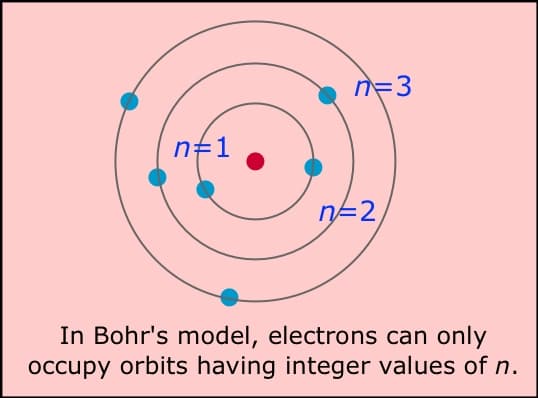
The Bohr atom View original
Is this image relevant?
File:Bohr model.jpg - Wikimedia Commons View original
Is this image relevant?
Planck constant - Simple English Wikipedia, the free encyclopedia View original
Is this image relevant?
The Bohr atom View original
Is this image relevant?
Fundamental Postulates and Assumptions
Bohr built his model on a set of postulates that deliberately broke with classical electromagnetism. Understanding why each postulate was needed helps you see the logic behind the model.
- Electrons orbit the nucleus in discrete, circular orbits with fixed radii and energy levels.
- Electrons can only exist in these specific, quantized energy states. They cannot occupy the spaces between allowed orbits.
- Electrons do not emit electromagnetic radiation while in stable orbits. This directly contradicts classical electromagnetism, which predicts that any accelerating charge (including one moving in a circle) should radiate energy and spiral into the nucleus. Bohr simply declared this doesn't happen in allowed orbits.
- Energy is absorbed or emitted only in discrete quanta when an electron transitions between orbits, following Planck's quantum hypothesis.
- The electrostatic (Coulomb) attraction between the electron and the nucleus provides the centripetal force that keeps the electron in its circular orbit.
- The electron's angular momentum is quantized: it can only take integer multiples of the reduced Planck constant, , where This is the key quantization condition that determines which orbits are allowed.
Mathematical Framework
These equations let you calculate orbit sizes, energy levels, and the wavelengths of light that hydrogen emits or absorbs.
Energy levels for hydrogen-like atoms (one electron orbiting a nucleus of charge ):
where is the principal quantum number. For hydrogen, .
Radius of the nth orbit:
where Å is the Bohr radius. Notice that higher means a larger orbit, and higher pulls the orbit inward.
Transition energy between two levels:
A negative means the atom emits a photon; a positive means it absorbs one.
Wavelength of emitted or absorbed light:
where is Planck's constant and is the speed of light.
Electron velocity in the nth orbit:
The ground-state electron in hydrogen moves at roughly 1/137 the speed of light.
Bohr Model's Explanation of Atomic Stability

Resolving Classical Instability
Classical electromagnetism has a fatal problem: an electron orbiting a nucleus is constantly accelerating, so it should continuously radiate energy, lose speed, and spiral into the nucleus in about seconds. Atoms obviously don't do this.
Bohr resolved this by postulating that electrons in allowed orbits simply do not radiate. Stability comes from quantization: because angular momentum is restricted to , only certain orbits are permitted, and the lowest one () has a finite radius. The electron literally has nowhere lower to go.
Accounting for Discrete Atomic Spectra
Before Bohr, scientists knew that hydrogen emits light only at specific wavelengths (you see distinct colored lines, not a continuous rainbow), but nobody could explain why.
- Bohr's model explains this naturally: each spectral line corresponds to an electron jumping between two specific energy levels.
- Bohr's frequency condition, , connects the energy gap between levels to the frequency (and therefore color) of the emitted or absorbed photon.
- The model successfully derives the Rydberg formula, which had previously been found only by fitting experimental data. This gave a theoretical foundation to the observed spectral series:
- Lyman series: transitions down to (ultraviolet)
- Balmer series: transitions down to (visible light)
- Paschen series: transitions down to (infrared)
Energy Levels and Transitions in Hydrogen-like Atoms

Calculating Energy Levels
For hydrogen (), the energy levels are:
| Energy (eV) | |
|---|---|
| 1 (ground state) | |
| 2 (first excited) | |
| 3 (second excited) | |
| 4 | |
| (ionized) |
The energy is negative because the electron is bound to the nucleus. At , the electron is free, and the atom is ionized.
For hydrogen-like ions (one electron, but ), the energies scale by . For example, has , so its ground-state energy is eV. That's much more tightly bound because the stronger nuclear charge pulls the electron closer.
Analyzing Electron Transitions
Here's how to find the wavelength of light from a transition:
- Identify the initial level and the final level .
- Calculate each energy: .
- Find the energy difference: .
- Convert to wavelength: . Using makes this quick.
Quick example: An electron in hydrogen drops from to (a Balmer series transition).
- eV
- eV
- eV
- nm
That's red light, and it matches the well-known H-alpha line in hydrogen's emission spectrum.
- Emission occurs when the electron drops to a lower level (), releasing a photon.
- Absorption occurs when the electron jumps to a higher level (), requiring an incoming photon of exactly the right energy.
Limitations of the Bohr Model vs Quantum Mechanics
Spectral and Structural Limitations
- Multi-electron atoms: The model only works for one-electron systems (H, , , etc.). Once you add electron-electron repulsion, the simple formula breaks down.
- Fine structure: High-resolution spectroscopy reveals that spectral lines are actually split into closely spaced components due to spin-orbit coupling and relativistic effects. Bohr's model has no way to account for this.
- Spectral line intensities: The model predicts where lines appear but says nothing about how bright each line is, or which transitions are more likely than others (selection rules).
- Chemical bonding: The model treats electrons as particles in circular orbits, which gives no insight into how atoms share electrons or form molecules.
- Zeeman effect: When atoms are placed in a magnetic field, spectral lines split further. Bohr's model can't explain this splitting.
Conceptual Inconsistencies with Modern Physics
- The Heisenberg uncertainty principle says you cannot simultaneously know an electron's exact position and momentum. Bohr orbits specify both a definite radius and a definite speed, which violates this principle.
- Quantum mechanics replaces fixed orbits with probability distributions (orbitals) described by wave functions. An electron doesn't travel a neat circular path; instead, there's a probability cloud showing where you're likely to find it.
- The model has no concept of electron spin, which was discovered later and is essential for explaining fine structure, the Pauli exclusion principle, and the structure of the periodic table.
- Space quantization (the fact that angular momentum can only point in certain directions relative to an external field) is also absent from Bohr's picture.
Despite these limitations, the Bohr model remains valuable. It gives correct energy levels for hydrogen, introduces the concept of quantization, and provides physical intuition that carries over into full quantum mechanics.
See Fiveable more often in Google
Mark Fiveable as a preferred source and Google is more likely to show you our guides in Top Stories, with a "preferred" badge in AI Mode and AI Overviews.