5.5 Polarization by Reflection and Scattering

🌀Principles of Physics III Unit 5 Review
5.5 Polarization by Reflection and Scattering
Polarization in Wave Optics
Fundamentals of Polarization
Polarization refers to the direction in which a light wave's electric field oscillates. For any electromagnetic wave, the electric field vibrates perpendicular to the direction the wave travels. In unpolarized light (like sunlight or a light bulb), the electric field points in random directions that are all perpendicular to the wave's path. Polarized light, by contrast, has its electric field confined to a specific pattern.
Polarization states describe that pattern:
- Linear polarization: the electric field oscillates back and forth along a single plane.
- Circular polarization: two perpendicular linear components with equal amplitude and a 90° phase difference combine so the electric field tip traces a circle as the wave propagates. Satellite communication antennas often use this because the signal doesn't depend on antenna orientation.
- Elliptical polarization: the most general case, where the two perpendicular components have unequal amplitudes or a phase difference other than 0° or 90°, so the electric field traces an ellipse. Linear and circular polarization are both special cases of elliptical polarization.
Polarization plays a role in reflection, refraction, and scattering, and it's the basis for technologies ranging from sunglasses to LCD screens.
Significance in Optical Systems
- Polarizing filters selectively transmit light oscillating in one direction, used in photography, sunglasses, and LCD displays.
- Optical isolators use polarization to block unwanted back-reflections in laser systems.
- Polarization-maintaining fibers preserve the polarization state of light over long distances, which is critical in fiber-optic communications and interferometry.
Polarization by Reflection and Scattering
Polarization by Reflection
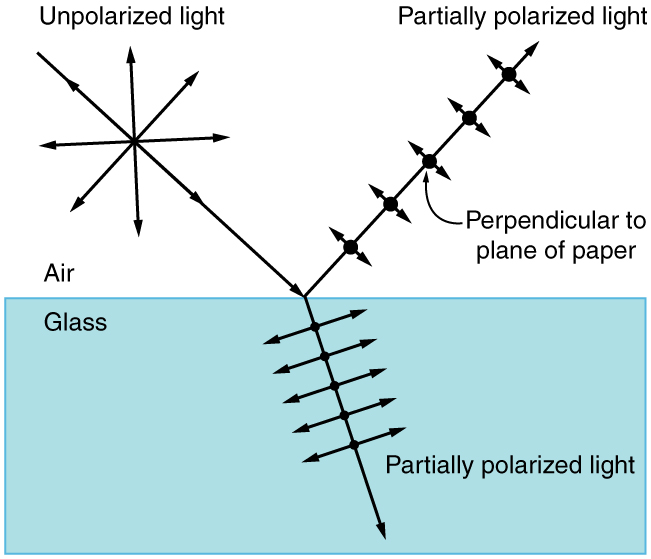
When unpolarized light strikes a smooth dielectric surface (like glass or water), the reflected light becomes partially polarized. The degree of polarization depends on the angle of incidence and the refractive indices of the two media.
Here's why it happens: at the surface, the incoming light drives electrons in the material to oscillate. Those oscillating charges re-radiate light (the reflected beam). A key fact about oscillating dipoles is that they don't radiate along their oscillation axis. The component of the electric field lying in the plane of incidence (called p-polarized light, "p" for parallel) reflects less efficiently than the component perpendicular to that plane (s-polarized light, "s" from the German senkrecht, meaning perpendicular). The result is that reflected light is preferentially s-polarized.
The Fresnel equations quantify this behavior. They give the reflection coefficients for s- and p-polarized components as functions of the incidence angle and the refractive indices of both media. You don't usually need to memorize the full Fresnel equations for this course, but you should understand the physical picture: s-polarization reflects more strongly than p-polarization at most angles, and the gap between them is largest at Brewster's angle.

Polarization by Scattering
When light encounters particles or molecules, it scatters, and the scattered light becomes partially polarized. The mechanism is similar to reflection: incoming light causes charges in the particle to oscillate as a dipole, and that dipole radiates preferentially perpendicular to its oscillation axis.
- Rayleigh scattering occurs when particles are much smaller than the wavelength of light (like and molecules in the atmosphere). The scattered light is partially polarized perpendicular to the plane defined by the incoming and scattered ray directions. Rayleigh scattering also explains why the sky is blue: shorter wavelengths scatter far more efficiently, with intensity scaling as .
- Mie scattering occurs when particle sizes are comparable to the wavelength. It produces less polarization than Rayleigh scattering and scatters all wavelengths more equally, which is why clouds and fog appear white rather than blue.
The maximum polarization from Rayleigh scattering occurs when you look at 90° to the direction of the incoming sunlight. If the sun is at the horizon, the patch of sky directly overhead is most strongly polarized.
Factors Affecting Polarization
- Wavelength: shorter wavelengths (blue/violet) scatter much more than longer wavelengths (red), which drives both the color and polarization pattern of skylight.
- Surface roughness: smooth surfaces produce a higher degree of polarization upon reflection. Rough surfaces scatter light in many directions, randomizing the electric field orientation and reducing polarization.
- Atmospheric conditions: molecular density varies with temperature, pressure, and altitude, causing polarization patterns in the sky to shift with weather and time of day. Dust and aerosols also reduce the degree of polarization by introducing Mie scattering.
Polarization vs. Angle of Incidence
How Incidence Angle Affects Polarization
As the angle of incidence increases from 0° (normal incidence), the degree of polarization in the reflected light generally increases, reaches a maximum at Brewster's angle, then decreases again as you approach grazing incidence (90°).
At normal incidence (0°), there's no preferred plane of incidence, so the reflected light remains unpolarized. At Brewster's angle, the p-polarized component has zero reflectance, so the reflected beam is 100% s-polarized. At grazing incidence (near 90°), both s- and p-components reflect strongly and the difference between them shrinks, so polarization decreases again.
One detail worth noting: the transmitted beam at Brewster's angle is only partially polarized. It still contains both components but is enriched in p-polarized light because the s-component was preferentially reflected.
Brewster's Angle
Brewster's angle is the incidence angle at which the reflected and refracted rays are exactly perpendicular to each other (they form a 90° angle). At this angle, the p-polarized component cannot be reflected because the oscillating dipoles in the surface would need to radiate along their own oscillation axis, which dipoles cannot do.
You can derive the formula from Snell's law. Since the reflected and refracted rays are perpendicular, , which means . Substituting into Snell's law:
Dividing both sides by :
where is the refractive index of the incident medium and is the refractive index of the reflecting medium.
Common values:
- Air to water ():
- Air to glass ():
Applications of Angle-Dependent Polarization
- Measuring refractive indices: by finding the angle at which reflected light is fully polarized, you can determine a material's refractive index directly from Brewster's law.
- Glare reduction: polarized sunglasses block s-polarized light, which is the dominant component in glare reflected off roads and water. Anti-reflective coatings on camera lenses also exploit Brewster's angle principles.
- Brewster windows in laser cavities are tilted at Brewster's angle so that p-polarized light passes through with zero reflection loss. This selects a single polarization for the laser output.
- Ellipsometry measures how polarization changes upon reflection from thin films to determine film thickness and optical properties, widely used in semiconductor manufacturing.
Applications of Polarization
Imaging and Display Technologies
- Polarizing filters in photography reduce glare from reflective surfaces and deepen sky contrast by blocking s-polarized reflected light.
- Circular polarizers on cameras combine a linear polarizer with a quarter-wave plate, preventing the polarizing filter from interfering with autofocus and metering systems that use beam splitters.
- LCDs sandwich liquid crystals between two crossed polarizers. Applying voltage changes the crystal alignment, controlling how much polarized light passes through each pixel.
- 3D cinema (e.g., RealD 3D) projects left-eye and right-eye images with different circular polarization states. Polarized glasses ensure each eye sees only its intended image, creating a stereoscopic effect.
Scientific and Industrial Applications
- Photoelasticity passes polarized light through transparent materials under mechanical stress. Stress-induced birefringence creates color fringe patterns that reveal internal stress distributions in plastics, glass, and engineering prototypes.
- Polarimetry measures how optically active substances rotate the plane of polarized light. This is used in chemistry to determine sugar concentrations in solution and in organic chemistry to identify chiral molecules.
- Polarization-sensitive optical coherence tomography (PS-OCT) enhances contrast in medical imaging of tissues, with applications in ophthalmology and dermatology.
Communication and Remote Sensing
- Radar systems use polarization diversity to improve target detection and distinguish different object types.
- Satellite communications transmit signals in orthogonal polarization states on the same frequency, effectively doubling channel capacity.
- LiDAR systems use polarization to study atmospheric aerosols and determine cloud particle shapes.
- Polarimetric remote sensing improves land cover classification by distinguishing vegetation types and surface materials based on their polarization signatures.
See Fiveable more often in Google
Mark Fiveable as a preferred source and Google is more likely to show you our guides in Top Stories, with a "preferred" badge in AI Mode and AI Overviews.