3.1 Maxwell's Equations and Electromagnetic Waves

🌀Principles of Physics III Unit 3 Review
3.1 Maxwell's Equations and Electromagnetic Waves
🌀 Principles of Physics III
Maxwell's equations are the foundation of electromagnetism, describing how electric and magnetic fields interact. These four equations explain the behavior of charges, currents, and electromagnetic waves, unifying electricity and magnetism into a single theory.
Electromagnetic waves, a key prediction of Maxwell's equations, are transverse waves of electric and magnetic fields. They travel at the speed of light in vacuum and include various types of radiation, from radio waves to gamma rays, each with unique properties and applications.
Maxwell's Equations and Electromagnetic Waves

Top images from around the web for Fundamental Principles of Maxwell's Equations
16.1 Maxwell’s Equations and Electromagnetic Waves – University Physics Volume 2 View original
Is this image relevant?
Maxwell's equations - Wikipedia View original
Is this image relevant?
Maxwell equations - Knowino View original
Is this image relevant?
16.1 Maxwell’s Equations and Electromagnetic Waves – University Physics Volume 2 View original
Is this image relevant?
Maxwell's equations - Wikipedia View original
Is this image relevant?
Fundamental Principles of Maxwell's Equations
Maxwell's equations are four equations that, taken together, completely describe classical electromagnetic phenomena. Each one captures a different aspect of how electric and magnetic fields behave:
- Gauss's law for electricity relates the electric field to the charge distribution that produces it. More enclosed charge means more electric flux through a surrounding surface.
- Gauss's law for magnetism states that magnetic monopoles do not exist. Every magnetic field line that enters a closed surface also exits it, so the net magnetic flux is always zero.
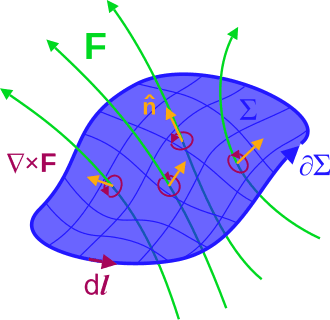
- Faraday's law of induction describes how a time-varying magnetic field generates (induces) an electric field. This is the principle behind electric generators and transformers.
- Ampère-Maxwell law relates the magnetic field to both electric currents and time-varying electric fields. The second term, involving the changing electric field, is Maxwell's addition and is called the displacement current.
The displacement current term is what makes the whole framework self-consistent. Without it, Ampère's law only works for steady currents. With it, a changing electric field can produce a magnetic field even in empty space, and that's exactly what allows electromagnetic waves to exist.
These equations can be written in both differential and integral forms. The differential forms describe what's happening at a single point in space; the integral forms describe the fields over surfaces and along paths. Both are useful depending on the problem.
Collectively, Maxwell's equations predict that electromagnetic disturbances propagate through vacuum at a constant speed of 299,792,458 m/s, which is the speed of light. This result laid the foundation for Einstein's theory of special relativity.
Mathematical Formulation and Implications
In differential form, the four equations are:
- Gauss's law for electricity:
- Gauss's law for magnetism:
- Faraday's law of induction:
- Ampère-Maxwell law:
The divergence equations (first two) describe how fields originate from sources. The curl equations (last two) describe how fields circulate and how changes in one field generate the other.
These equations apply to both static situations (charges at rest, steady currents) and dynamic situations (time-varying fields, accelerating charges). In the dynamic case, the coupling between and through Faraday's law and the Ampère-Maxwell law is what gives rise to electromagnetic waves spanning the entire spectrum, from radio waves to gamma rays.
Before Maxwell, electricity, magnetism, and optics were treated as separate subjects. These equations unified all three and, by predicting a fixed speed of light independent of reference frame, challenged Newtonian concepts of absolute space and time.
Derivation of Electromagnetic Wave Equation

Mathematical Derivation Process
The wave equation for electromagnetic fields can be derived directly from Maxwell's equations. Here's the process for the electric field, assuming a region of space with no free charges () and no free currents ():
-
Start with Faraday's law and take the curl of both sides:
-
Substitute the Ampère-Maxwell law (with ) into the right side to replace :
-
Apply the vector identity for the curl of a curl:
-
Use Gauss's law in the charge-free region, where , so the first term vanishes.
-
The result is the electromagnetic wave equation for :
A similar process (taking the curl of the Ampère-Maxwell law and substituting Faraday's law) yields the identical wave equation for :
Interpretation and Significance
Both wave equations have the standard form , which tells you the propagation speed is:
Plugging in the known constants:
- F/m (permittivity of free space)
- H/m (permeability of free space)
you get m/s, which matches the measured speed of light. This was the key result that led Maxwell to conclude that light itself is an electromagnetic wave.
The fact that the wave equations for and have identical form reflects their coupled nature: neither field can propagate alone. A changing generates , and a changing generates , sustaining the wave as it moves through space.
Properties of Electromagnetic Waves

Wave Characteristics and Behavior
Electromagnetic waves have several defining properties:
- They propagate at m/s in vacuum. In a medium, the speed is reduced to , where is the index of refraction.
- They are transverse waves: both the electric and magnetic field oscillations are perpendicular to the direction of propagation.
- The and fields are also mutually perpendicular to each other and oscillate in phase. If points in the -direction and the wave travels in the -direction, then points in the -direction.
- The field amplitudes are related by . Because is large, the electric field amplitude is much larger in SI units than the magnetic field amplitude for the same wave.
- They carry both energy and momentum. The energy density is proportional to the square of the field amplitudes.
- The Poynting vector gives both the direction of energy flow and the energy flux (power per unit area, in W/m²). Its time-averaged magnitude is called the intensity of the wave.
- Like all waves, electromagnetic waves exhibit reflection, refraction, diffraction, and interference.
Electromagnetic Spectrum and Applications
The electromagnetic spectrum spans an enormous range of frequencies and wavelengths, all governed by the relation . From lowest to highest frequency:
- Radio waves ( from ~km to ~m): telecommunications, radio broadcasting, cell phones
- Microwaves ( from ~m to ~mm): cooking, radar, satellite communication
- Infrared ( from ~mm to ~700 nm): thermal imaging, remote sensing, fiber optic communication
- Visible light ( ~ 400–700 nm): vision, photosynthesis, optical instruments
- Ultraviolet ( from ~400 nm to ~10 nm): sterilization, fluorescence, material analysis
- X-rays ( from ~10 nm to ~0.01 nm): medical imaging, crystallography
- Gamma rays ( < ~0.01 nm): cancer treatment, nuclear physics, astrophysical observations
All of these are the same physical phenomenon (oscillating and fields) differing only in frequency and wavelength.
Unification of Electricity, Magnetism, and Light
Historical Context and Theoretical Implications
Maxwell's equations provided the first unified mathematical framework for electric and magnetic phenomena. Before Maxwell, Coulomb's law, Ampère's law, and Faraday's law were understood as separate empirical results. Maxwell showed they were all aspects of a single underlying theory.
The most striking consequence was the demonstration that light is an electromagnetic wave. This unified optics with electromagnetism, collapsing three branches of physics into one.
The mechanism of unification is the concept of the electromagnetic field: a changing electric field produces a magnetic field (via the displacement current), and a changing magnetic field produces an electric field (via Faraday's law). This mutual generation is what allows electromagnetic waves to sustain themselves and propagate through empty space.
Maxwell's theory predicted the existence of electromagnetic waves beyond visible light. Heinrich Hertz confirmed this experimentally in 1887 by generating and detecting radio waves in his laboratory, validating the theory.
Because Maxwell's equations predict a fixed speed of light that doesn't depend on the motion of the source or observer, they were incompatible with Galilean relativity. Resolving this tension led directly to Einstein's special relativity in 1905, and eventually to quantum electrodynamics, the quantum theory of electromagnetic interactions.
Practical Applications and Modern Relevance
Maxwell's equations are not just theoretical; they're the working foundation for a huge range of technologies:
- Antenna and waveguide design: The equations govern how electromagnetic energy is radiated and guided through structures.
- Telecommunications: Fiber optics, wireless networks, and satellite links all rely on controlled propagation of electromagnetic waves.
- Medical imaging: MRI uses oscillating magnetic fields; CT scans use X-rays. Both are grounded in electromagnetic theory.
- Particle accelerators: Radiofrequency cavities accelerate charged particles using oscillating electromagnetic fields.
- Photonics and optoelectronics: Lasers, LEDs, and photodetectors all operate based on the interaction of electromagnetic fields with matter.
- Astrophysics: Observations of pulsars, quasars, and the cosmic microwave background all depend on understanding electromagnetic radiation across the spectrum.
See Fiveable more often in Google
Mark Fiveable as a preferred source and Google is more likely to show you our guides in Top Stories, with a "preferred" badge in AI Mode and AI Overviews.