8.3 Atomic Spectra and Energy Levels

🌀Principles of Physics III Unit 8 Review
8.3 Atomic Spectra and Energy Levels
🌀 Principles of Physics III
Atomic Emission and Absorption Spectra
Atomic spectra are the distinct patterns of light that atoms emit or absorb. Each element produces a unique spectral pattern, making spectra one of the most powerful tools for identifying elements and understanding atomic structure. These patterns exist because electrons in atoms occupy only specific, discrete energy levels.

Top images from around the web for Origin and Characteristics of Atomic Spectra
16.3 Bohr’s Theory of the Hydrogen Atom – Atomic Spectral Lines – Douglas College Physics 1207 View original
Is this image relevant?
The Bohr atom View original
Is this image relevant?
atomic spectra Archives - Universe Today View original
Is this image relevant?
16.3 Bohr’s Theory of the Hydrogen Atom – Atomic Spectral Lines – Douglas College Physics 1207 View original
Is this image relevant?
The Bohr atom View original
Is this image relevant?
Origin and Characteristics of Atomic Spectra
When an atom gains energy (from heat, electricity, or light), its electrons jump to higher energy levels. When those electrons drop back down, they release that energy as photons with very specific wavelengths. This is why atomic spectra consist of sharp lines rather than a smooth rainbow.
There are two complementary types:
- Emission spectra show bright colored lines against a dark background. You see these when excited atoms release photons as electrons fall to lower energy levels.
- Absorption spectra show dark lines within an otherwise continuous spectrum. These appear when atoms absorb photons at exactly the wavelengths needed to promote electrons to higher levels.
The wavelength (or frequency) of each spectral line is set by the energy difference between the two levels involved in the transition:
where is Planck's constant () and is the photon's frequency. Because each element has a unique arrangement of energy levels, no two elements produce the same spectral pattern.
Bohr's atomic model was the first to explain this: electrons can only occupy certain allowed orbits, and spectral lines correspond to transitions between those orbits.
Types of Atomic Spectra and Their Applications
The type of spectrum you observe depends on the source:
- Continuous spectra contain all wavelengths across a range with no gaps. Hot, dense objects like incandescent light bulb filaments produce these.
- Line spectra consist of discrete, isolated wavelengths characteristic of individual elements. Neon signs are a classic example: the specific red-orange glow comes from neon's emission lines.
- Band spectra appear as groups of closely spaced lines and are produced by molecules rather than individual atoms. Molecular nitrogen in the aurora borealis produces band spectra.
These spectra have broad practical uses:
- Element identification: Flame tests in chemistry use emission colors to identify metals in unknown samples. Sodium, for instance, produces a distinctive yellow doublet near 589 nm.
- Astronomy: Spectral analysis reveals what stars are made of. Doppler shifts in spectral lines (redshift or blueshift) tell us whether a star or galaxy is moving toward or away from us.
- Medical and materials analysis: X-ray spectroscopy uses characteristic X-ray emission lines to determine elemental composition in both diagnostic imaging and materials science.
Spectral Lines and Electronic Transitions

Relationship Between Spectral Lines and Energy Levels
Every spectral line maps directly to a specific electron transition between two discrete energy levels. The energy of the photon involved equals the gap between those levels:
For emission, the electron drops from a higher level to a lower one, releasing a photon. For absorption, the electron absorbs a photon and jumps from a lower level to a higher one. The same wavelength is involved in both directions for a given pair of levels.
Not every transition is equally likely. Selection rules, derived from quantum mechanics and conservation of angular momentum, determine which transitions are "allowed" and which are "forbidden." A key selection rule is , meaning the azimuthal quantum number must change by exactly one. "Forbidden" transitions aren't truly impossible; they're just far less probable and produce much weaker spectral lines.
The intensity of a spectral line depends on two things: the probability of that transition occurring and how many atoms are in the initial state to begin with.
Fine Structure and Quantum Numbers
If you look at spectral lines with high enough resolution, many of them split into closely spaced groups. This is called fine structure, and it arises from spin-orbit coupling: the interaction between an electron's orbital angular momentum and its intrinsic spin. The electron's spin magnetic moment interacts with the magnetic field generated by its own orbital motion, slightly shifting energy levels depending on whether the spin and orbital angular momenta are aligned or anti-aligned.
Even finer splitting, called hyperfine structure, comes from interactions between the electron's magnetic moment and the magnetic properties of the nucleus.
Four quantum numbers describe each electron's state in an atom:
- Principal quantum number (): Determines the main energy level (shell). Higher means higher energy and larger orbital size. Takes positive integer values: 1, 2, 3, ...
- Azimuthal quantum number (): Describes the shape of the orbital and the electron's orbital angular momentum. Ranges from 0 to . The values correspond to the s, p, d, f orbital labels.
- Magnetic quantum number (): Specifies the orbital's orientation in space relative to an external magnetic field. Ranges from to , giving possible orientations.
- Spin quantum number (): Represents the electron's intrinsic spin, either or .
The Pauli exclusion principle states that no two electrons in the same atom can share all four quantum numbers. This is what forces electrons into different orbitals and ultimately determines the structure of the periodic table.
Rydberg Equation for Spectral Lines

Fundamentals of the Rydberg Equation
The Rydberg equation predicts the exact wavelengths of spectral lines for hydrogen and hydrogen-like (single-electron) atoms:
where:
- is the wavelength of the emitted or absorbed photon
- is the Rydberg constant for hydrogen, approximately
- and are the principal quantum numbers of the lower and upper energy levels, respectively ()
The quantity is called the wavenumber and is directly proportional to the photon's energy. To find the frequency instead, use and rearrange.
Example calculation: Find the wavelength of the first Balmer line ():
- Plug into the Rydberg equation:
- Evaluate the bracket:
- Multiply:
- Invert: (red light)
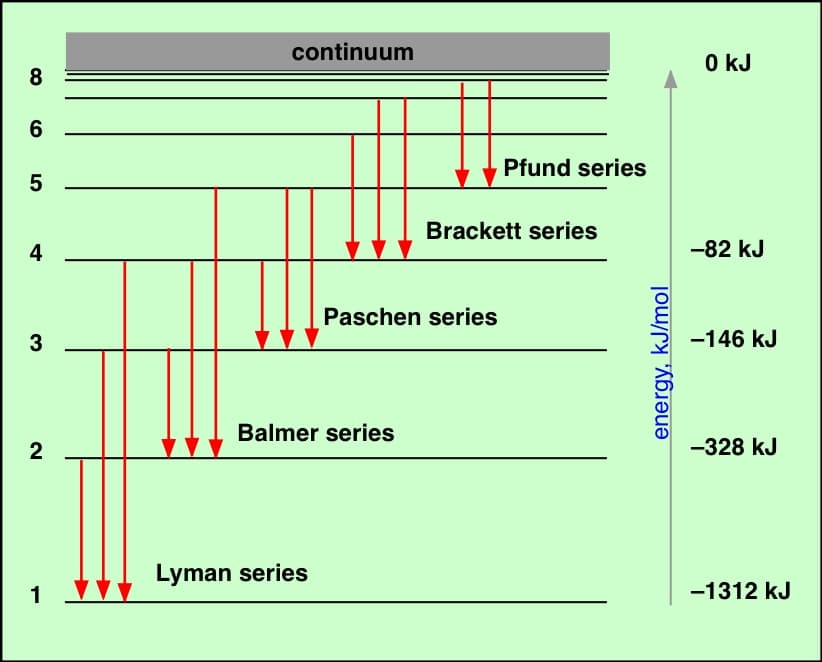
Different values of define named spectral series for hydrogen:
- Lyman series (): Transitions down to the ground state. These photons are in the ultraviolet range.
- Balmer series (): Transitions to the first excited state. These fall in the visible range (roughly 400–700 nm), which is why they were discovered first.
- Paschen series (): Transitions to the second excited state. These are in the infrared.
- Brackett () and Pfund () series extend further into the infrared.
For hydrogen-like ions (, , etc.), the equation scales with the square of the atomic number:
The factor means that ions with higher nuclear charge have much larger energy gaps and therefore shorter-wavelength (higher-energy) spectral lines.
Applications and Extensions of the Rydberg Equation
The Rydberg equation is most accurate for one-electron systems, but its usefulness extends further:
- Ionization energy: Setting in the equation gives the energy needed to completely remove the electron from a given level. For hydrogen in the ground state (), this gives 13.6 eV.
- Rydberg states: Atoms with electrons excited to very high values (near the ionization limit) are called Rydberg atoms. These have exaggerated properties like enormous orbital sizes and extreme sensitivity to external fields.
- Multi-electron atoms: The basic Rydberg equation doesn't work directly for atoms with more than one electron because inner electrons partially shield the nuclear charge. Quantum defect theory modifies the equation by replacing with an effective quantum number , where is the quantum defect that accounts for shielding and depends on .
- Precision spectroscopy: The Rydberg constant is one of the most precisely measured constants in physics (known to about 12 significant figures), making it central to atomic clocks and tests of fundamental theory.
Atomic Spectra in Quantum Mechanics
Historical Significance and Theoretical Development
Atomic spectra played a pivotal role in the birth of quantum mechanics. Classical physics predicted that accelerating electrons in orbit should radiate energy continuously, producing a smooth spectrum and spiraling into the nucleus within roughly seconds. The observation of discrete spectral lines flatly contradicted this prediction.
Bohr's 1913 model resolved the crisis by proposing that electrons occupy only quantized orbits with specific energies. Transitions between these orbits explained the hydrogen spectrum with remarkable accuracy. While Bohr's model was eventually replaced by full quantum mechanics (it couldn't handle multi-electron atoms or predict line intensities), it was a crucial stepping stone.
Further spectroscopic discoveries drove theory forward:
- Fine structure in spectral lines led to the discovery of electron spin and the development of quantum electrodynamics (QED).
- Precision spectral measurements provided rigorous tests of quantum mechanical predictions, confirming the theory's accuracy to extraordinary precision. The Lamb shift, a tiny splitting in hydrogen's energy levels, was one of QED's greatest early confirmations.
- Spectroscopic analysis enabled the discovery of new elements. Helium was first identified in the Sun's spectrum in 1868 before it was found on Earth, and several other elements were discovered through their spectral signatures.
Modern Applications and Ongoing Research
Atomic spectra remain at the center of cutting-edge physics and technology:
- Atomic clocks: Cesium fountain clocks define the SI second based on a specific hyperfine transition in cesium-133 (9,192,631,770 oscillations), achieving accuracy to about 1 second in 300 million years.
- Laser cooling and trapping: By tuning lasers slightly below a specific atomic transition frequency, physicists can slow atoms to near absolute zero, enabling experiments on Bose-Einstein condensates and other exotic states of matter.
- Quantum computing: Ion trap qubits rely on precise control of atomic energy levels to store and manipulate quantum information.
- Astrophysics: Spectral analysis of distant galaxies reveals their composition, temperature, and velocity, and has been central to measuring the expansion rate of the universe.
- Environmental monitoring: Spectroscopic techniques detect trace pollutants and atmospheric gases at extremely low concentrations, often down to parts per billion.
See Fiveable more often in Google
Mark Fiveable as a preferred source and Google is more likely to show you our guides in Top Stories, with a "preferred" badge in AI Mode and AI Overviews.