3.2 Electromagnetic Spectrum

🌀Principles of Physics III Unit 3 Review
3.2 Electromagnetic Spectrum
🌀 Principles of Physics III
Electromagnetic waves span an enormous range of frequencies and wavelengths, from radio waves longer than a football field to gamma rays smaller than an atomic nucleus. The electromagnetic spectrum organizes all of these waves into regions based on their frequency and wavelength, and each region interacts with matter differently. That's what makes the spectrum so useful: different regions power different technologies, from medical imaging to wireless communication to astronomy.
Regions of the Electromagnetic Spectrum

Top images from around the web for Spectrum Overview and Characteristics
Electromagnetic Energy | Chemistry View original
Is this image relevant?
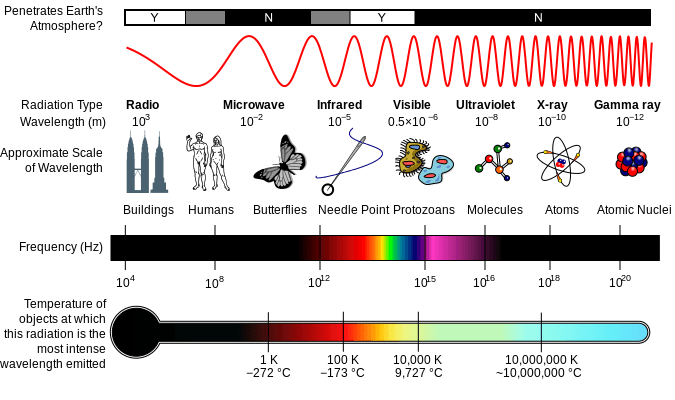
CH103 – CHAPTER 3: Radioactivity and Nuclear Chemistry – Chemistry View original
Is this image relevant?
Spectral imaging - Wikipedia View original
Is this image relevant?
Electromagnetic Energy | Chemistry View original
Is this image relevant?
CH103 – CHAPTER 3: Radioactivity and Nuclear Chemistry – Chemistry View original
Is this image relevant?
Spectrum Overview and Characteristics
All electromagnetic waves travel at the speed of light in a vacuum, but they differ in wavelength and frequency. The spectrum is continuous, meaning there are no hard boundaries between regions, but we divide it into seven main regions (ordered from lowest to highest frequency): radio waves, microwaves, infrared, visible light, ultraviolet, X-rays, and gamma rays.
The relationship tying wavelength and frequency together is:
where is the speed of light in a vacuum ( m/s), is wavelength, and is frequency. Since is constant, wavelength and frequency are inversely related: as one goes up, the other goes down.
Wavelength and Frequency Ranges
Here's how the regions break down, from longest wavelength to shortest:
- Radio waves: m, GHz
- Microwaves: mm to 0.1 m, GHz to 300 GHz
- Infrared: nm to 1 mm, GHz to 430 THz
- Visible light: nm to 700 nm, THz to 790 THz
- Ultraviolet: nm to 380 nm
- X-rays: nm to 10 nm
- Gamma rays: nm, Hz
Notice that the infrared range starts at about 700 nm (the red edge of visible light), not 750 nm. The boundaries between regions aren't perfectly sharp, but 700 nm is the more standard cutoff used in physics.
Visible light is a tiny sliver of the full spectrum. Most of what electromagnetic waves do happens in regions our eyes can't detect at all.
Properties and Applications of Electromagnetic Waves
Radio Waves and Microwaves
Radio waves ( m) have the lowest frequencies and longest wavelengths. They diffract around obstacles and penetrate buildings easily, which is why they're the backbone of long-distance communication: AM/FM radio, television broadcasts, wireless internet, and radar.
Microwaves ( mm to 0.1 m) sit just above radio waves in frequency. Water molecules absorb microwaves at certain frequencies because the oscillating electric field forces the polar water molecules to rotate back and forth, generating thermal energy through friction. That's why microwave ovens heat food so effectively. Beyond cooking, microwaves are used in satellite communications, cell phone networks, weather radar, and GPS.

Infrared and Visible Light
Infrared radiation ( nm to 1 mm) is closely associated with thermal energy. Any object with a temperature above absolute zero emits infrared radiation, which is why thermal imaging cameras can "see" heat. Other applications include night vision goggles, fiber optic communication, TV remote controls, and temperature sensors.
Visible light ( nm to 700 nm) is the only region the human eye can detect. Violet light sits near 380 nm and red light near 700 nm, with all other colors (blue, green, yellow, orange) falling in between. Visible light is essential for vision and photosynthesis, and it drives technologies like photography, microscopy, and solar panels.
Ultraviolet, X-rays, and Gamma Rays
Ultraviolet radiation ( nm to 380 nm) carries enough energy per photon to damage DNA in skin cells, which is what causes sunburn and increases cancer risk with prolonged exposure. That same energy makes UV useful for sterilization and disinfection, since it can destroy the DNA of bacteria and viruses. UV is also used in forensic analysis, fluorescence imaging, and studying astronomical objects.
X-rays ( nm to 10 nm) have high penetrating power, meaning they pass through soft tissue but are absorbed by denser materials like bone and metal. The reason is that denser materials have more electrons per unit volume to interact with the X-ray photons. This property is what makes medical X-ray imaging and airport security scanners possible. X-ray crystallography also uses this radiation to determine the atomic structure of materials by analyzing diffraction patterns.
Gamma rays ( nm) are the most energetic electromagnetic waves. They're produced by nuclear reactions and certain radioactive decay processes. In medicine, focused gamma rays are used in radiation therapy to destroy cancer cells. Other applications include sterilizing medical equipment, food irradiation, and gamma-ray telescopes that study the most violent events in the universe.
Photon Energy vs Frequency
Energy-Frequency Relationship
Electromagnetic waves carry energy in discrete packets called photons. The energy of a single photon is directly proportional to the wave's frequency, described by the Planck-Einstein relation:
- = photon energy (in joules)
- = Planck's constant ( J·s)
- = frequency of the wave
This means higher-frequency waves (like gamma rays) carry far more energy per photon than lower-frequency waves (like radio waves). The word "discrete" here is key: energy isn't delivered in a continuous stream but in individual chunks, each with energy .

Energy-Wavelength Relationship
Since , you can substitute into the energy equation to get:
This form is useful when you know the wavelength instead of the frequency. Notice that energy is inversely proportional to wavelength: shorter wavelength means higher energy.
This relationship explains why gamma rays and X-rays are classified as ionizing radiation: their photons carry enough energy to knock electrons off atoms and break molecular bonds in biological tissue. Radio waves, by contrast, have such low photon energies that they pass through your body without causing molecular damage.
Quick calculation example: A photon of green light has nm = m. Its energy is:
To put that in perspective, this is about eV (electron volts), a common unit for photon energies. You convert using J.
These energy relationships are the foundation for spectroscopy, photovoltaic cell design, and much of quantum mechanics.
Importance of the Electromagnetic Spectrum
Scientific Research and Technology
Different parts of the spectrum reveal different information about the universe. In astronomy, radio telescopes detect the cosmic microwave background radiation left over from the Big Bang, while infrared telescopes observe cool stars and dust-obscured galaxies that are invisible in optical light. X-ray and gamma-ray telescopes capture emissions from black holes and neutron stars.
Spectroscopy is one of the most powerful tools built on the electromagnetic spectrum. Every element and molecule absorbs or emits light at characteristic wavelengths, producing a unique pattern like a fingerprint. By analyzing these patterns, scientists can identify chemical compositions. This technique is used to determine what distant stars are made of, detect pollutants in water, and characterize new materials in the lab.
Advanced Applications
The electromagnetic spectrum underpins a wide range of modern technologies:
- Communication: Fiber optic cables transmit data using infrared light, achieving far higher bandwidth than electrical cables. Different wavelengths can carry separate signals through the same fiber simultaneously.
- Energy: Solar cells convert visible and near-infrared radiation into electricity. The efficiency of a solar cell depends on how well it captures photons across these wavelength ranges, which is why the photon energy equation matters for solar cell design.
- Medical imaging: MRI uses radio-frequency waves, CT scans use X-rays, and PET scans detect gamma rays. Each technique exploits a different part of the spectrum to image the body in a different way.
- Manufacturing and security: X-ray and UV inspection systems perform quality control, while infrared and terahertz imaging are used in security screening.
- Laser technology: Lasers produce coherent light at specific wavelengths and are applied in surgery, precision cutting, barcode scanning, and data storage.
The spectrum isn't just a chart on a wall. It's the toolkit that drives most of modern physics and engineering, and nearly every topic you'll encounter in this course connects back to how electromagnetic waves behave at different frequencies.
See Fiveable more often in Google
Mark Fiveable as a preferred source and Google is more likely to show you our guides in Top Stories, with a "preferred" badge in AI Mode and AI Overviews.