1.6 Superposition and Interference

🌀Principles of Physics III Unit 1 Review
1.6 Superposition and Interference
🌀 Principles of Physics III
Superposition of Waves
Principle of Superposition
When two or more waves overlap in the same region of space, the resulting displacement at any point is the algebraic sum of the individual wave displacements. This is the principle of superposition, and it's one of the most important ideas in wave physics.
"Algebraic sum" is doing real work here. It means you add the displacements with their signs. If one wave displaces the medium +3 cm and another displaces it +2 cm at the same point, the result is +5 cm. If they're +3 cm and −3 cm, the result is zero.
A few things to know about superposition:
- It applies to all wave types: mechanical waves (sound, water), electromagnetic waves (light), and even quantum mechanical wave functions.
- It depends on linearity. As long as the medium responds linearly (displacement stays proportional to the restoring force), superposition holds regardless of differences in amplitude or frequency. In practice, large-amplitude waves can push a medium into nonlinear behavior, and superposition breaks down.
- It's the foundation for more complex wave phenomena you'll encounter throughout this course: standing waves, beats, and interference patterns.
Mathematical Representation and Analysis
The principle is expressed as:
where each is the displacement of an individual wave at a given point and time.
For two sinusoidal waves traveling in the same direction with the same frequency and wavenumber:
The combined wave is:
To simplify this, you use the sum-to-product trigonometric identity. For the special case where :
where .
Read this result carefully. The factor acts as the resultant amplitude, and the sine factor is a traveling wave at the average phase. So the phase difference between the two waves controls the amplitude of the combined wave. Everything in interference comes back to phase difference.
- When , the cosine factor equals 1 and the resultant amplitude is (full reinforcement).
- When , the cosine factor equals 0 and the resultant amplitude vanishes (full cancellation).
Interference Patterns of Waves
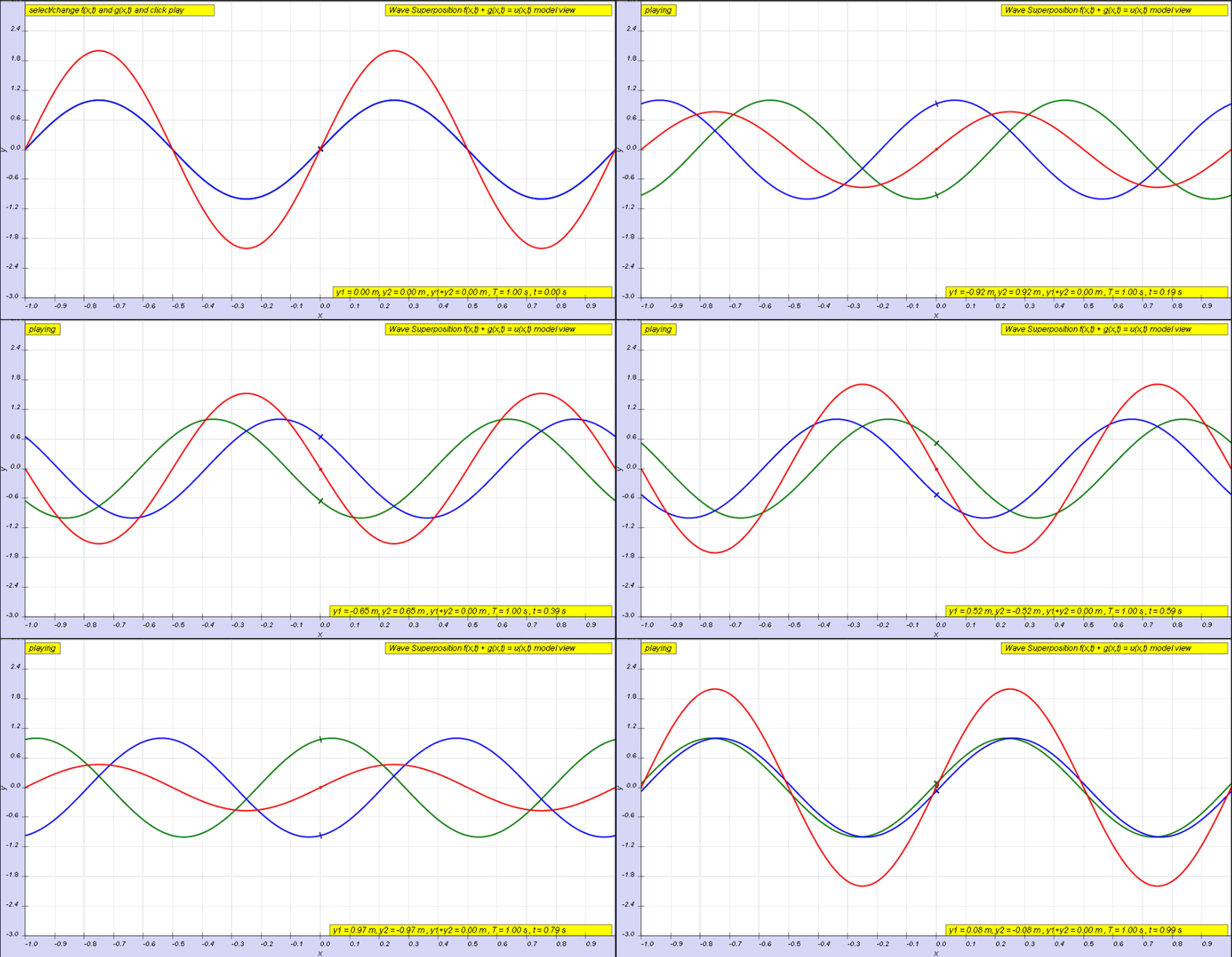
Formation and Characteristics
Interference patterns form when coherent waves overlap in space. Coherent means the waves have the same frequency and a constant phase relationship over time. Without coherence, the phase relationship shifts randomly and no stable pattern appears.
Where the waves overlap, some regions experience enhanced amplitude and others experience diminished amplitude. These regions alternate in a regular, predictable way, producing the characteristic bright/loud and dark/quiet zones you see in interference experiments.
- Observable in many media: ripple tanks (water), speakers (sound), and optical setups (light).
- The pattern depends on the relative phase difference between the waves at each point in space.
- In two and three dimensions, interference creates alternating regions of high and low intensity arranged along curves (2D) or surfaces (3D) of constant path difference.
- Classic demonstrations include the double-slit experiment, Michelson interferometry, and diffraction gratings.
Mathematical Analysis
The phase difference between two waves arriving at a point from different paths is:
where and are the distances each wave travels from its source to the observation point, and is the wavelength. The quantity is called the path length difference.
Note that additional phase shifts can arise from reflections (e.g., a shift upon reflection from a denser medium), so the total phase difference may include contributions beyond just the path length.
The resulting intensity at that point for two-wave interference is:
The cosine term controls whether the waves add or subtract. When , intensity is maximized. When , intensity is minimized. This single equation captures the entire logic of two-wave interference.
For the equal-intensity case (), this simplifies to:
This form is especially useful for double-slit problems.
Constructive vs. Destructive Interference
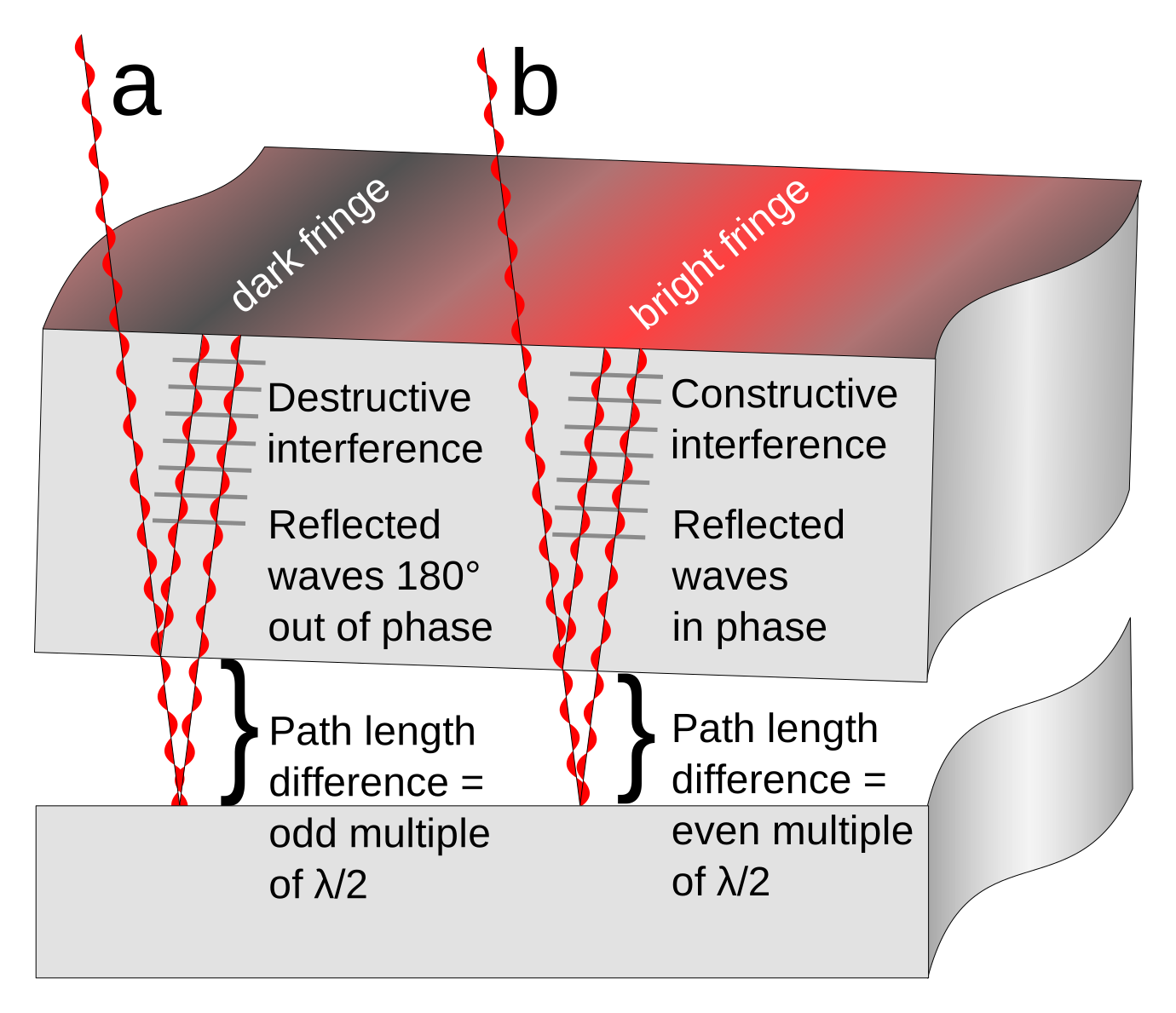
Constructive Interference
Constructive interference happens when waves arrive in phase, meaning their crests line up with crests and troughs line up with troughs. The result is a wave with greater amplitude than either individual wave.
The condition for constructive interference:
In terms of path length difference:
The waves reinforce when their path difference is a whole number of wavelengths.
- Produces bright fringes in optical experiments (like the double-slit).
- For two equal-intensity waves, the resultant intensity is . That's four times a single wave's intensity, not just double, because intensity is proportional to amplitude squared: doubling the amplitude quadruples the intensity.
Destructive Interference
Destructive interference happens when waves arrive out of phase, with crests aligned to troughs. The waves cancel, partially or completely.
The condition for complete destructive interference:
In terms of path length difference:
The waves cancel when their path difference is a half-integer number of wavelengths.
- Produces dark fringes in optical interference patterns.
- For two waves of equal amplitude, the resultant amplitude is zero: complete cancellation. If the amplitudes differ, cancellation is only partial, and the minimum intensity is .
- Practical applications include noise-cancelling headphones (a speaker generates a wave that's phase-shifted by relative to incoming noise) and antireflective coatings on lenses (the coating thickness is chosen so that reflected waves from the front and back surfaces destructively interfere).
Superposition and Interference Applications
Wave Phenomena
Standing waves form when two identical waves travel in opposite directions through the same medium. Their superposition creates a pattern with fixed nodes (zero displacement) and antinodes (maximum displacement). Unlike traveling waves, standing waves don't transport energy along the medium. This is how vibrating strings and air columns in instruments produce musical tones at specific resonant frequencies.
Beats occur when two waves with slightly different frequencies interfere. The result is a periodic rise and fall in amplitude, sometimes called amplitude modulation. The beat frequency equals the absolute difference of the two frequencies:
For example, two tuning forks at 440 Hz and 442 Hz produce 2 beats per second. Musicians use this to tune instruments: as the two frequencies get closer, the beats slow down and eventually disappear when the frequencies match.
Thin-film interference happens when light reflects off the top and bottom surfaces of a thin transparent film (soap bubbles, oil slicks on water). The two reflected waves travel slightly different path lengths, and their interference produces the colorful patterns you see. Keep in mind that a phase shift occurs when light reflects from a surface where the refractive index increases, so you need to account for both the path difference (, where is the film's refractive index and is its thickness) and any reflection phase shifts when determining whether interference is constructive or destructive.
Measurement and Imaging Techniques
- The Michelson interferometer splits a light beam into two paths, reflects them back, and recombines them. Tiny changes in one path length shift the interference pattern, allowing measurements of distances as small as fractions of a wavelength. LIGO uses this same principle, with 4 km arms, to detect gravitational waves.
- Double-slit and single-slit diffraction patterns are explained by interference of waves passing through apertures. For a double slit, the fringe spacing on a distant screen is , where is the slit separation and is the distance to the screen.
- Holography records the interference pattern between a reference beam and light scattered from an object, preserving full 3D phase and amplitude information that can be reconstructed later.
- Interferometric sensors detect minute changes in pressure, temperature, or strain by monitoring shifts in interference fringes.
See Fiveable more often in Google
Mark Fiveable as a preferred source and Google is more likely to show you our guides in Top Stories, with a "preferred" badge in AI Mode and AI Overviews.