4.1 Reflection and Refraction

🌀Principles of Physics III Unit 4 Review
4.1 Reflection and Refraction
🌀 Principles of Physics III
Specular vs Diffuse Reflection
When light hits a surface, it always reflects, but the quality of that reflection depends on the surface's texture at a microscopic scale. This distinction between specular and diffuse reflection explains why you can see your face in a polished mirror but not in a sheet of paper.
Specular reflection occurs on smooth, polished surfaces. All incoming parallel rays bounce off in the same direction, producing a clear, mirror-like image that preserves the spatial relationships between points in the scene.
Diffuse reflection occurs on rough or irregular surfaces. Incoming parallel rays scatter in many different directions, so no coherent image forms. This is actually how you see most objects around you: the diffuse reflection from a book, a wall, or a desk sends light to your eyes from every angle.
The key detail here is that every individual ray in diffuse reflection still obeys the law of reflection. Each ray's angle of reflection equals its angle of incidence. The scattering happens because the microscopic surface normals point in different directions across the rough surface.
The dividing line between the two types comes down to how surface irregularities compare to the wavelength of light:
- Specular: surface irregularities are smaller than the wavelength of light (~400–700 nm)
- Diffuse: surface irregularities are larger than the wavelength of light
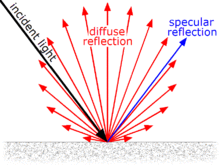
Top images from around the web for Types of Reflection
Specular reflection - Wikipedia View original
Is this image relevant?
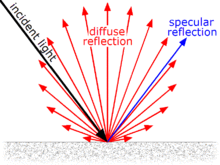
Diffuse reflection - Wikipedia View original
Is this image relevant?
Diffuse reflection - Wikipedia View original
Is this image relevant?
Specular reflection - Wikipedia View original
Is this image relevant?
Diffuse reflection - Wikipedia View original
Is this image relevant?
Laws of Reflection
Two simple rules govern all reflection, whether from a flat bathroom mirror or a curved telescope dish.
- The angle of incidence equals the angle of reflection:
- The incident ray, the reflected ray, and the normal line all lie in the same plane.
Both angles are measured from the normal, which is the line perpendicular to the reflecting surface at the point where the light hits. This is a common source of mistakes: angles are measured from the normal, not from the surface itself.
These laws aren't limited to light. They apply to any wave (sound, water waves, microwaves) reflecting off a boundary.
Applications in Optics
- For plane mirrors, the law of reflection directly explains why the image appears to be the same distance behind the mirror as the object is in front of it (a virtual image).
- For curved mirrors, you apply the law of reflection locally at each point on the curved surface. The normal direction changes from point to point, which is what allows curved mirrors to focus or diverge light.
- Practical designs like telescopes, solar concentrators, and laser cavities all rely on precise control of reflected ray paths using these same two rules.
Refraction and its Causes
Refraction is the bending of light as it crosses a boundary between two materials with different optical properties. This bending is what makes a straw look broken in a glass of water and what allows lenses to focus light.
Why Light Bends
Light travels at different speeds in different materials. When a wavefront enters a new medium at an angle, one side of the wavefront slows down (or speeds up) before the other side does. This speed mismatch causes the wavefront to pivot, changing the direction of propagation.
The index of refraction quantifies how much a material slows light down:
where is the speed of light in vacuum ( m/s) and is the speed of light in the medium. A higher means slower light and a denser optical medium. For reference: air has , water has , and glass ranges from about 1.5 to 1.9.
When light moves from a lower- medium into a higher- medium, it bends toward the normal. When it moves from higher to lower , it bends away from the normal.

Total Internal Reflection
When light travels from a higher- medium to a lower- medium (e.g., water to air), there's a maximum angle of incidence beyond which no light transmits into the second medium. All of it reflects back. This is total internal reflection, and the threshold angle is the critical angle.
Dispersion
Different wavelengths of light have slightly different indices of refraction in the same material. Shorter wavelengths (violet) refract more than longer wavelengths (red). This is dispersion, and it's what separates white light into a spectrum when it passes through a prism. It's also the mechanism behind rainbows: sunlight refracts, reflects, and disperses inside water droplets.
Applying Laws of Refraction
Snell's Law
The quantitative tool for refraction problems is Snell's Law:
where and are the indices of refraction of the two media, and and are the angles of incidence and refraction, both measured from the normal.

Solving a Refraction Problem Step by Step
- Draw the boundary between the two media and the normal at the point of incidence.
- Identify , , and the known angle (usually ).
- Plug into Snell's Law and solve for the unknown angle:
- Check the direction of bending: toward the normal if entering a denser medium, away if entering a less dense one.
- For multiple interfaces (e.g., light passing through a glass slab), apply Snell's Law separately at each boundary.
Finding the Critical Angle
Set in Snell's Law (the refracted ray grazes the boundary):
This only has a solution when . For any angle of incidence greater than , total internal reflection occurs.
For example, the critical angle for water-to-air is:
Apparent Depth
An object submerged in a medium with index appears closer to the surface than it actually is when viewed from above (in air). The apparent depth relates to the real depth by:
This is why a pool looks shallower than it really is.
Broader Applications
- Fiber optics rely on total internal reflection to trap light inside a thin glass or plastic strand, enabling high-speed data transmission.
- Corrective lenses use controlled refraction through curved surfaces to redirect light onto the retina.
- Optical path length, defined as (index times physical distance), accounts for the fact that light takes longer to traverse denser media. This concept becomes important in interference and thin-film problems later in the course.
See Fiveable more often in Google
Mark Fiveable as a preferred source and Google is more likely to show you our guides in Top Stories, with a "preferred" badge in AI Mode and AI Overviews.