6.1 Work and Power

🍏Principles of Physics I Unit 6 Review
6.1 Work and Power
🍏 Principles of Physics I
Work and Force Relationships
Work and power give you the tools to track how energy moves through a physical system. Whenever a force acts on an object and that object moves, energy gets transferred. Understanding how much energy and how fast it transfers is what this section is all about.
Work as a Force-Displacement Product
Work quantifies the energy transferred to (or from) an object when a force acts on it through a displacement. It's measured in joules (J), where 1 J = 1 N·m.
The equation for work done by a constant force is:
where is the magnitude of the force, is the magnitude of the displacement, and is the angle between the force vector and the displacement vector.
The angle determines the sign and size of the work:
- Positive work (): The force has a component in the direction of motion, so it speeds the object up or adds energy. Example: pushing a stalled car forward up a hill.
- Negative work (): The force has a component opposing the motion, so it removes energy. Example: brakes applying a friction force opposite to a car's displacement.
- Zero work (): The force is perpendicular to the displacement, so no energy is transferred. Example: carrying a box across a room at constant height. The upward force you exert is perpendicular to the horizontal displacement, so you do zero work on the box (in the physics sense).
Zero work also results whenever the displacement is zero, no matter how large the force. Pushing against a wall as hard as you can does no work if the wall doesn't move.

Work Problems with Constant and Variable Forces
Constant forces are the most straightforward case. You plug directly into .
For example, if you push a 20 kg box across a floor with a horizontal force of 50 N over 4 m, the work you do is:
Variable forces require integration because the force changes as the object moves:
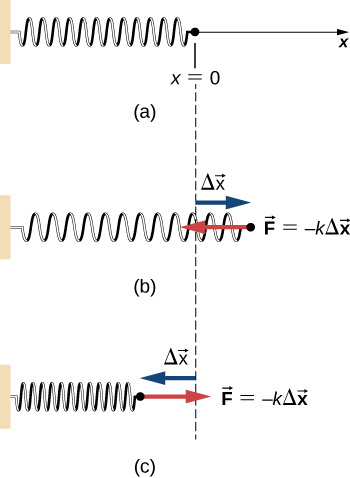
The most common example at this level is a spring obeying Hooke's Law, where . The work done by a spring as it moves from stretch to is:
The Work-Energy Theorem connects work directly to motion. The net work done on an object equals its change in kinetic energy:
This is powerful because it lets you find an object's final speed without tracking acceleration over time. If a 1000 kg car has 5000 J of net work done on it starting from rest:
Power as Work Rate
Power measures how fast work is done, or equivalently, how fast energy is transferred. It's measured in watts (W), where 1 W = 1 J/s.
- Average power:
- Instantaneous power:
There's also a useful form that relates power directly to force and velocity:
For a force applied in the direction of motion, this simplifies to . This version is especially handy for problems about vehicles. For instance, if a car engine provides 4000 N of forward force while traveling at 20 m/s, the engine's power output is:
Work-Force-Displacement Relationships
On a force vs. displacement graph, the work done equals the area under the curve. For a constant force, that area is a rectangle. For a spring force (which varies linearly), it's a triangle. This graphical interpretation is useful for finding work when the force function is complex or given only as a graph.
Conservative vs. non-conservative forces is a distinction that matters for energy analysis:
- Conservative forces (gravity, spring force): The work they do depends only on the starting and ending positions, not the path taken. This is what makes potential energy a meaningful concept.
- Non-conservative forces (friction, air resistance): The work they do does depend on the path. A longer path with friction means more energy lost to heat.
Work also applies to rotational systems, where the analog of becomes:
Here is the torque and is the angular displacement in radians.
In any closed system, energy is conserved. Work is the mechanism by which energy transfers between forms: kinetic, potential, thermal, and so on. Tracking work done by each force is how you account for where the energy goes.
See Fiveable more often in Google
Mark Fiveable as a preferred source and Google is more likely to show you our guides in Top Stories, with a "preferred" badge in AI Mode and AI Overviews.